5 Takeaways From the Supreme Court’s Latest Term
ANALYSIS: Some lessons from the latest round of SCOTUS decisions.
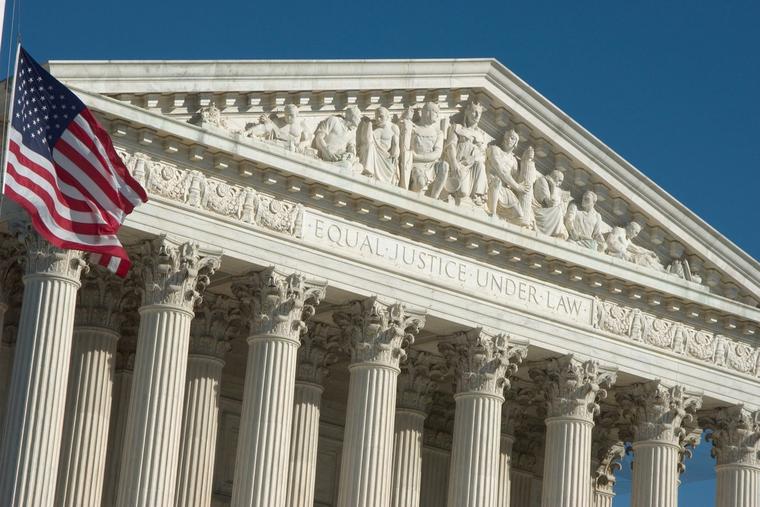
As the U.S. Supreme Court released its annual decisions last month for the cases it considered during its 2024-25 term, many media accounts characterized the court as being hopelessly divided into two warring and politicized ideological camps.
But a closer look at the outcomes from the Supreme Court’s latest term paints a much more nuanced picture. Here are five takeaways from the court’s decisions.
1. Judicial philosophy motivates the court, not partisan politics.
In advance of the annual June flurry of decisions, Justice Amy Coney Barrett found herself in the crosshairs of some of President Donald Trump’s political supporters.
Their complaint: that the Catholic Supreme Court justice was increasingly breaking ranks with the other five members of the court’s “conservative” faction and has become a “wild card” who can’t be counted on to support the Republican president’s central political priorities.
Along with Barrett, four of the court’s other five Catholics — Chief Justice John Roberts, Justice Clarence Thomas, Justice Samuel Alito and Justice Brett Kavanaugh — are characterized as conservatives by Supreme Court analysts. Justice Neil Gorsuch, the sixth court conservative, is not Catholic.
However, according to judicial analysts, it’s inaccurate to characterize Barrett or the rest of the court’s majority as being primarily guided by political conservatism. Instead, to varying degrees, they subscribe to the judicially conservative philosophy that the U.S. Constitution, and federal laws passed by Congress, should be interpreted in light of what the drafters of these legal instruments originally intended and based on what their texts state.
By contrast, the court’s trio of legal progressives — Justices Elena Kagan, Sonia Sotomayor and Ketanji Brown Jackson — subscribe, in varying degrees, to the competing judicial philosophy that the Constitution and federal laws are “living documents,” whose contents can be reinterpreted by the courts to reflect significant contemporary legal, social and political developments.
But since all the justices have nuanced understandings of their own judicial beliefs, including Justice Barrett, neither the court’s conservative nor its progressive factions move forward in predictable lockstep.
2. SCOTUS unanimously defends Catholic Charities.
Moreover, all nine justices frequently unite when the facts in a case warrant such unanimity. According to SCOTUSblog.com, which closely monitors the court’s proceedings, 42% of the Supreme Court’s decisions during the 2024-2025 terms were unanimous.
A case in point was the court’s unanimous 9-0 June 5 Catholic Charities Bureau v. Wisconsin Labor and Industry Review Commission decision. The case stemmed from the state of Wisconsin’s refusal to designate the Church-run Catholic Charities Bureau as a “religious entity,” on the grounds that allegedly it was not “operated primarily for religious purposes.”
Chief Justice Roberts delegated Justice Sotomayor, the court’s lone progressive Catholic, to serve as the author of the court’s smackdown of Wisconsin’s stance.
Sotomayor concluded that the case involved a “paradigmatic form of denominational discrimination” because under the state’s legal approach, Catholic Charities Bureau would qualify as a religious organization if it “engaged in proselytization or limited their services to fellow Catholics.”
Since Catholic religious beliefs do not motivate its agencies to provide social services with those same conditions attached, Wisconsin’s refusal to designate the Catholic Charities Bureau as a religious entity violates “the clearest command of the Establishment Clause,” Sotomayor stated, which “is that the government may not officially prefer one religious denomination over another.”
3. Progressive fissures were more glaring.
While internal fissures can be observed frequently among the court’s six-member conservative majority and its three-member progressive minority, they were more visible among progressives during the court’s latest term.
Indeed, while Justice Kagan has been identified exclusively as a progressive since her appointment to the court in 2010 by President Barack Obama, she — and not Barrett — is the court’s current “wild card” in terms of breaking with her own supposedly progressive perspectives.
“Here’s a figure that might surprise: Justice Elena Kagan, the Supreme Court’s leading liberal, was in the majority of 70% of this term’s non-unanimous outcomes,” The Wall Street Journal’s editorial board noted in a June 30 commentary. “To compare, Justices Clarence Thomas and Samuel Alito, stout conservatives, were each at 62%, tied with Justice Sonia Sotomayor.”
Even Sotomayor — who remains stridently opposed to much of what the Trump administration is seeking to do in terms of its executive actions — recently manifested a willingness to break occasionally with progressive orthodoxy. On July 8, she joined herself to an 8-1 majority decision that held that Trump’s cuts to the federal workforce were lawful.
Jackson was the only dissenter to that decision. Appointed to the Supreme Court by President Joe Biden in 2022, she is regarded by many observers as the current court’s most ideological member.
The New York Times reported this month that Jackson told a July 10 legal gathering in Indianapolis that “the state of our democracy” keeps her awake at night. During the court’s latest term, she has dissented against multiple decisions and has frequently attacked her more conservative colleagues in scathing and personal terms.
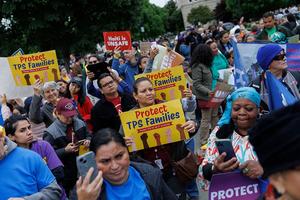
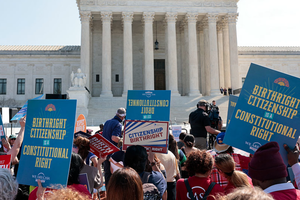
4. The birthright-citizenship case wasn’t really about birthright citizenship.
Many judicial analysts believe this term’s most significant ruling was the Supreme Court’s landmark June 27 decision that sharply restricted the ability of lower-court judges to issue nationwide injunctions against the application of federal laws that are being challenged by plaintiffs.
The 6-3 majority decision — with all six court conservatives in support and all three progressives opposed — was delivered in the Trump v. Casa case that stemmed from the president’s effort to overturn “birthright citizenship” for some children who are born in the U.S. The decision, authored by Justice Barrett, did not address validity of birthright citizenship, an issue that remains under adjudication in numerous lower courts.
Instead, Barrett found there is no historical precedent in U.S. law for sweeping national injunctions.
“Nothing like a universal injunction was available at the founding, or for that matter, for more than a century thereafter,” she stated in her majority decision. “Thus, under the Judiciary Act, federal courts lack authority to issue them.”
At his “Divided Argument” Substack, University of Chicago law professor Samuel Bray commented, “Today’s decision is a vindication and reassertion of the proper role of the federal courts in our constitutional system.”
5. Justice Barrett’s pointed criticism of Justice Jackson raised eyebrows.
Jackson responded to Barrett’s majority decision with one of her trademark dissents, denouncing her colleagues’ motives and integrity.
According to the progressive jurist, the majority decision is “profoundly dangerous” and represents “an existential threat to the rule of law.”
Barrett was notably unimpressed by her fellow justice’s inflammatory rhetoric.
“We will not dwell on Justice Jackson’s argument, which is at odds with more than two centuries’ worth of precedent, not to mention the Constitution itself,” Justice Barrett commented in her majority decision. “We observe only this: Justice Jackson decries an imperial Executive while embracing an imperial Judiciary.”