10 Things Pope Leo Calls Us to Do in ‘Magnifica Humanitas’
Action items we can all live out in daily life.

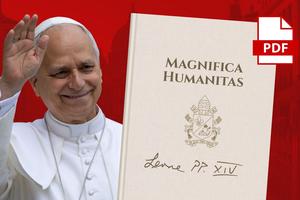
While Pope Leo XIV’s encyclical Magnifica Humanitas calls on political leaders and creators of artificial intelligence systems to act responsibly, considering the threats this technology poses to the human person, much of the Pope’s concrete suggestions are aimed at ordinary people.
The challenge, the Pope writes, goes beyond regulating AI. It’s an “invitation for us Christians to work together in order to foster a peaceful, just and dignified life in community.”
In the age of artificial intelligence, he writes, it is necessary to reflect on the social doctrine of the Catholic Church, which helps us discern modern-day challenges in light of the Gospel and our understanding of the human person created in the image of God.
“My hope is, first and foremost, to help the lay faithful and people of goodwill rediscover their duty of implementing [these principles] in their daily lives, family relationships, work and involvement in society,” he continues.
Here are 10 “action items” for all of us from Magnifica Humanitas:
1. Get involved and take responsibility.
Pope Leo calls for us to recognize our “solidarity” with one another and our obligation to take an active role in working towards the common good.
He suggests “staying informed, engaging with others, making their voice heard and contributing to public decisions and choices” (73).
2. Don’t use AI when you don’t need to.
Pope Leo warns that “excessive reliance” on AI tools can “weaken personal creativity
and judgment.” While appearing to provide objective answers to questions, they “reflect the cultural assumptions of those who designed and trained them, with all their strengths and limitations,” he writes.
AI chatbots could also affect our ability to form human relationships, he writes.
“Hence, the danger is not so much that a person may believe they are communicating with another person, but rather that they may gradually lose the very desire to form genuine human connections” (100).
3. Cultivate relationships.
While the digital culture offers increased opportunities for connection, it doesn’t satisfy the human need for genuine closeness, the Pope writes.
“In an era that favors speed and fragmentation, the human person still yearns to receive care and recognition from attentive minds, kind words and hands capable of tenderness,” writes the Pope.
“I invite everyone to cherish places and times where physical presence remains crucial, such as shared meals,” he suggests, naming Christian community gatherings and spending time with the lonely and serving the poor as opportunities for such encounters (239).
4. Help children and young people say ‘No’ to AI.
Parents and educators should help young people resist the urge to turn to their screens for entertainment and to AI for quick and easy answers to their questions, Pope Leo points out. He warns that young people today, bombarded by the constant stream of digital entertainment, suffer from “fatigue, boredom and apathy concerning the effort required for seeking the truth” (139).
“We must learn, then, how to exercise restraint in the use of AI and to protect our young people from the promise of the perfect machine, from that subtle temptation which renders human thought seemingly superfluous precisely when it is most needed,” he writes (140).
5. Protect children and young people from addiction, pornography, and sexual exploitation.
Pope Leo warns against giving personal mobile devices to young children and allowing them to use them without adult supervision.
The danger, he writes, is that such inappropriate access to technology could “exacerbate young people’s vulnerabilities, foster addiction and expose them to isolation, bullying and cyberbullying, as well as to pressures to share intimate images or sensitive information” (141).
6. Prioritize human employees.
The Pope’s encyclical includes an admonition for employers. AI can be useful, he writes, when it relieves humans of arduous, repetitive or dangerous tasks. However, care should be taken to ensure that the use of AI doesn’t adversely affect human beings by taking their jobs.
“[T]he protection of employment opportunities and the irreplaceable role of the individual must remain the general rule,” the Pope writes.
“The pursuit of greater profits cannot justify choices that systematically sacrifice jobs, because the human person is an end, not a means, and the economic order must remain subordinate to human dignity and the common good” (152).
7. Be mindful of our words.
We must “disarm” our words to build a more humane civilization, the Pope writes.
“Words have enormous power, something we experience in our daily interactions; for example, spoken words can change our mood for better or worse,” he writes.
The Pope also calls on us to make an examination of conscience “regarding the words we use, the prejudices we have and the explicit or implicit aggression that lies within them” (214).
8. Revive dialogue.
The Pope calls for dialogue, not just in “relations between States,” but in our daily lives.
It’s necessary that we acquire an attitude “that seeks to forge bonds of fraternity built on listening, an open demeanor, making time for each other and even wasting time together,” he writes (220).
9. Adopt a program of Christian life.
To confront the immense technological changes that are taking place, the Pope suggests that we adopt “a sober yet demanding program of Christian life.”
This program would involve “contemplating God’s plan, living ecclesial unity by partaking of the Eucharist, building a world centered on the common good and praying in union with the Blessed Virgin Mary” (229).
10. Build a ‘construction site of our time.’
We are faced with a pivotal choice, the Pope writes in the introduction to the encyclical: “either to construct a new Tower of Babel or to build the city in which God and humanity dwell together.”
The Tower of Babel, he explains, was a project “conceived without reference to God, supported by a uniformity that eliminated diversity and that chose homogenization over communion.”
The alternative is today a “construction site” for a “civilization of love” with Christ as its cornerstone.
He compares the builders of this new city to Nehemiah, who discerned God’s will to rebuild the walls of Jerusalem.
Pope Leo writes: “I see in him a striking parable to our own vocation, which is not to be passive spectators of social and cultural fractures, nor mere commentators on what is crumbling, but men and women prepared to enter the construction sites of history — research laboratories, technology companies, schools, the media, institutions and local communities — in order to rebuild what has collapsed and protect what is threatened” (241).
- Keywords:
- catholic living
- artificial intelligence