Faith Is Key to Healing Dehumanized Society, Cardinal Says
‘Being a Christian is not about belonging to a club, but about translating the Gospel into action. We must embody what we believe.’
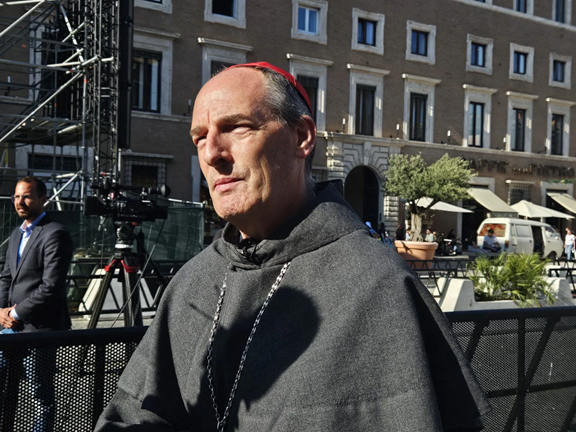
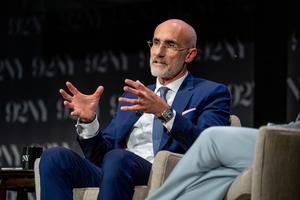
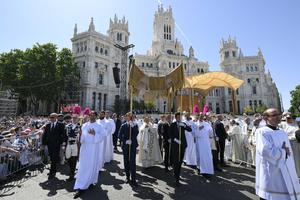
Cardinal François-Xavier Bustillo, of Ajaccio, Corsica, one of the most prominent ecclesiastical figures in contemporary France, recently welcomed Pope Francis to Corsica for what proved to be the Pontiff’s final apostolic journey in December 2024.
The Spanish-born prelate, ordained to the Order of Friars Minor Conventual in 1994 and elevated to the cardinalate in 2023, recently published Réparation (Fayard, 2025), a timely reflection on healing societal divisions and restoring human dignity in an increasingly fragmented world.
In a Sept. 11 interview with the Register, Cardinal Bustillo discusses the urgent need for spiritual renewal, the Church’s mission of reconciliation, and the role of faith in rebuilding authentic human community amid contemporary challenges.
In your book, you talk about a society that is torn apart and plagued by conflict. You make this observation, but in your opinion, what are the causes? Where do this division and constant conflict come from
If our society is divided, fractured, violent and suffering, it is because there is deep pain at its root. We have gradually dehumanized our world. In my view, the fact that we have removed God — faith, religion, spirituality — is one of the major causes. After May 1968, it was widely claimed that we no longer needed God.
More than 50 years later, I feel that society is no better off: Violence, divisions and fractures have increased. Yet a fragile society can disappear. Hence the urgency to repair: to repair society, social life and relationships. The spiritual dimension can help. Faith and religion are not obstacles: They can help to unify individuals and society, while always respecting each person and their individual journey.
You emphasize the presence of a “conflict of words,” where words are used to hurt. You also speak of harshness in our human relationships. Isn’t this a form of inhumanity that is taking hold?
At the heart of the divide is a deficit of humanity. We have forgotten the human aspect. Rediscovering a verticality — faith, inner life — can help to rebuild the bond. We also lack a common denominator:
Everything seems to have disintegrated into juxtaposed individuals. There is much talk about secularism and faith (which touches on the intimate), but little about religion as a social reality: It contributes to living together. When Jesus says, “Love one another; love your enemies; do not judge; do not condemn,” he is addressing people who are called to form a community and thus to improve the quality of life in a society.
Perhaps we need to get back to basics: We are human beings who also need an inner life to seek peace — a peace that we lack.
These divisions also exist within the Church: People call themselves “left-wing Catholics” or “right-wing Catholics,” and they disagree about the liturgy. Catholics, who should be an example of communion, do not always bear witness to this. What does this situation inspire in you?
I agree with this observation. How can we preach unity for society if, within the family that is the Church, we are divided? We must restore unity and communion.
Too often, we oppose each other over questions of form: “I am traditional”; “I am charismatic”; “I am modern.”
The Catholic Church is not a sect; we are not clones. Let us rejoice in diversity!
When we emphasize differences, we end up suspecting each other: “You are dangerous because ... .” This is a superficial view and, in my opinion, one without spiritual depth. The goal of the Church is unity. Our diversity is not a threat.
The tragedy is forgetting what unites us: Jesus Christ.
We focus so much on forms that we forget the essential: We believe in Christ. As Leo XIV reminded us at the beginning of his pontificate, unity is not incidental. If the tensions of the world penetrate the Church, our witness is weakened. We must first have spiritual and human coherence, an inner unity; then our mission will be credible.
In France, there has been a sharp increase in adult baptisms — nearly 10,000 this year. This is a great grace. From a pastoral point of view, how can we welcome them after baptism and truly introduce them to the life of the Church? And how can we amplify this movement?
The life of faith does not end with baptism. Many young people today do not come from a Christian background: They have not “known” clericalism, but rather spiritual emptiness and the absence of the Church. For them, priests, bishops and cardinals are distant figures.
At the same time, these young people are searching for an identity.
Catholicism offers a true spiritual identity — provided it is embraced.
Some say, “I am Muslim,” others say, “I am Christian,” but there are people who say, “I am nothing.” That phrase strikes me. You can’t be “nothing.” It’s a source of suffering, but also an opportunity for the Church: to repair its relationship with the younger generations.
After the crises, we did not seek to “win back” people; yet young people are coming. There is a thirst for God. Our dual responsibility is clear: first, welcoming and preparing for baptism — a beautiful spiritual fatherhood; then continuity: You don’t receive a sacrament like a stamp.
We must nourish faith, integrate people into the community, and accompany them. The arrival of these new baptized members also refreshes the faith of established Catholics.
Seeing the dynamism and freshness of the neophytes, Catholics from traditional families rediscover the meaning of apostolate and dynamism in society.
You often refer to confraternity, particularly in Corsica, as places of social and cultural connection. What role do they play today
Confraternities have both a spiritual and social dimension. They have existed since the 14th century within the Franciscan tradition and bring together many laypeople who want to experience something meaningful in the Church.
Today, in Corsica, we have more than 3,000 members, mostly men. In recent months, several confraternities have welcomed young people aged 20 to 25 who are thirsty for meaning, who ask questions and want to serve — even accompanying funerals, with appropriate training. Joining a confraternity is not “joining a club”: There is a welcoming ritual, visible signs of baptism, a fraternal life.
Historically, confraternities took care of widows, orphans and the poor. In the current crisis, I see them as original and timely instances for building bridges between leaders and the population, between institutions and the field — intermediary bodies that forge links, driven by spiritual motivation.
What do you see as the role of a cardinal? To elect the pope during a conclave, of course, but also to participate in the government of the universal Church and advise the supreme pontiff?
There is an advisory dimension to the pope, but also the task of animating the universal Church. Cardinals are links between the bishop of Rome and the local Churches. So I navigate between my diocese — my primary responsibility, in Corsica — and requests from elsewhere.
When a cardinal travels, it is to encourage the life of the local Churches. Pope Francis greatly emphasized this dimension by creating cardinals in places where there were none — in Mauritius, the Central African Republic, Mongolia. ... This demonstrates catholicity. He also revived an ancient tradition of creating cardinals based on individuals rather than seats. In the past, not all large cities necessarily had a cardinal, while some smaller ones did. The appointment is at the pope’s discretion; it may come as a surprise, and that’s fine.
The Mediterranean is a major region, with its tensions, wars, and religious divisions. How can we “repair” it in this context?
The Mediterranean is a cradle of civilization. Its ports have forged commercial and cultural ties, creating a shared memory that must not be forgotten. This is not about nostalgia, but about keeping memories alive in order to rediscover paths of brotherhood between North and South, between different cultures and religions. First, we must build trust.
The Romans spoke of captatio benevolentiae, or reaching agreement on cultural grounds before resorting to military force. In the Mediterranean network, contacts exist with Tunis, Morocco, Barcelona, Italy, Greece, Istanbul, Lebanon. ...
Dialogue is never easy, but it is essential: We must repair Mediterranean ties and prevent the region from becoming a permanent hotbed of conflict.
Religions have a role to play in appeasing and setting an example. During Pope Francis’ meeting with the grand imam of Al-Azhar and the Declaration on Human Fraternity, the Church showed the way forward.
Some are wary of dialogue, but for us Christians, it is fundamental: the Word became flesh, the Logos is at the heart of our faith, so dialogos is our normal way.
Benedict XVI often reminded us of this in the intercultural and interreligious sphere. When brute force prevails over words, civilization becomes fragile. Despite the complexity of situations and the weakness of certain international institutions, we must continue to engage in dialogue.
You mention the mission of Christians: What does the world expect of them today?
The world expects authentic witnesses, not theorists. Being a Christian is not about belonging to a club, but about translating the Gospel into action. We must embody what we believe — without arrogance or complexes. It is through consistency in life that moral authority is born.
This consistency also comes through prayer, but in their daily lives, laypeople are often very busy. How can we pray more, so that every day is a life of prayer, amid family and professional constraints?
We live in a frenetic society. Prayer restores order, calms agitation, and teaches us to settle down and rest in God.
Our churches are sacred places to be rediscovered: There is no need for exoticism to find peace. Returning to churches during the week to pray, to dialogue with the Lord, is a practice to be rediscovered.
Prayer is not just a set of formulas learned by heart; it requires teaching: telling God what is in our hearts, letting him enter and dwell in our lives — as if we were inviting Christ into the boat of our existence.
It reminds us that we are not alone in our professional, family, emotional or health struggles. This moment of encounter expands our tense hearts: This is the purpose of prayer, to allow ourselves to be touched by God’s love so that we may become peaceful and available to follow him.
Jean-Baptiste Noé is a historian and writer.
- Keywords:
- faith in everyday life
- post-christian europe
- college of cardinals
- converts to catholicism
- adult baptisms
- cardinal bustillo
- dignity of the human person
- human fraternity