Witnessing and Preaching: How Religious Communities Influence College Life
At these schools, students are introduced to a community’s particular charism or way of life and are deeply affected by the presence and witness of the religious who walk these campuses.
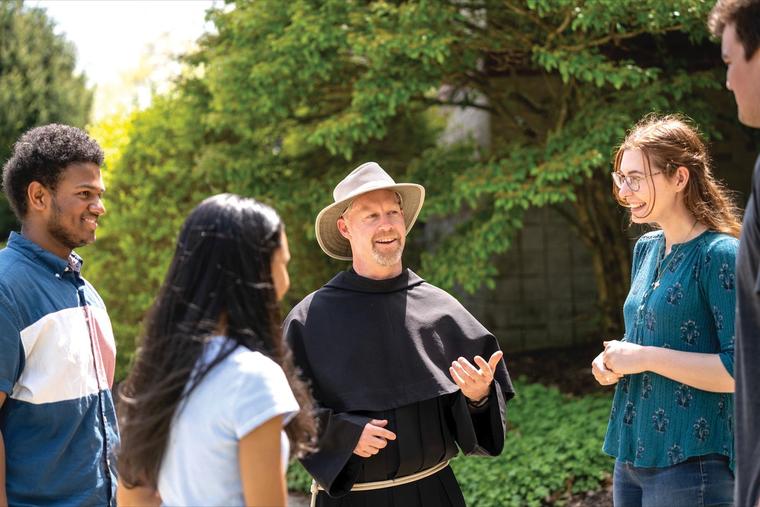
Back in his college days, Benedictine Brother Maximilian Anderson was a self-described “knucklehead.” By his junior and senior years at Benedictine College in Atchison, Kansas, though, he had embraced the Catholic faith.
He attributes this reversion to the monks of St. Benedict Abbey, the Benedictine abbey that founded and continues to influence the school’s Catholic identity, and the influence they had on those who helped him return to the faith.
“The monks were this silent but significant presence throughout my time in college here,” Brother Maximilian told the Register. “I would hear stories about how the monks impacted my friends and the ministry they did. I remember being really impacted by the communal fatherhood from the monks as a student as I was growing deeper in prayer and my relationship with God.”
After graduating in 2016, Anderson became a FOCUS missionary. But, a few years later, he returned to Atchison — this time entering St. Benedict’s Abbey as a monk.
Now, he spends his days ministering to and working with college students, introducing them to the Rule of St. Benedict and the Benedictine charisms of prayer, work and stability.
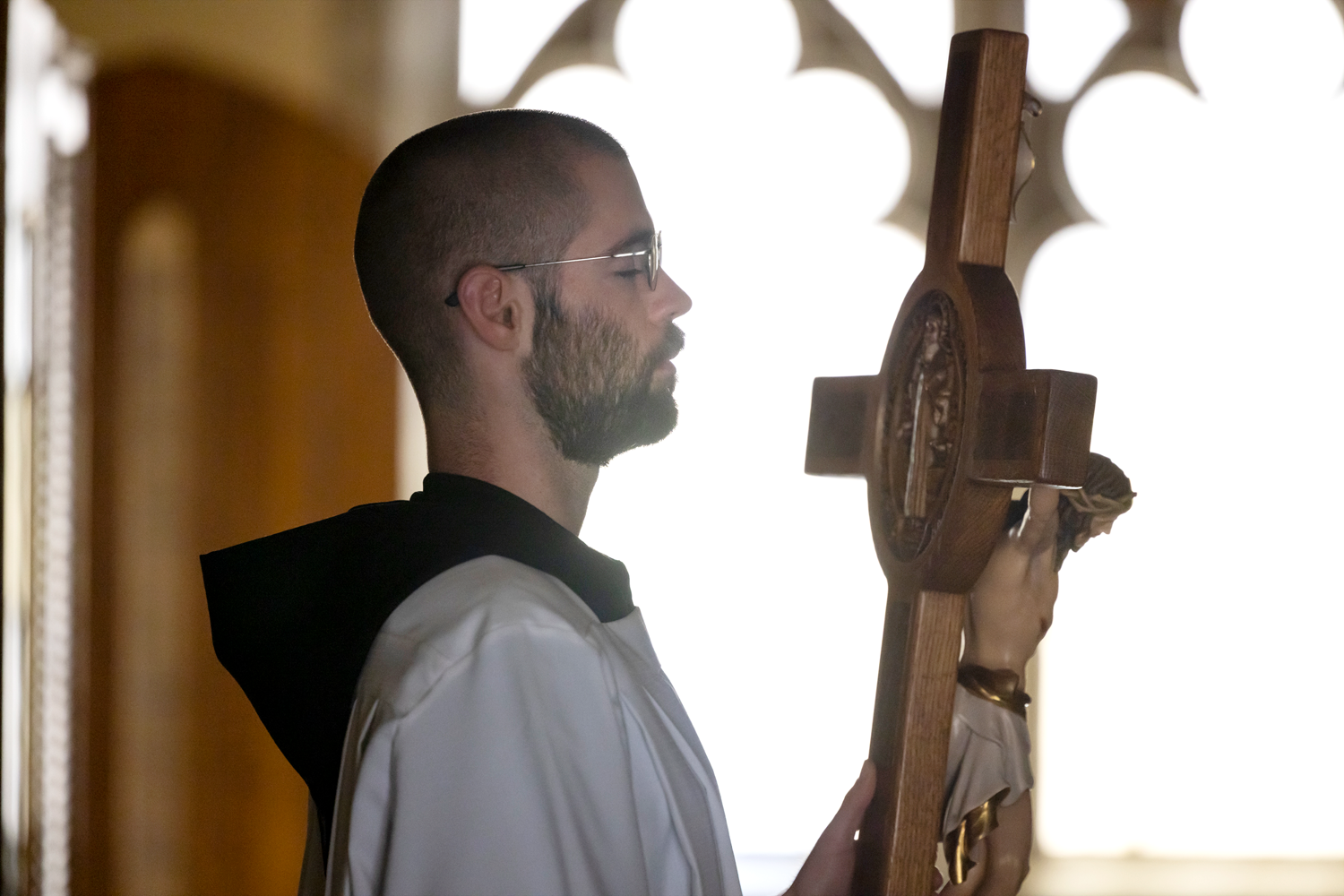
“College is super formative and what happens within the context of the four years is huge for the decades that follow. I know that, for me, a ton of formation happened during college,” Brother Maximilian said. “Thus, there is a real desire for me to accompany young people during what’s an important period of life for them.”
Despite fewer vocations and a diminished presence on many campuses, religious communities continue to play a critical role in the formation of college students as they govern and minister at various Catholic universities and colleges across the country.
At these schools, students are introduced to a community’s particular charism or way of life and are deeply affected by the presence and witness of the religious who walk these campuses.
At Benedictine College and other institutions, these religious are embedded in the very framework of the institution, often founding the institution and being a stable presence. “I do not know how Benedictine College could be Benedictine College if it doesn’t stay connected to the Benedictine community that founded and sponsored it,” Brother Maximilian said. “We are still very involved at the top in terms of the governing bodies. At the same time, though, I think there’s a very real influence we have on the college by simply keeping the way of the monastic life and introducing students to that life by inviting them to prayers and through our interactions with them.”
Far from the cornfields of Atchison, another community of Benedictine monks traveled to North Carolina in 1876 with the hope of establishing a school to minister to young people. The college was established that year.
“The monks were looking for ways to minister and they decided they could do that best by opening schools because schools would help educate the young people, help them preserve their culture and their religion, and could also be a source of vocations,” Benedictine Father Elias Correa-Torres, Belmont Abbey’s director of formation, told the Register. “They would also use the schools to train seminarians, so they could support the parishes in the area.”
St. Francis Effect
In the 1940s, the Diocese of Steubenville, Ohio, approached a nearby community of the Third Order Regular Franciscan Friars and asked if they would be interested in starting a school.
They agreed and founded the College of Steubenville in 1946.
“Education has always been a ministry of the Franciscans,” Franciscan Father Jonathan St. André, vice president for Franciscan life, told the Register. “Sometimes people think Francis was against books or learning, and it’s not that. He wanted them to remain humble, and he wanted to make sure that prayer and devotion were a part of study.
“What we try to do at the university is to bring in that call that everything our students study should be rooted in truth and should be rooted in prayer and devotion.”
With surging vocations, religious filled many teaching positions at institutions in the early days. But with declining vocations, communities had to adjust and discuss how to maintain their charism on campus.
“We are very much engaged in our own discussion and discernment as a community about how to influence the college because historically the monks basically were the faculty,” Benedictine Brother Jean-Marie Hogan, a monk at St. Benedict’s Abbey, told the Register. “Today, we have three monks teaching classes here on campus and then our priest monks doing sacramental ministry, confession, serving as spiritual directors, etc.”
At Franciscan, the friars also assess campus needs. A few friars continue to teach, a few serve in the administration, including the president, Franciscan Father Dave Pivonka, and the others attempt to maintain a robust presence on campus through ministering to students as athletic or dorm chaplains, through the sacraments or by simply being present on campus.
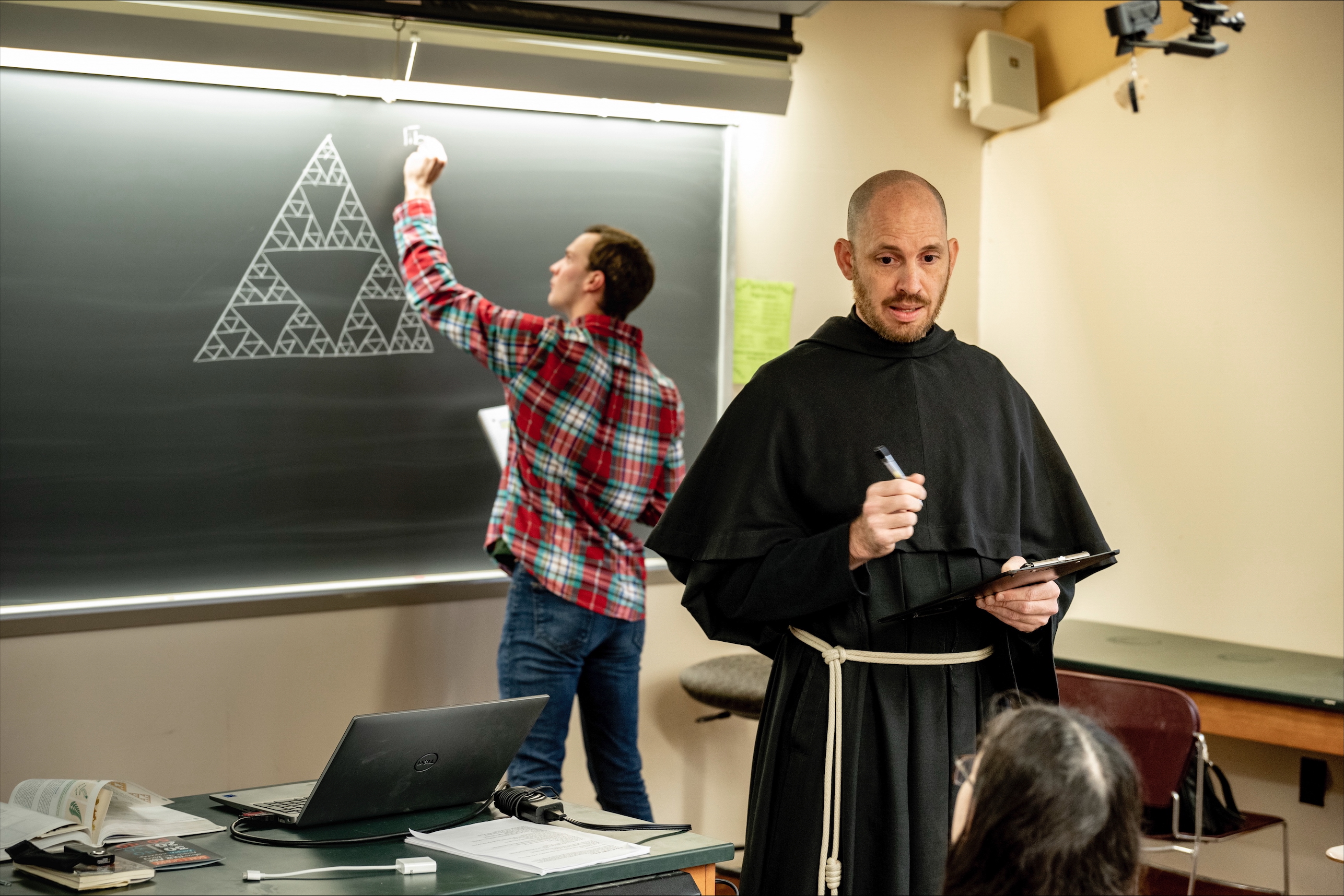
“The Lord has given us a gift to make incarnate the charism of St. Francis and to show forth the beauty of being a consecrated religious,” Father St. André said, adding that it’s a “beautiful connection where we get to be spiritual fathers” to students.
“When they see us walking around in our black habits and with our cords, I think it’s an encouragement to them and a witness to them to live their faith.”
The students indeed appreciate the friars. Theresa Antony met the friars when she arrived as a freshman at Franciscan. These frequent interactions have changed the now-senior theology and classics major’s outlook. “When you see and interact with religious regularly, it changes your perspective of what you look at yourself like in your future,” Antony said. “They are so prayerful and attentive to the students that are around them, especially because it’s part of their charism to create that kind of community and be the impetus for our conversion.”
“They have been a massive influence on me as an inspiration for the way that I can think about my life when I get to be their age and what the Lord is calling me to.”
Through interacting with, and witnessing, the spiritual life of the friars, Antony has been encouraged in her discernment as she prepares to graduate this May. “When you see the example and the inspiration of those who are living that life and living it well right in front of you, it inspires you,” Antony said. “The friars definitely have had a positive impact on my desire to discern a religious vocation, especially because they do it so well. Witnessing people who are completely in love with the Lord and who understand that this is a viable way of life ... really makes that vocation come alive for someone who’s even just considering it.”
Sign of Stability
For other students, the religious are constant, stable figures during the tumultuous years of college.
“The influence they have just over the different values they have on campus is huge,” said Joe Halfmann, a sophomore at Benedictine College. “They have a big say in the core values of Benedictine; and because of the monks’ influence on people, their spirituality is just very present across campus.”
At Belmont Abbey, students take a “Benedictine Spirituality” course freshman year, where they read the Rule of St. Benedict. “We are very much interested in forming the whole human person, which is to say we want people to be a good person and to know and to seek what is true,” Father Correa-Torres said. “Part of that is learning how to live well, and I think the rule of St. Benedict and our charism has a lot of wisdom to offer and we want to share that with our students.”
At Belmont Abbey, junior Peter Helbling sees the monks’ influence at work in everything he does.
“Everything we do here and our entire education is kind of an outpouring of the love, the work and the prayers of the monks over the last 150 years,” Helbling said. “They are teachers; they are around for spiritual direction; there is even one who is usually around in the dining halls. I don’t go a day without seeing a monk. They are part of life here.”
He added: “They have helped me to grow in my relationship with God by teaching me the Benedictine spirituality and the Benedictine way of life.”
- Keywords:
- religious life
- catholic college students