Venerable Fulton Sheen Explains Why the Rosary Changes Everything
Drawing from ‘The World’s First Love,’ Bishop Sheen offers timeless counsel on why the Rosary strengthens and sanctifies every soul.

Venerable Fulton Sheen had a deep devotion to the Blessed Virgin Mary. It is no surprise, then, that of the more than 65 books he published, he said his favorite was The World’s First Love. Naturally, it is about Mary and Marian devotion.
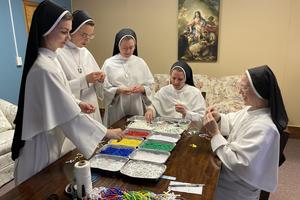
Bishop Sheen considered the Rosary the greatest sacramental, an answer to everything. As national director of the Society for the Propagation of the Faith, he even designed the multicolored World Mission Rosary to pray for the world.
Let’s imagine hearing Bishop Sheen answer the very questions he once explored in his favorite book — insights that continue to deepen and inspire Marian devotion.
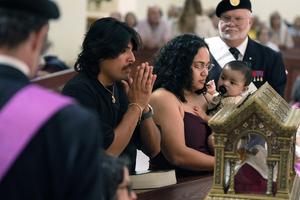
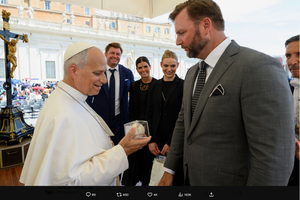
Bishop Sheen, Pope Leo XIV recently advised a newly married couple to pray the Rosary together. Do you advise the same for couples?
Married couples ought to say the Rosary together each night, for their common prayer is more than the separate prayers of each.
When the child comes, they should say it before the Crib, as Joseph and Mary prayed there. In this earthly Trinity of Child, Mother, and foster father, there were not two hearts with but a single thought, but one great Heart into which the other two poured themselves out as confluent streams.
How does that relate to everyone, to individuals?
That is what we do when we say the Rosary. We are saying to God, the Trinity, to the Incarnate Savior, to the Blessed Mother: “I love you, I love you, I love you.” Each time it means something different because, at each decade, our mind is moving to a new demonstration of the Savior’s love: for example, from the mystery of His Love which willed to become one of us in His Incarnation, to the other mystery of love when He suffered for us, and on to the other mystery of His Love where He intercedes for us before the Heavenly Father. And who shall forget that Our Lord Himself in the moment of His greatest agony repeated, three times within an hour, the same prayer?
What happens when we don’t pray the Rosary aloud, but silently? What can you compare it to?
The beauty of the Rosary is that it is not merely a vocal prayer. It is also a mental prayer.
One sometimes hears a dramatic presentation in which, while the human voice is speaking, there is a background of beautiful music, giving force and dignity to the words. The Rosary is like that. While the prayer is being said, the heart is not hearing music, but it is meditating on the Life of Christ all over again, applied to his own life and his own needs.
As the wire holds the beads together, so meditation holds the prayers together. We often speak to people while our minds are thinking of something else. But in the Rosary, we not only say prayers, we think them. Bethlehem, Galilee, Nazareth, Jerusalem, Golgotha, Calvary, Mount Olivet, Heaven — all these move before our mind's eye as our lips pray.
The stained-glass windows in a Church invite the eye to dwell on thoughts about God. The Rosary invites our fingers, our lips, and our heart in one vast symphony of prayer, and for that reason is the greatest prayer ever composed by man.
You also emphasize how the Rosary has a special value to many groups. Who? How does it help them?
The worried, the intellectual and the unlearned, and the sick.
How does it help the worried?
Worry is a want of harmony between the mind and the body. Worried people invariably keep their minds too busy and their hands too idle. God intended that the truths we have in our mind should work themselves out in action. “The Word became flesh” — such is the secret of a happy life. But in mental distress, the thousand and one thoughts find no order or solace within and no escape without.
In order to overcome this mental indigestion, psychiatrists have taught soldiers suffering from war shock how to knit and do handicrafts, in order that the pent-up energy of their minds might flow out through the busy extremities of their fingers. This is, indeed, helpful, but it is only a part of the cure.
Worries and inner distress cannot be overcome by keeping the hands alone busy. There must be a contact with a new source of Divine Energy and the development of confidence and trust in a Person Whose essence is Love.
Could worried souls be taught the love of the Good Shepherd Who cares for the wayward sheep, so that they would put themselves into that new area of love all their fears and anxieties would banish.
But that is difficult. Concentration is impossible when the mind is troubled; thoughts run helter-skelter; a thousand and one images flood across the mind; distracted and wayward, the spiritual seems a long way off.
The Rosary is the best therapy for these distraught, unhappy, fearful, and frustrated souls, precisely because it involves the simultaneous use of three powers: the physical, the vocal, and the spiritual, and in that order.
The fingers, touching the beads, are reminded that these little counters are to be used for prayer. This is the physical suggestion of prayer. The lips move in unison with the fingers. This is a second or vocal suggestion of prayer.
The Church, a wise psychologist, insists that the lips move while saying the Rosary, because She knows that the external rhythm of the body can create a rhythm of the soul. If the fingers and the lips keep at it, the spiritual will soon follow, and the prayer will eventually end in the heart.
The beads help the mind to concentrate. They are almost like the self-starter of a motor; after a few spits and spurts, the soul soon gets going. Every airplane must have a runway before it can fly. What the runway is to the airplane, the Rosary beads are to prayer — the physical start to gain spiritual altitude. The very rhythm and sweet monotony induce a physical peace and quiet and create an affective fixation on God.
The physical and the mental work together if we give them a chance. Little by little the worried, as they say the Rosary, see that all their worries stemmed from their egotism. No normal mind yet has ever been overcome by worries or fears who was faithful to the Rosary. You will be surprised how you can climb out of your worries, bead by bead, up to the very throne of the Heart of Love Itself.
What about the educated and the unlearned?
The spiritual advantages which one derives from the Rosary depend upon two factors: first, the understanding that one has of the joys, sorrows, and glory in the Life of Christ; and second, the fervor and love with which one prays. Because the Rosary is both a mental and a vocal prayer…
It happens that the simple often pray better than the learned, not because the intellect is prejudicial to prayer, but because, when it begets pride, it destroys the spirit of prayer.
The Rosary is a great test of faith. What the Eucharist is in the order of Sacraments, that the Rosary is in the order of sacramentals — the mystery and the test of faith — the touchstone by which the soul is judged in its humility. The mark of the Christian is the willingness to look for the Divine in the flesh of a babe in a crib, the continuing Christ under the appearance of bread on an altar, and a meditation and a prayer on a string of beads.
The more one descends to humility, the deeper becomes the faith. The Blessed Mother thanked her Divine Son because He had looked on her lowliness. The world starts with what is big, the spirit begins with the little…the trivial! The faith of the simple can surpass that of the learned, because the intellectual often ignore those humble means to devotion, such as medals, pilgrimages, statues, and Rosaries.
One of the last acts of Our Lord was to wash the feet of His disciples, after which He told them that out of such humiliation true greatness is born.
When it comes to love, there is no difference between the intellectual and the simple. … But if the simple and the intellectual love, in the human order, in the same way, then they should also love God in the Divine order, in the same way. The educated can explain love better than the simple, but they have no richer experience of it. The theologian may know more about the Divinity of Christ, but he may not vitalize it in his life as well as the simple.
The Rosary is the meeting ground of the uneducated and the learned; the place where the simple love grows in knowledge and where the knowing mind grows in love.
What about the sick?
The Rosary brings together the otherwise dissipated thoughts of life in the sickroom into the white and burning heat of Divine Love.
When a person is healthy, his eyes are, for the most part, looking to the earth; when he is flat on his back, his eyes look to Heaven. Perhaps it is truer to say that Heaven looks down on him.
In such moments when fever, agony, and pain make it hard to pray, the suggestion of prayer that comes from merely holding the Rosary is tremendous or better still, caressing the Crucifix at the end of it. Because our prayers are known by heart, the heart can now pour them out, and thus fulfill the Scriptural injunction to "pray always.”
The Rosary is the book of the blind, where souls see and there enact the greatest drama of love the world has ever known; it is the book of the simple, which initiates them into mysteries and knowledge more satisfying than the education of other men; it is the book of the aged, whose eyes close upon the shadow of this world, and open on the substance of the next. The power of the Rosary is beyond description.
And here I am reciting concrete instances, which I know. Young people, in danger of death through accident, have had miraculous recoveries— a mother, despaired of in childbirth, was saved with the child — alcoholics became temperate — dissolute lives became spiritualized — fallen-aways returned to the faith — the childless were blessed with a family, soldiers were preserved during battle, mental anxieties were overcome, and pagans were converted.
Then should we pray the Rosary always and everywhere?
All the idle moments of one's life can be sanctified, thanks to the Rosary. As we walk the streets, we pray with the Rosary hidden in our hand or in our pocket; driving an automobile, while waiting to be served at a lunchroom, or waiting for a train, or in a store; or while playing dummy at bridge; or when conversation or a lecture lags — all these moments can be sanctified and made to serve inner peace, thanks to a prayer that enables one to pray at all times and under all circumstances.
Any other advice?
If you wish to convert anyone to the fullness of the knowledge of Our Lord and of His Mystical Body, then teach him the Rosary. One of two things will happen. Either he will stop saying the Rosary — or he will get the gift of faith.