Sir James MacMillan’s ‘Angels Unawares’ Makes World Premiere in the Sistine Chapel
The Catholic Scotsman’s new oratorio for soloists, choir and orchestra invites listeners to rediscover the sacred in everyday life and to reflect on the reality and presence of angels.
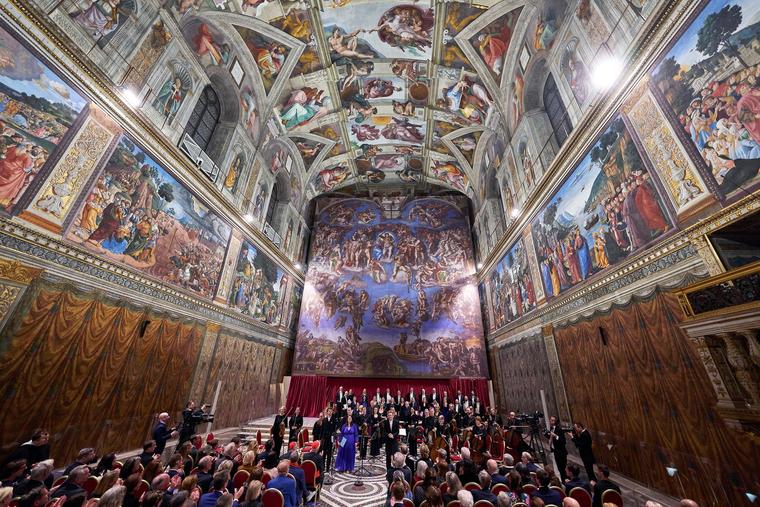
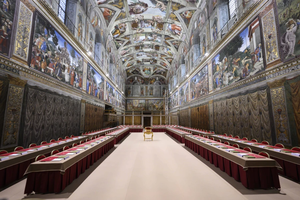
VATICAN CITY — Concerts in the Sistine Chapel are exceptionally rare, but for The Sixteen and Britten Sinfonia, their March 22 performance marked their second appearance since their debut in 2018, when they made history with the first-ever live-streamed concert from the chapel.
At the heart of the evening — as eight years earlier — was the music of Scottish Catholic composer Sir James MacMillan.
MacMillan, who was knighted in 2015 and awarded the King’s Medal for Music in 2025 for his services to music, has had his compositions performed at royal and state occasions, as well as major Catholic events, including Pope Benedict XVI’s visit to the U.K. and St. John Henry Newman’s beatification in 2010.
Angels Unawares is his latest oratorio.
Divided into twelve movements — six rooted in the Old Testament and six in the New — each traces encounters with angels that are as unexpected as they are mysterious.
‘How Could I Not Have Known?’
The phrase “How could I not have known?” resonates beneath frescoes by Michelangelo. Set to music, The Song of Tobias by poet Robert Willis recounts how the young traveler journeyed alongside the archangel Raphael, unaware of his angelic nature until the very end.
How could I not have known?
The angel walked beside my every step
And calmed my fears and cheered my nervous heart.
Before it is fully realized, Tobias’ question becomes our own.
The music and its words draw the listener to reflect on the quiet, unseen work and guidance of angels — and of God — in our lives, as intended by the composer. Sir James MacMillan told the Register, “I think we should talk more about them, ask questions about what they are and what we think they are.”
“Do they exist? Are they metaphors or are they real messengers from heaven?” MacMillan continued. “I know what I think. They are real. And I don’t think I could have written this piece in the way that I did if I did not believe in the veracity of angelic presences in the world and in our culture.”
The title of the work takes its inspiration from a passage in the Epistle to the Hebrews: “Do not neglect to show hospitality to strangers, for thereby some have entertained angels unawares” (Hebrews 13:2).
At its core, “it is an encouragement to show kindness to strangers as a spiritual discipline,” MacMillan explained ahead of the concert — “an appeal to treat all individuals with dignity and compassion, recognizing that every encounter with another person could carry a significance, maybe even supernatural.”
The concert, attended by Cardinal Nichols and Cardinal Parolin, marked the first world premiere in the Sistine Chapel. It was not, however, the first time MacMillan’s music had been live-streamed in the sacred venue — eight years ago, his own work first achieved that distinction.
“The same performers came here in 2018 with my Stabat Mater, and I thought that was going to be a once-in-a-lifetime experience,” he said. “But we are back again and with a very different kind of piece, and again, it was a huge thrill to hear my music come to this place.”
Angels Unawares is the eighth commission by the Genesis Foundation, which “came about through a long, ongoing discussion with its founder, John Studzinski.”
Not only did Studzinski — a “crucial figure for the arts and for Catholic culture” — know “Robert Willis, the poet who wrote the text,” but “he also got Pope Leo’s permission for the concert to be held in the Sistine Chapel,” the composer marveled.
“It’s all a mystery to me,” MacMillan admitted. “It was all done without my knowledge. And John Studzinski is the man who made it happen. He is the one who spoke to Pope Leo about it. And I am kind of amazed that it has happened, but here we are.”
Commissioning Sacred Music for Today
“Yes, Pope Leo allowed us to do this; he was the one who gave us his consent,” Studzinski told the Register. “As you know, the Sistine Chapel is not normally used for concerts and it’s normally used, as it’s a functioning museum, and so we are deeply grateful to Pope Leo for doing this and we hope to do it again.”
The Genesis Foundation, which was founded 25 years ago, is the United Kingdom’s largest commissioner of sacred music, having commissioned dozens of new choral works.
Studzinski explained that while the foundation — whose purpose “is to nurture young and emerging artists and give them their first break” — also works in visual arts, theater and photography, music and composition occupy a special place within its mission:
“Because of my faith,” he added, “and because of our access to some great partners, such as Harry Christophers and James MacMillan, we have done a lot of sacred music commissioning.”
As MacMillan explained, the topic of angels was chosen as the result of long conversations and shared fascinations.
“I am very interested in the role that angels play in contemporary society,” Studzinski shared. “And believe it or not, there has never been an international piece of music of this scale, a 70-minute concert, dedicated to the holy angels in the context of Scripture.”
Reflecting on society’s “strong fascination with angels,” Studzinski pointed to the work’s evangelizing character, saying, “I think many people, even those without a formal religion, sometimes invoke angels as a way of accessing some kind of spiritual framework.”
Sacred Music for the ‘Concert World’
From the Sistine Chapel to international concert halls, MacMillan’s music has not gone unnoticed.
In recognition of his extraordinary contribution to contemporary sacred music, the Pontifical Institute of Sacred Music in Rome conferred an honorary doctorate (honoris causa) upon MacMillan earlier this month.
On that occasion, he told the Register that while “most of the music [he] write[s] is sacred music,” most of it is written “for the concert world,” emphasizing that sacred music is not always exclusively liturgical, like Edward Elgar’s The Dream of Gerontius, “a profoundly Catholic work.”
One of sacred music’s unique strengths lies in its capacity to reach a wider audience.
“When I write a big piece of sacred music,” the Scottish composer said, “I know that it will be encountering an audience of people who may not share my faith, may not share my worldview.”
Referencing several of his works — like St. John Passion, St. Luke Passion, Christmas Oratorio and Angels Unawares — MacMillan explained that these are intentionally meant for “the bigger concert world.”
There, he explained, he encounters “people who love music, whether they are religious or not, sometimes skeptical, agnostic or atheistic, who know instinctively deep in their hearts that music is a spiritual art form.”
“Their lives have been changed, transformed through this powerful spiritual force, which is music,” he added, noting that believers and nonbelievers alike come together not only “in their love of music” but in their “search for the sacred through the art of music itself.”
Journey to Catholic Composing
Being a Catholic composer, MacMillan emphasized, is “a very special vocation.”
“It is different from writing for the concert world because the responsibility of the composer writing music for the liturgy is that we are providing music which is meant to carry the thoughts and the deep prayers and devotions of the assembly to the altar of God.”
Speaking about his own path, MacMillan said he “wanted to be a composer from the first day [he] was given an instrument.”
“Something happened,” he recalled. “A little switch went on, a little light went on as soon as I was given an instrument. And the desire to write music came almost simultaneously with the desire to play or to perform music.”
In fact, MacMillan said, “I don’t really remember a time when I did not want to be a composer,” adding that he wrote his first piece of music when he was only 10 years old.
Exposed to the “great composers of the past” — such as Mozart, Haydn, Beethoven and Wagner — from a young age, MacMillan admitted that “when [he] was a little boy, [he] didn’t really know there was a difference between sacred and secular music.”
However, he added, “I was also a little Catholic boy in the west of Scotland. And that Catholic experience through family, church, parish and school was also very important.”
He explained that his parish “was just a little parish church in the countryside,” but it was there he first heard Church music, chant and hymns, and understood “the way that music is used for our liturgical prayers.”
“Composers through the ages have been midwives to prayer,” he observed, and the music they “have supplied for the Church has transformed people’s spiritual lives,” whether believers or not.
“Music, in itself, is a numinous form,” MacMillan added. “It’s a door, a window into the divine.”
Note: The concert will be broadcast on BBC Radio 3 on March 29 at 7:30 p.m.