Learn About the Papacy, Plus More Reasons to Study the Catechism, According to a Catholic Theologian
‘The Catechism gives us encouragement and hope,’ says Edward Sri.

Catholic theologian Edward Sri was still a young graduate student when the second edition of the Catechism of the Catholic Church debuted in America in the 1990s.
“I remember the day it was released; it was a very moving experience,” Sri recently told the Register, noting that he was working for a diocese as an intern, preparing catechists for instruction, as the new version began showing up on bookshelves.
“Certainly as a teacher, but also on a personal level, there are so many insights [from the Catechism] that I have meditated on in prayer, that have shaped my heart, and that have given me much encouragement and hope in times of trouble.”
Sri, who lives with his wife Beth, and their children, in Colorado, called the volume a treasury of wisdom, practical encouragement and guidance in daily life. “It’s certainly been that way for me and, I pray, for all who encounter the Catechism.”
He noted that Pope Francis decreed an indulgence for anyone studying the Catechism during this Jubilee Year of Hope (see Section III, “Works of Mercy and Penance”).
“Of course, we should always be studying our faith,” he said, adding that the late Holy Father gave “the Jubilee Year a number of devotions and spiritual activities” and encouraged “us to go in deeper during his special year of grace — including through reading the Catechism.”
Sri — a well-known speaker and author of several best-selling books who regularly appears on EWTN — offered Register readers seven reasons to study the Catechism, along with tips for where to begin.
1. Discover the great love story within.
The Catechism is not merely a reference book that we put on our shelves and refer to just when we have a question about certain beliefs or practices, but a love story, from beginning to end. “It’s taking us on a journey through the story of the God who is love and who created us freely out of love so that he could share his love with us.”
Though we often turn away from that love in sin, God continues to seek us out, ultimately through sending his Son to earth, a Son “who even dies for us, rises, ascends to the Father, and sends the Spirit into our hearts through the Church, so we can be transformed and filled with that love.” And through studying the Catechism, we can more fully enter into that love story.
“The more I learn, it gives me another reason to fall in love with Jesus.”
2. Overcome the “Humpty Dumpty” grasp.
Catholics often have a “Humpty Dumpty” understanding of our faith, grasping the various parts, such as 12 apostles, 10 commandments and seven sacraments, but not always how they fit together and apply to our daily lives. By journeying through the Catechism intentionally, “we begin to understand how all the different points of faith are there to help us to grow in our friendship in Christ, and how they all fit together to tell this one story of love.”
3. Satisfy a deep and abiding hunger.
Many Catholics are hungering to get to the deeper explanations for the faith. By taking time to move through the Catechism with guidance, questions can be satisfied. “Whether it’s a question as big as the Eucharist or as simple as the liturgical seasons of the year, everything is there for a reason, and it’s been beautifully put together by Our Lord.”
In a new teaching series on the Catechism, which explains the papacy, Sri, a founding leader of FOCUS, of which he serves as senior vice president of apostolic outreach, elaborates on the role of the bishop of Rome — timely topic as the world welcomes Pope Leo XlV:
“In the Bible, we see Jesus gave authority to his apostles to teach and lead in his name. So close was the connection between Jesus and the authority he gave his apostles that he said to them, ‘He who hears you, hears me, and he who rejects you, rejects me’ (Luke 10:16). But this authority wasn’t just given to those original apostles. It was intended to be handed on to their successors, the bishops from generation to generation throughout the ages.
“[Pope St.] Clement also articulates what happens after the apostles’ successors would eventually die. New leaders in the next generation would step into those offices of leadership. The apostles accordingly designated such men, then made the ruling that likewise, on their death, other proven men should take over their ministry. ... Through this continuous line of apostolic succession, the authority Jesus gave the apostles 2,000 years ago has been handed down from one bishop to the next, all the way down to the bishops we have today who continue to teach and lead in Christ’s name.”
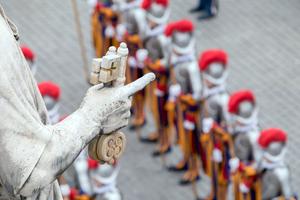
“Clement’s writings also point to the importance of one of those bishops, the bishop of Rome, and the idea of the papacy,” Sri also explains in the series, adding, “The first bishop of Rome was St. Peter, the one apostle who is given the keys of the Kingdom and a special leadership role for the Church as a whole (see Matthew 16:19). That’s why Clement saw his role as the successor of Peter, as the bishop of Rome, as having importance, not just for the people in Rome but for the whole Church. In fact, he wrote a letter to the Christians in Corinth, giving them instructions and commands, assuming those Christians far away in Greece would follow his directives. That wouldn’t make any sense unless he had responsibility and authority over the Christians not just in his city, but throughout the entire world.
“The bishop of Rome, the bishops’ lines of succession — these weren’t ideas that were invented by the later Church. They have their roots going all the way back to the first century. And we see them here going all the way back to this early bishop of Rome, St. Clement.”
4. Help bring our loved ones back.
To be equipped to help our fallen-away loved ones return to the Catholic faith, we first need to understand why the faith makes such a difference in our own lives. It’s not effective to simply tell our loved ones that they need to go to church or read a book. When we take time to form ourselves deeply in the faith, we’re changed by those truths and become a more effective instrument for drawing others back to the heart of the Church and her perennial teaching. “The Catechism wasn’t just thrown together in the 1990s, but has been built from previous catechisms, starting from the 16th century” and explains the “whys”: “Why do we believe this? Where did this belief come from? Why is it so important? Or how can this doctrine — whether it’s a question about … saints or kneeling or holy water … it’s meant to facilitate an encounter with Christ.”
5. Effectively address a culture at odds.
Even Catholics committed to the faith must confront a post-Christian world that doesn’t support the faith and often plants seeds to undermine it, which makes understanding the truths of our faith so important. We can look to St. Paul, who was given the task of trying to convert a culture of people with different values, worldviews and lifestyles, as he encouraged the minority Christian faction to avoid being conformed to the world through a renewal of their minds (Romans 12:2). “If we don’t want to be conformed to the secular age around us, we need to form our minds with the truths of the faith.”
6. Reach beyond the “rulebook” mentality.
The Catechism is a great reference for answering moral questions, like why we believe in purgatory, but it’s much more than that, providing a framework for understanding the four pillars of our faith (creed, sacraments, prayer and the moral life), by journeying through Christian history and learning how the early Christians “devoted themselves to the teaching of the apostles, to the breaking of the bread, and to the prayers” (Acts 2:42). “When the Catholic Church throughout the ages summarized what it means to be Catholic, they would turn to those four points,” with their ancient, indelible roots.
7. Deepen our friendship with Jesus.
At the heart of it all is our friendship with Jesus Christ, but to live in that friendship, we need to know him, both through Scripture, highlighted in the Catechism, and the Catechism itself, which helps us know both who Jesus is and how to live in right relationship with him. “The Catechism helps answer how we should live together as Christians here on earth and with God,” in “the great tradition of Scripture, the saints and in the life of prayer.”
LEARN MORE
Listen to EWTN’s replays of The Catechism in a Year podcast, read articles like Father John Hardon’s “Understanding the Catechism of the Catholic Church” and others at the Register, or subscribe to Sri’s “Foundations of Faith: A Journey Through the Catechism of the Catholic Church” study.
- Keywords:
- edward sri
- papacy
- catechism
- church history