Josef Pieper, AI, and Pope Leo’s Vision for Humanity
Watch ‘Beyond the Machine: Josef Pieper and the Challenge of AI’ on EWTN.
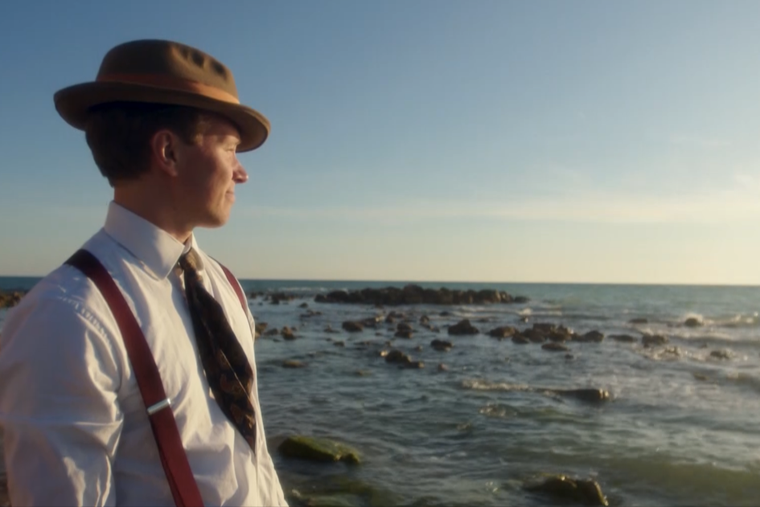
The Sicilian seaside’s stillness is worlds away from Silicon Valley’s technological prowess.
But the thought of Josef Pieper (1904-1997) — a German Catholic philosopher who drew on the teaching of Thomas Aquinas with a focus on leisure, notably in his book Leisure: The Basis of Culture — connects these locales.
Pieper stressed the good of leisure — and the new film Beyond the Machine: Josef Pieper and the Challenge of AI, debuting Tuesday from EWTN Studios, posits that his thought is needed amid the age of artificial intelligence.
Airing one day after the release of Pope Leo XIV’s encyclical Magnifica Humanitas, the film offers a layer of context for understanding the American Pontiff’s wide-ranging treatise on human dignity as the “AI revolution” ramps up.
Having lived through the rise of Hitler in his native Germany, Pieper reflected on how humans were not made for total work and prioritized the role of leisure in daily life.
“Immersion in the real” is a key component for leisure, observes professor Therese Cory, director of the Jacques Maritain Center at the University of Notre Dame and a member of the Pontifical Academy of St. Thomas Aquinas, in EWTN’s new film. (Leisure is a “book that changed my life,” according to Cory.)
Joining Cory in EWTN’s film, produced prior to Magnifica Humanitas’ release, are a variety of other voices, including Dominican Father Philip-Neri Reese, professor of philosophy at the Pontifical University of St. Thomas (Angelicum) in Rome; Brett Robinson, associate director for outreach and associate professor of practice at Notre Dame’s McGrath Institute for Church Life; D.C. Schindler, professor of metaphysics and anthropology from the Pontifical John Paul II Institute for Studies on Marriage and Family; and Vatican journalist Delia Gallgher.
The film highlights how leisure rests on a proper focus of free time, spent contemplating nature and beauty with others.
In the film, Pieper is heard in voice-overs of his own words, including in archival footage, about his travels away from 1930s Germany.
For Pieper, the age of Nazi ideology experienced a loss of meaning — and that correlates to today, with the rise of AI, the film’s sources explain.
In docudrama segments showing Pieper on vacation in the Tyrol, Austria, mountains, then visiting Florence’s cathedral, as well as in Rome and at the Sicilian seaside, the documentary highlights his philosophy of the soul of leisure, anchored in celebration and tied to divine worship — true beauty taken in, with festivity as a component.
In this context, good things have their origin rooted in God — with the interviewees noting that AI and algorithms can’t replace God and community.
The “Catholic vision of reality,” Schindler reflects, has much to offer. (Also tune in to hear why he thinks “intelligence” in artificial intelligence is a misnomer.)
Pope Leo’s response to AI since the start of his pontificate centers on defense of human dignity, looking back to Pope Leo XIII’s 1891 Rerum Novarum.
“Today we find ourselves in a new culture, deeply characterized and formed by technology. It is up to us — it is up to each one of you — to ensure that this culture remains human,” the Pope reminded digital missionaries and influencers in July 2025, as the film highlights.
The film’s sources, in agreement with Pope Leo, note that the Church’s social doctrine must be applied to AI.
Robinson, for instance, considers a question worthy of reflection: What does not finishing an email (and letting AI do so) and focusing less on creative pursuits mean for humanity? What is that doing to the human person?
Pope Leo XIV recalled in that same July 2025 gathering: “Faced with cultural changes throughout history, the Church has never remained passive; she has always sought to illuminate every age with the light and hope of Christ by discerning good from evil and what was good from what needed to be changed, transformed and purified.”
In the scenes showing Pieper vacationing in Sicily by the sea, real delight is underscored, based on peace and receptivity.
Such seaside stillness, Cory says, is the “antidote to what ails us.”
“Leisure is a form of silence, of that silence which is the prerequisite of the apprehension of reality: Only the silent hear and those who do not remain silent do not hear,” Pieper reminds the masses in his writing, as the film recounts.
Contemplation, discusses Legionary Father Michael Baggot, a bioethics professor at the Pontifical Athenaeum Regina Apostolorum in Rome, is contact with the highest reality.
What is at stake in today’s intelligence revolution is not so different from the cog-in-a-wheel Industrial Revolution, explains Dominican Sister Catherine Joseph Droste, professor of theology at the Angelicum: humanity’s proper place amid that revolution.
As Beyond the Machine also stresses, AI cannot behold the beauty, meaning or understanding of things as human cans.
Magnifica Humanitas and AI
The heart of reality and human nature is underscored in Magnifica Humanitas, Leo’s first encyclical, with the Pope noting that “creation bears the imprint of an original goodness that our human outlook must preserve, cultivate and bring to fulfilment. In this regard, the Church offers herself in a way that helps to interpret reality in all its depth. She supports with humble firmness the choices that promote the dignity of every person, the cohesion of communities and the good of all” (20).
“We can embrace the technological progress that alleviates suffering and unlocks new possibilities, provided that we do not abandon the very essence of our humanity, namely the capacity for relationship and love,” Leo emphasizes. “This leads to a crucial question: if an authentic ‘more than human’ exists, where is it to be found? The Christian faith answers that question by pointing to a fulfilment that does not arise from a technological divinization, but through God’s grace received in Christ” (126).
Pope Leo also warns, “if technology becomes the ultimate criterion, the human person risks being reduced to data, a cog in a machine or a commodity” (180).
Among the themes that Leo addresses throughout the encyclical is that of preserving civilization against the temptation of dehumanization, which takes a new shape in the face of AI.
“The civilization of love will not arise from a single or spectacular gesture, but from the sum total of small and steadfast acts of fidelity that serve as a bulwark against dehumanization” (213), Pope Leo XIV reminds the world, underlining an earlier observation: “The quality of a civilization is measured not by the power of its means, but by the care it is able to offer, by its ability to recognize the other as a face not merely as a function. The ability to care for one another is a fundamental dimension of our humanity, one that is learned and mastered through lived experience. Reading stories to a child, offering company to an elderly person and arranging a home so that it is welcoming are simple gestures often rooted in family life. They teach us to value care at a societal level and train us to recognize others as persons worthy of attention” (114).
That is the crux of Pope Leo’s wisdom: “In the era of artificial intelligence, when human dignity is threatened by new forms of dehumanization, ours is the pressing duty to remain profoundly human. We must lovingly safeguard the grandeur of humanity bestowed upon us and revealed in its fullness in Christ, the splendor of which no machine can ever replace” (15).
“The risk of dehumanization — of building a future that excludes God and reduces the other to a means — is an ancient and ever-new temptation that today takes on a technical guise,” Leo writes (10).
Human dignity, which cannot be eclipsed by the efficiency of machines, is at the heart of the new encyclical. “No computational system, however sophisticated, can create a heart that gives itself, or a conscience that discerns good from evil,” Leo writes. “Even when machines excel in efficiency, a human face that asks to be gazed upon remains the center of our history. This human face is the fullness toward which history is moving. It is the mystery of ‘recapitulation’: the certainty that the Father has decreed to bring all things, those in heaven and those on earth, back to Christ, the one Head (cf. Eph 1:10)” (233).
Leo XIV adds in the final paragraph of his encyclical: “With the same faith as Mary, let us become ‘weavers of hope’ in our world, sharing who we are and what we have, so that the presence of Jesus may grow among us and his Kingdom take shape. In the humble fidelity of daily life, even the era of AI can become a time in which the Holy Spirit brings about the civilization of love in our lives” (245).
Pieper would appreciate Leo’s “weavers of hope” poetic phrasing, for wonder is at the heart of Pieper’s thought, as Father Reese elaborates upon.
Film for Our Time
Robert Ducan’s Beyond the Machine is a film for our time, encouraging viewers to reflect on tech temperance and viewing AI through the lens of the Church. The original score by Adam Tucker reflects the true aesthetic of leisure.
Thus, Silicon Valley needs to look back to the seaside — to the human heart and how it is made to flourish.
ON TV
May 26 (8 p.m. EST)
May 30 (9 a.m. EST)
May 31 (1:30 p.m. EST)

Amy Smith Amy Smith is a Register senior editor who edits devotions and features for print and online. Fueled by prayer and coffee, she enjoys writing about everything from Jane Austen to saints for the Register. She is the author of The Plans God Has for You: Hopeful Lessons for Young Women (Emmaus Road Publishing). Her writing has also appeared in various other Catholic publications. She has a master’s degree in journalism and a B.A. in English.