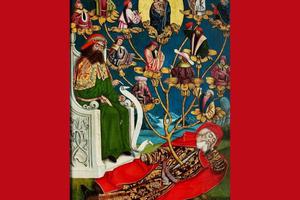
How St. Matthew Sees Money Matters
BOOK PICK: ‘Be Good Bankers: The Economic Interpretation of Matthew’s Gospel’

BE GOOD BANKERS:
THE ECONOMIC INTERPRETATION OF MATTHEW’S GOSPEL
(WITH A FRESH TRANSLATION)
Michael Pakaluk
Regnery Gateway, 2025
265 pages, $32.99
Last week, Pope Leo XIV spoke of the Parable of the Vineyard Workers, from the Gospel of Matthew (20:1-16), observing: “For the owner of the vineyard, that is, for God, it is just that each person has what he needs to live. He called the laborers personally, he knows their dignity, and on the basis of this, he wants to pay them, and he gives all of them one denarius.”
This isn’t the only economically focused passage by St. Matthew.
Michael Pakaluk, professor at the Busch School of Business of The Catholic University of America, offers a provocative thesis: Did Matthew the tax collector arrange his Gospel around concepts of commerce and redemption? Can concepts of business and investment help explain salvation history?
Too many Catholics seem so focused on Jesus’ warning “you cannot serve both God and mammon” (Matthew 6:24) that they overlook all the other ways Jesus used financial, commercial and business imagery to convey his teaching. Catholics speak of the “economy of salvation.”
“Redemption” presupposes paying a “debt,” while the theology of the Incarnation addresses what is demanded of the one paying that debt. Jesus himself tells money-based parables. He criticizes the servant entrusted with a talent (a unit of currency, not an ability) who buries rather than invests it. He holds the zeal of the servant who cooks the books to protect his interests as an example of the single-minded zeal with which we should pursue salvation. So, the idea that the world of finance and commerce could help illumine Jesus’ teaching is hardly far-fetched.
“Jesus liked to teach ‘Be good bankers,’ which meant more than ‘Be good money-changers.’ It meant also: be good traders, investors, risk-takers, and assessors of value. We have seen that salvation from of old was conceived of as a buying back, paid for by the death of the Christ. We have seen that Christians naturally turned to commercial images to describe the Christian life. In short, we have located what might be called a mode of explaining the Gospel that would most adeptly be grasped and handled by someone with some kind of financial background.”
Somebody like Matthew.
This is not Pakaluk’s first go at Gospel reinterpretation. He has previously written translations with commentaries. With Mark, he tried to look at the Evangelist as channeling Peter; with John, the Evangelist giving voice to Mary. Pakaluk’s background in antiquity studies — philosophy and language, though not strictly biblical exegesis — equips him for the task.
I specifically mention biblical exegesis because there is a certain kind of Scripture scholar dismissive of writing about the Bible other than according to criteria of a certain vision of biblical criticism. I do not deny the value and importance of such scholarship. Neither, however, do I want to confine study of the Bible solely to it.
The Bible is not a museum piece. It is the living word of God, and the Church has read it that way. The Patristic Fathers, for example, interpreted Scripture in a fourfold sense, a practice long continued in the Church. Were such readings illegitimate? Are we limited to one reading today’s scholars proclaim? I think not.
As a tax collector in ancient Israel, Matthew would have been familiar with at least two financial systems: the Jewish way in business and the Roman fiscal/legal superstructure imposed on Israel as an occupied province. As one raised in a Jewish environment, Matthew could not avoid the uniquely Jewish perspective that the whole of life — including successful business — had to be lived according to God’s Law. As one working in a Roman context, he could not be unfamiliar with the detailed rules, including meticulous record-keeping, his financial obligations imposed. Should we expect these factors would not influence his Gospel?
I’m not going to give away specifics or comment on particular insights Pakaluk offers, other than to say that this book offers a new, unique and challenging way of thinking about Matthew’s message. As the Sunday Lectionary shifts to Matthew’s Gospel next Advent, it’s right on time.
John M. Grondelski writes from Falls Church, Virginia.
- Keywords:
- st. matthew’s gospel
- st. matthew