Did Jesus Really Die on April 3, A.D. 33?
Faith, history and science converge on one of Christianity’s oldest questions surrounding the Crucifixion.
A father once gave his 8-year-old daughter a book titled Great Men of History. As she flipped through its pages, she noticed something peculiar: Every figure, from explorers to emperors, had a clear date of birth and death.
All except one.
“Why is it we know when all these other famous people were born and died,” she asked, “but we don’t know when Jesus was born and died?”
Her father didn’t have an answer, but the question stayed with him. That father was British scientist and physicist Colin Humphreys — and years later, it would inspire his investigation into one of history’s most enduring mysteries: the date of the Crucifixion.
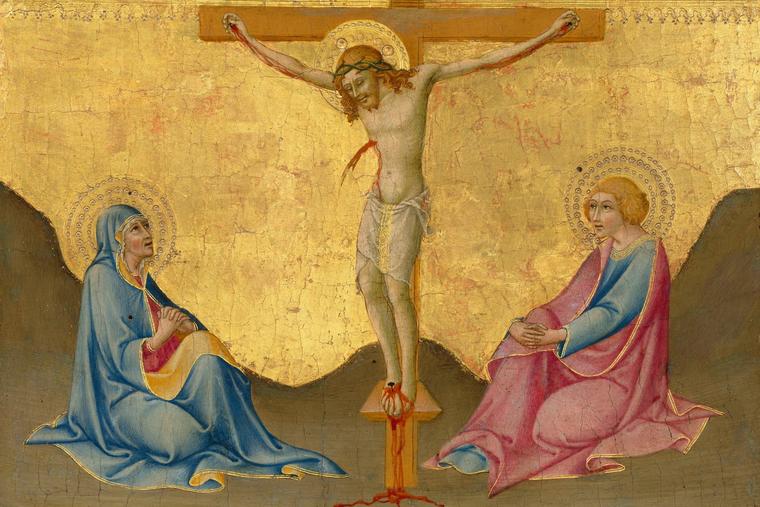
Nearly 2,000 years later, the question still isn’t settled. But it has drawn historians, biblical scholars and scientists — dating back to Sir Isaac Newton — into a meticulous search.
This year, the question feels especially close. Good Friday falls on April 3 — the same calendar date that many scholars believe may correspond to the very day Jesus was crucified in A.D. 33.
The Catholic Church does not claim certainty about the exact date of the Crucifixion. The Gospels and historical records, however, provide a series of clues that narrow the possibilities.
A Catholic Apologist’s Seven Clues
One Catholic scholar who has examined the evidence closely is Jimmy Akin, senior apologist at Catholic Answers. In an April 2013 Register article, Akin argued that various references in the Gospels indicate the date of April 3, A.D. 33.
The Gospels agree that Jesus was executed under the Roman governor Pontius Pilate and during the high priesthood of Caiaphas. Independent sources, including the Roman-Jewish historian Josephus, place both men in office between A.D. 26 and 36, setting the outer limits.
The timeline tightens further in the Gospel of Luke, which dates the beginning of John the Baptist’s ministry to the 15th year of the reign of Tiberius Caesar, or A.D. 29. Since Jesus’ ministry followed and extended over time, his death must come after that point.
All four Gospels, Akin argued, also agree on the day: Jesus was crucified on a Friday, the “day of preparation,” just before the Sabbath. “That eliminates six days of the week, but there were still quite a few Fridays between A.D. 29 and 36,” he wrote.
They also concur that the Crucifixion occurred at Passover — though the exact timing requires careful interpretation. The Gospels of Matthew, Mark and Luke (the Synoptic Gospels) present the Last Supper as a Passover meal, while the Gospel of John suggests it occurred before the feast began.
Rather than viewing it as a contradiction, many scholars see John’s account as historically more precise. In Jesus of Nazareth: Holy Week, Pope Benedict XVI wrote that “trial and execution on the feast seem scarcely conceivable,” pointing instead to a crucifixion on the day of preparation, when the Passover lambs were being sacrificed.
Akin agreed with this reasoning, noting that John’s reference to Jewish authorities avoiding defilement so they could still “eat the Passover” suggests it took place before the feast began (John 18:28-29a).
From there, the possibilities narrow sharply. Only two years in that window align a Friday with Passover: April 7, A.D. 30, and April 3, A.D. 33.
Two additional details, according to Akin, tip the balance. John’s Gospel refers to multiple Passovers, indicating that Jesus’ ministry spanned more than two years — a better fit for A.D. 33. The Synoptic Gospels also cite Jesus’ death as occurring around “the ninth hour,” which in modern timekeeping corresponds to 3 p.m.
Taken together, Akin argued, these seven clues point to 3 p.m. on Friday, April 3, A.D. 33.
What Does Astronomy Reveal?
If Scripture and history narrow the window, astronomy attempts to sharpen it.
Because the Jewish calendar depended on the visible crescent moon, determining the date of Passover requires reconstructing when that crescent would have been sighted. In Jewish tradition, the month of Nisan begins when observers see the first crescent of the new moon. The Passover feast begins on Nisan 15, around the time of the full moon.
Calculating this backward is the challenge Colin Humphreys set out to tackle more than four decades ago.
Using those calculations, Humphreys and astronomer W. Graeme Waddington concluded in their 1983 Nature article that Nisan 14 fell on April 3, A.D. 33. He also pointed to a lunar eclipse that occurred that evening, which he argued would have been visible over Jerusalem.
For Humphreys, that detail offered a possible connection to what Peter later proclaimed at Pentecost, citing the prophet Joel: “The sun shall be turned to darkness and the moon to blood, before the day of the Lord comes, the great and magnificent day” (Acts 2:20-21).
“I thought … what does it mean that the moon turned to blood?” he said. Seeing an image of an eclipsed moon made the idea vivid: “it was blood red.” In ancient sources, he argued, that phrase was a “standard description of a lunar eclipse.”
But that interpretation is highly contested within the scientific community.
Bradley Schaefer, a professor emeritus of physics and astronomy at Louisiana State University, told the Register that — like many scientists who have studied this topic — his work points to a crucifixion date of either April 7, A.D. 30, or April 3, A.D. 33.
Regardless, Schaefer — who has studied more than 20 lunar eclipses to understand their visibility from different locations — argued that while the A.D. 33 partial eclipse did occur, it would not have been noticeable from Jerusalem.
“We know the exact time when the eclipse ended … and when the moon rose,” he explained. The umbral part, he added, was already over, and a faint shading would not have stood out. “The penumbral shades … are completely unnoticeable at the time of the rising of the moon from Jerusalem.”
Schaefer’s point highlights the difficulty of interpreting astronomical data from ancient observational calendars. A slightly hazy sky could shift the start of a month by a day — meaning the visible timing of Nisan 14 could vary on who was observing and under what conditions.
“As a highly experienced professional, I know exactly well that the presence of a lunar eclipse on April 3, A.D. 33 was not detectable from Jerusalem,” he said. “No doubt about it.”
Robert Scherrer, a professor of physics and astronomy at Vanderbilt University and a member of the Society of Catholic Scientists, emphasized the strength of astronomy in this context. “We can predict lunar eclipses going way back in time,” he said, even mapping where they would have been visible.
Why Easter Moves
Long before modern science entered the discussion on the Crucifixion, the early Church faced another question: When should Christians celebrate the Resurrection? The solution, decided at the Council of Nicaea in A.D. 325, was to observe Easter on “the Sunday following the first full moon (14 Nisan) after the vernal equinox” (CCC 1170).
This rule symbolically links Easter to Passover, reflecting the timing of Jesus’ death and resurrection, while using a fixed ecclesiastical date of March 21 for the vernal equinox rather than the actual astronomical equinox, which varies from year to year.
Like Passover, which is based on the Jewish lunar calendar, Easter’s date depends on the lunar cycle, so it does not fall on a fixed date but can occur between March 22 and April 25 in the Western Church, which follows the Gregorian calendar. The Eastern Orthodox Churches, using the older Julian calendar and different ecclesiastical rules, often celebrate Easter on a different date.
For Cardinal Joseph Ratzinger — later Pope Benedict XVI — the Council’s solution was deeply significant. In his 1999 book The Spirit of the Liturgy, he wrote that the Church’s method connects “the two great cosmic forms of ordering time” with the story of Christ — so that in Jesus, “death becomes resurrection and passes into eternal life.”
Does a Date Change the Meaning?
The search for the exact date of the Crucifixion is compelling. It brings together Scripture, history and science, pointing to the deeply historical nature of the Gospel accounts.
But even those who study it most closely are careful about what it proves.
Schaefer called it a “scholarly question” that shouldn’t “affect anyone’s faith.” Scherrer similarly cautioned that scientific conclusions are always provisional, and that faith should not rest on science alone.
Humphreys, however, said that the effort still enriches our understanding of the intersection between science and faith. “It really increases the historical basis of our Christian faith,” he said. “Jesus is a real, historical person. This goes back to what my 8-year-old daughter picked up on with her book.”
While the precise date “adds something,” Jimmy Akin told the Register, it is not what is most significant.
“The important thing is that Jesus died to save us and the world,” he said, “not the specific calendar date this falls on in any given year.”