Generous St. Joseph at the Mouth of the Mountain
Costa Rica, the second smallest country in Central America, was “discovered” by Christopher Columbus in 1502 and given its name by later Spanish explorers and settlers. The name means rich coast.
The travelers were Catholic, but not all had evangelization as their primary objective. Most were after treasure and territory for themselves and the crown.
The natives called the colonists abras, from the verb abrir (open), because the Spaniards were at the same time opening a way from the San José valley to the mountains.
In 1737, the Spanish created Costa Rica’s first parish church. It was a simple straw cottage. The church was named Ayuda de Parroquia de San José de la Boca de Monte: The Help of the Parish of St. Joseph at the Mouth of the Mountain.
A larger church built of wood saw its first Mass in 1776. Then followed an imposing stone structure. Large rocks were taken from a nearby river and carried by mules and carts into the city. The process was gruelingly slow because there were no roads; the heavy haul had to be maneuvered through narrow passageways.
The exterior of the church was done in a style known as Guatemale. This involved mixing clay with other local ingredients to form dried stucco. The parishioners of the church did all of the work.
On April 10, 1821, a great earthquake struck, severely damaging the church. The people set about to rebuild.
And rebuild they did. In 1850, their church was elevated to the status of cathedral. All renovations would be completed the following year. The San José Cathedral remained the same until 1913.
That year, two small towers that had been lost in the earlier earthquake were replaced with towers brought from Germany and Holland. The church you see today is much the same as the one you would have found following the 1913 work.
The great saint to whom the city and its cathedral are dedicated — St. Joseph, whose feast the Church celebrates on March 19 — is surely pleased with how well this holy spiritual home has stood up to the ravages of time and the strains of human history.
Humble House
The church’s interior is the same today as it was before the earthquake. Rather than reflect a single style of architectural design, the décor is a happy mix of varying epochs and approaches. It might be said that the overarching style is Spanish colonial, but with disparate influences. For example, the cupolas are distinctly Roman, while the columns are definitely Doric.
There are three naves, yet the cathedral, which seats 1,500, is relatively small compared to its immense Latin American cousins in Mexico and Guatemala.
The main altar was brought as a gift from Europe. The pulpit is made of wood, and the altar is of marble. A variety of beautiful woods can be identified throughout the cathedral.
In the 1920s, three marvelous statues — the Holy Family, St. Joseph and Jesus — were lovingly restored. The stained-glass windows were imported from France, as was the 150-year-old organ.
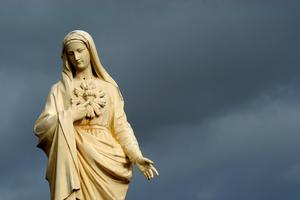
Don Carlos Balsa, an internationally acknowledged authority on South American art, painted the fresco of the Blessed Trinity (Santisima Trinidad) in the dome. Below the fresco is a unique statue of the Blessed Virgin crowned with 12 stars and the moon beneath her feet (see Revelation 12:1).
The Blessed Sacrament Chapel, which is separate from the main body of the church, also features a unique painting of the Holy Trinity. God the Father and Christ are enthroned beneath the Holy Spirit, represented as a dove radiating light. Before them are Joseph and Mary, accompanied by angels, in adoration. Below the painting, the Blessed Sacrament is exposed for adoration.
The cathedral’s Stations of the Cross were carved in Costa Rican wood by Italy’s famous (and still thriving) Ferdinand Stuflesser studio. Stuflesser also made the statues of the Blessed Virgin, The Holy Family, St. Joseph and Jesus.
The newest feature is a plaque commemorating the 150th anniversary of the erection of the cathedral, dating from Feb. 28, 1850. It was placed by San José Archbishop Roman Arietta in 2000.
The 1912 Catholic Encyclopedia reported that the cathedral of San José, “noted for the dignity and elegance of its architecture,” is “the largest and handsomest religious edifice in the capital.” Nearly a century later, I think that still holds true.
San José himself — a hard-working carpenter, lest we forget — must be as proud of this place of worship and sacrifice as Costa Ricans have been blessed by it over the centuries since it began amid mixed motives. Truly, through his saints, God writes straight with crooked lines.
Joseph Albino writes from
Syracuse, New York.
Metropolitan Cathedral of St. Joseph
Avenida 2-4 — Calle 2-4
San Jose, Costa Rica
Web: mcjdcr.go.cr/san_jose_04_catedral/catedral_metropolitana.html
Planning Your Visit
Mass is said in English Saturdays at 4 p.m. in the Blessed Sacrament Chapel. Each Thursday afternoon at 3, the cathedral hosts a holy hour.
- Keywords:
- March 18-24, 2007