‘Exodus: Gods and Kings’: Theological Reflections
New Biblical Film Raises Scriptural and Religious Issues
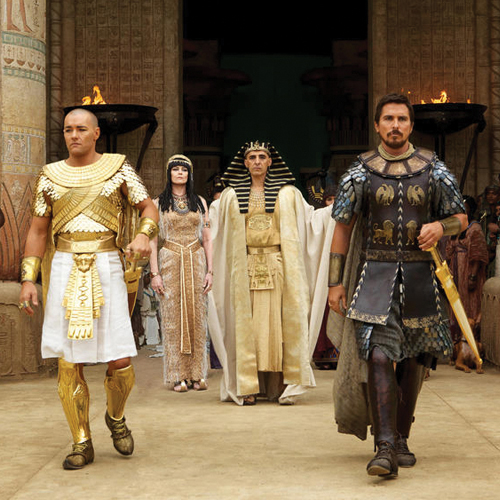
Ridley Scott’s Exodus: Gods and Kings is the year’s third big-screen Bible epic. Broad outlines of the drama are those of the biblical story, but there’s plenty of creative license — some defensible, some less so. It’s a movie with many problems, like most of Scott’s recent epics, but Scott has a better story to work with here and adds something of value to the world of Bible cinema.
Many retellings of the Exodus story focus on the dramatic and emotional implications of the notion that Moses, raised in the Egyptian court at Memphis, would have been like a son to one pharaoh (commonly identified as Seti I) and perhaps like a brother to another (Rameses II). Not many Moses movies, on the other hand, have pondered the spiritual implications of Moses’ default religious milieu being Egyptian polytheism, or the covenant deity of the Hebrews being a stranger to him, one whose uniqueness and character Moses might have come to grasp slowly, over time.
Not that Scott’s Moses, portrayed by Christian Bale, is a pious pagan. On the contrary, he is a skeptical humanist, one who regards the mummeries of the court soothsayer as idle superstition. He has some notion of the beliefs of the Hebrew slaves; he even knows that the name “Israelite” connotes wrestling with God. The strangeness of Scott’s burning-bush sequence and his daring approach to representing the divine presence Moses encounters may offer an imaginative way of bridging, at least partially, this religious cultural gap between Moses’ day and our own.
Unlike Charlton Heston’s Moses, who heard a disembodied voice (Heston’s own voice) at the burning bush, Bale’s Moses sees and hears a young boy — not a beatific boy speaking in dulcet tones, like a proper Christian angel, but a scowling boy with a curt manner and a temper. In a key scene, the boy expresses indignation over the subjugation of the Hebrews and startling fury at the divine pretensions of Egypt’s leaders: “These pharaohs, who imagine they are living gods, are nothing more than flesh and blood! I want to see them on their knees begging for it to stop!” Depending on the viewer’s dispositions, the boy’s temperament could be described as fierce, petulant, spiteful, etc. Moses’ reply clarifies a key point: The boy is not God himself, but a heavenly messenger. There is biblical warrant for the idea that Moses encountered a messenger (or angel) of the Lord (Hebrew malak YHWH) at the burning bush (see Exodus 3:2, Acts 7:30-38).
Still, I imagine many Christians, and Jews for that matter, watching this scene will end up feeling that “Malak” (as he’s credited) might represent someone else’s god, but not our God. This is precisely what intrigues me about it.
Reading Exodus 3 as a Christian, I think of God speaking to Moses as the Holy Trinity, and rightly so. Yet I’m also aware that this story was passed down for centuries by pre-Christian Jews who had no conception of the Trinity — and, of course, the story is sacred to Jews today who do not accept the Trinity.
If Malak’s manner leaves us at times uncomfortable, the depiction of God in the Old Testament at times has a similar effect, or ought to, if we aren’t dulled by familiarity. For example, the Old Testament depicts God commanding the massacre of whole populations, including women and children. At times, even God’s prophets are appalled by his decisions, arguing with him and even apparently changing his mind, as when Moses persuades God not to repudiate his people (Exodus 32). I know very well the range of theological and exegetical answers to these issues. (I am working on my second seminary master’s degree, after all, and my first is in sacred Scripture, with an Old Testament focus.)
But knowing the answers doesn’t mean we shouldn’t feel the weight of the questions. It’s one thing to illuminate the dark passages of Scripture; it’s another to dismiss them as a non-problem, to say there are no dark passages. There are. Pope Benedict XVI wrote about these dark passages in his apostolic exhortation Verbum Domini, pointing out, among other things, that divine Revelation is “deeply rooted in history,” with God working in slow, progressive stages to shape his chosen people, despite the resistance of human sinfulness.
How God is depicted in the Pentateuch may not always fully conform to a developed Christian understanding of God, but it reflects how God was understood at a certain stage in salvation history. A case can be made that dramatic adaptations of these stories can reflect this ambiguity — though, of course, what we get then is how God was understood at a certain stage in salvation history, as that is understood by the artist in his own context, for good or ill. I won’t say I’m comfortable with all of the filmmakers’ choices here, but then I’m also sometimes uncomfortable with pious biblical movies that gloss over these issues, revising the story to get God off the hook, as it were.
Given this progressive nature of divine Revelation, I can roll with the movie’s conceit that it took Moses time to grasp how Pharaoh’s grip on the Hebrews would be loosened, so that Moses spins his wheels while trying guerrilla-resistance tactics before God unleashes the plagues. (Noah depicts its protagonist’s understanding of the Creator’s will in the flood likewise, clarifying slowly over time.) On the other hand, the guerrilla-resistance sequence is part of a pattern of ratcheting up the tension between Moses and Rameses (Joel Edgerton) to such a degree that Moses is basically unable to fulfill his biblical role of God’s negotiator with Pharaoh.
On to the plagues: The whole business gets started on a rather ludicrous, almost horror-movie note, but it works pretty well after that. The plagues aren’t the only instance of divine activity for which the film posits actual or possible naturalistic rationales. Moses’ encounter with Malak is preceded by a blow on the head, which Zipporah (Moses’ wife) explicitly says could have caused Moses to imagine the encounter. The parting of the Red Sea (or Reed Sea) is accounted for as a dramatic draining of water caused by an approaching tsunami, which naturally wiped out the Egyptians (a theory that has been around for years). Further complicating matters, Moses does not foretell the plagues (although he does know from Malak that something is coming); instead, he only interprets them as divine action once they are under way.
None of this means, of course, that the film doesn’t affirm God’s active presence in the story. To begin with, there is the authorial weight of the opening titles, which expressly declare that not only have the Hebrews not forgotten their God during their centuries of slavery, but God has not forgotten them. And a tsunami that comes along at precisely the right moment to drain the sea for the Hebrews and then drown the Egyptian army certainly seems heaven-sent in one way or another.
Crucially, there is one sign that is clearly supernatural: the death of the Egyptian firstborn on Passover night. In this sign, which Moses does foretell and which is accompanied by an ominous shadow from heaven falling over the land, the hand of God is nakedly at work, thereby attesting that the other signs are not just coincidence.
Exodus: Gods and Kings is a flawed but intriguing film — one that, if I can’t quite embrace it, I’ve at least enjoyed wrestling with, as it were, even as the film’s Moses (and perhaps the filmmakers?) wrestled with God.
Steven D. Greydanus is the Register’s film critic.
Read the full article at NCRegister.com.
- Keywords:
- Dec. 28, 2014-Jan. 10, 2015