Catholic College Chapels Embrace Traditional Architecture
Catholic liberal arts colleges have turned toward traditional architecture when expanding to accommodate the numbers. Here are two examples.

Overflowing chapels and packed student centers present a happy problem for thriving Catholic communities on college campuses.
As these growing Catholic communities demand more space for worship, Catholic liberal arts colleges have turned toward traditional architecture when expanding to accommodate the numbers. Chapels constructed over the course of the past decade feature Gothic and Romanesque architecture — bell towers, arches and spires — as well as sacred art, mosaics and iconography inspired by both Western and Eastern traditions.
Young people on these campuses say they desire to encounter the faith and to evangelize through beauty and in accordance with the tradition of the Catholic Church.
Christ the King Chapel | Christendom College | Front Royal, Virginia | O’Brien & Keane Architecture | Dedicated April 2023
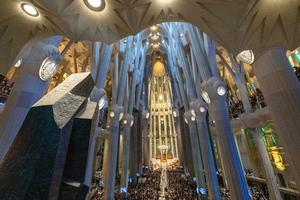
A tremendous Gothic cathedral stands out against the backdrop of the Blue Ridge Mountains on the campus of Christendom College in Front Royal, Virginia.
“It’s hard to single out any particular architectural element or feature. We worked to make it one unified building, inside and out, so everything is interdependent,” architect Jim O’Brien said. “I would say the most important things about the design are the interior proportions, which offer an uplifting vertically, and the clerestory windows, through which the filtered daylight from above can provide a feeling of transcendence.”
Former president of Christendom College Timothy O’Donnell said he wanted the church to reflect the medieval architecture of the Irish Gothic Revival.
“You’re always being led to look up with the Gothic,” O’Donnell said. “When you walk in, I was really hoping [you] would feel like you’re stepping back in time. … You’re stepping into a world where the supernatural and the reality of the supernatural is made manifest.”
The chapel, which seats more than 500 people, is built in a cruciform structure with a crossing tower, slate roof, and twin spires. Two side chapels house statues depicting the Pietà and the death of St. Joseph. Twelve columns lining the nave inside the church represent the 12 Apostles, and 12 bells named for and dedicated to the apostles ring in the twin spires. Students can spend quiet prayer time in “Our Lady’s Chapel,” a small chapel behind the high altar dedicated to Mary.
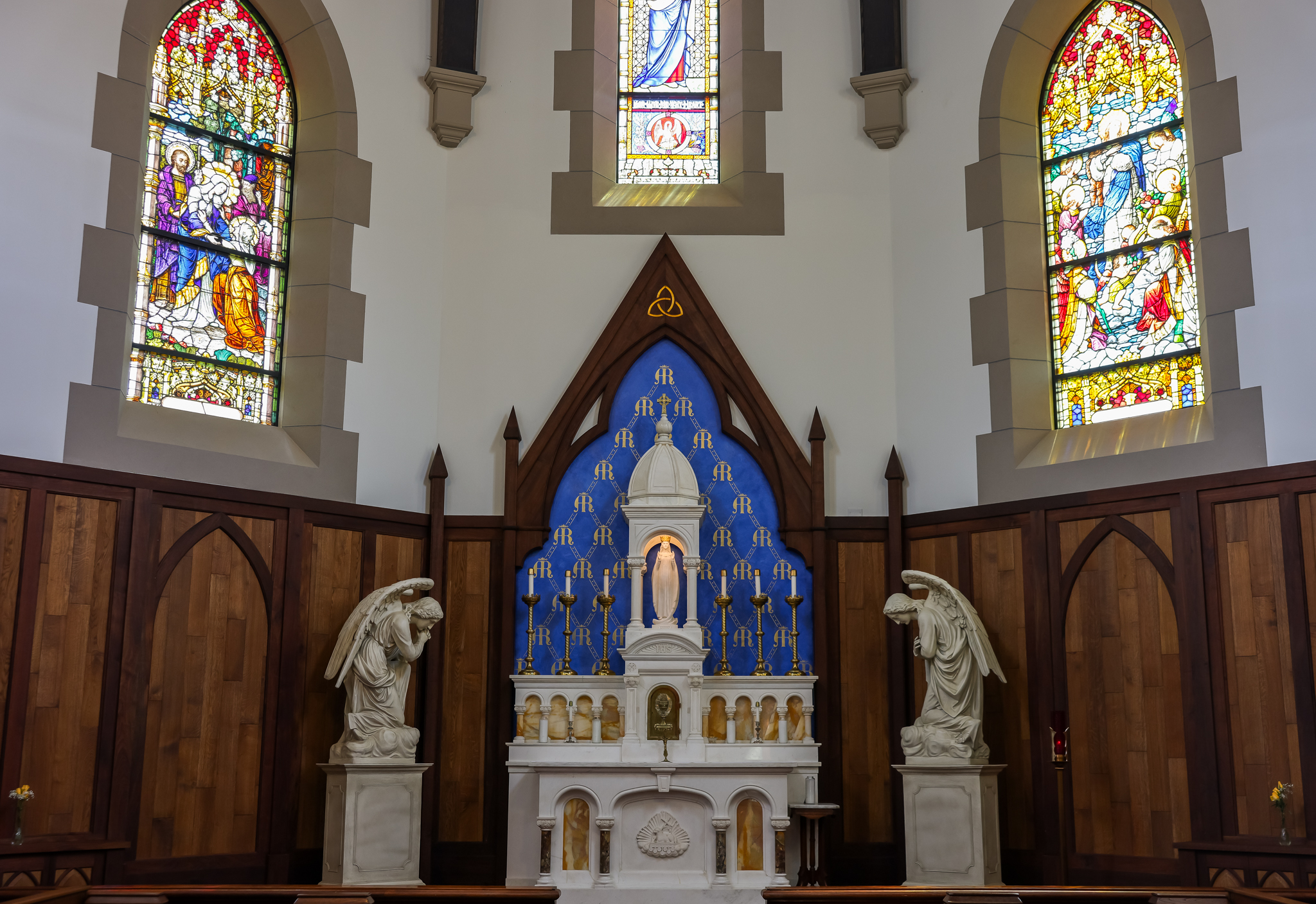
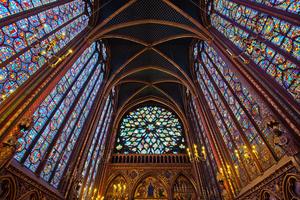
Light fills the church due to its 72 clear windows, 114 stained-glass windows, and two large transept stained-glass windows. Because the chapel is built facing west on an east-west axis, the sun shines directly through a south-facing nativity window on winter afternoons. When the sun rises in the spring, the light shines through the image of the Resurrection on the opposite side. The sunrise always hits the east-facing Sacred Heart window, which presides over Our Lady’s Chapel and is immediately visible upon entering the church.
“It’s like looking at the Transfiguration; it’s just radiant,” O’Donnell said.
The college recently installed a large thurible, similar to the botafumeiro at the Cathedral of Santiago de Compostela in Spain, as a nod to the college’s Spanish heritage. The thurible is swung to incense the church on special occasions such as the Solemnity of Christ the King.
Though the Gothic cathedral stands out in the rural landscape, small artistic features tie the chapel back to the Virginia roots of the college. The floor inside the church is entirely inlaid black walnut from woods on the college’s land, except for the sanctuary, which is cherrywood. The cornerstone is made of marble from Virginia, brought to Rome for a special blessing from Pope Benedict XVI before construction. When the Pope saw the renderings, he simply said: “It is very beautiful.”
“The Catholic faith is something that is very, very beautiful. So being able to communicate that beauty in glass, in mosaic, in marble, and in beautiful carved wood is very compelling,” O’Donnell said.
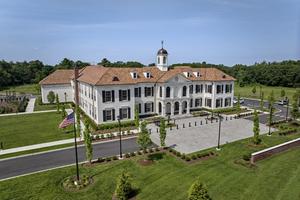
Christ the King Chapel | Franciscan University of Steubenville | Steubenville, Ohio | MCF Architecture and Steve Baker of Baker Architects | Dedication Anticipated August 2025
Franciscan University of Steubenville is following in the footsteps of its namesake, responding to the Lord’s call to rebuild.
“The very beginning of the Franciscan life is Francis kneeling in the San Damiano Chapel in Assisi, and he hears the Lord say to him, ‘Rebuild my church,’” the college’s president, Franciscan Father Dave Pivonka, said. “When I was beginning to pray and think about it, that’s what I was struck by. The renovation, the rebuilding, is consistent with our founding.”
Because the current chapel built in the 1970s is so dear to the university community, Father Pivonka said he wanted to renovate the chapel rather than build a new structure. He aimed to preserve the original structure and feel of Christ the King Chapel as well as the iconic spire that has become a trademark of the university.
“Rather than running away or hiding from our past and our history, we actually chose to embrace it,” Father Pivonka said. “When you walk into the renovated chapel, there’s going to be some elements of the chapel that have the original bare walls, because we wanted to embrace that.”
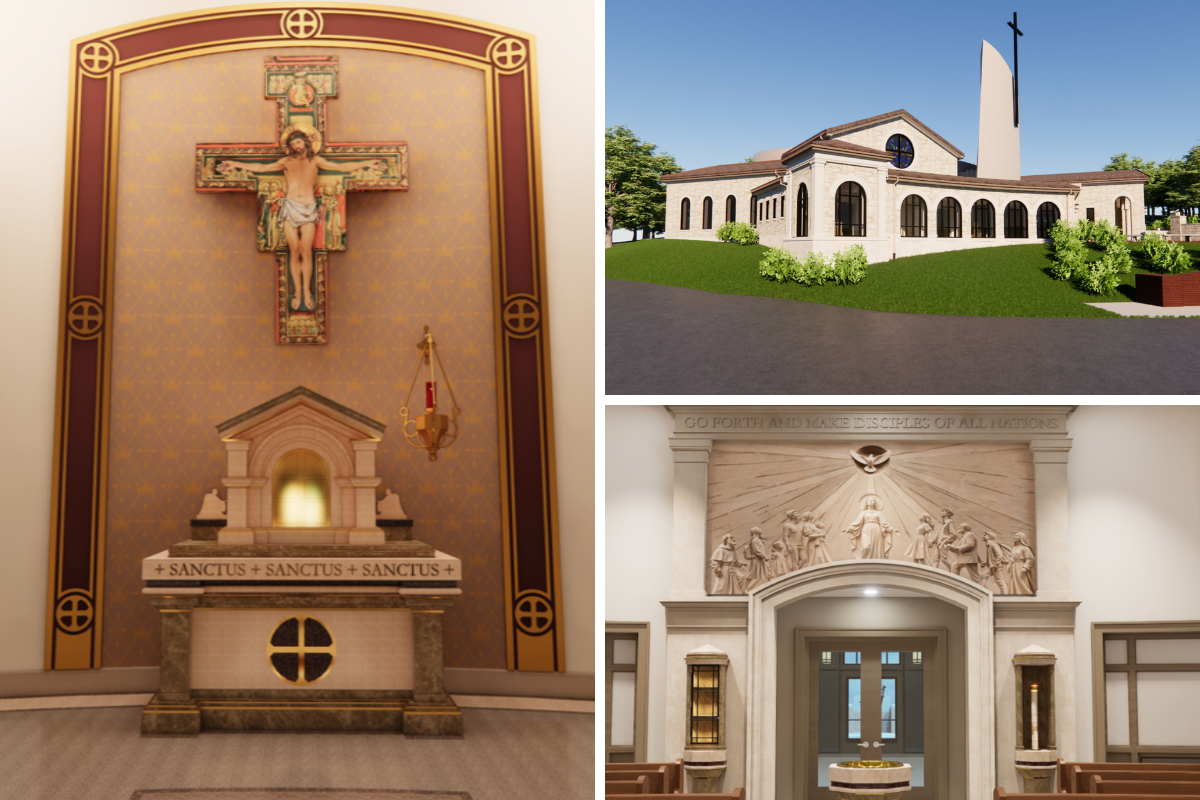
The renovated church will tell the ongoing story of Franciscan University, Father Pivonka said, just as visible renovations in the San Damiano Church in Assisi tell the story of St. Francis.
The goals for the renovation included giving the community more space as well as making the chapel more beautiful, more theologically rich, and more Franciscan.
The new stone exterior mirrors the Basilica of St. Francis in Assisi, according to Franciscan Father Jonathan St. Andre, vice president for Franciscan life at the university. A three-arched entrance calls to mind both the Trinity and the three visitors to Abraham in the Old Testament.
“When you walk into the chapel now, the crib, the cross and the Eucharist are prominent,” Father Pivonka said, adding these three elements are central to Franciscan theology.
A large relief at the base of the altar will show the Nativity scene, a replica of the original San Damiano cross will hang over the altar, and an elevated tabernacle will stand at the center of the church.
The chapel will also feature the artistry of several faculty, according to Father St. Andre, including a large mural of Christ the King in the narthex by Amber Knorr and four stained-glass windows crafted by Carl Fougerousse in Austria, showing the kerygma (the Gospel message), four Franciscan saints, and the life of St. Francis.
Knorr said she was impressed while working on the project by what the administration was able to accomplish, transforming the Christ the King Chapel while respecting its legacy.
“It’s a lot harder to rebuild and make something beautiful,” said Knorr, a visiting instructor of fine arts. “They’ve done a really good job of honoring the nostalgic feeling of Christ the King while making it beautiful, and larger, and more functional for the next generation.”
Moira Gleason is a journalism student from Hillsdale College.
- Keywords:
- sacred architecture
- college campuses