Why Does Jesus Vanish at Emmaus?
COMMENTARY: The Road to Emmaus helps us to recognize the Risen Lord as present in the Eucharist.
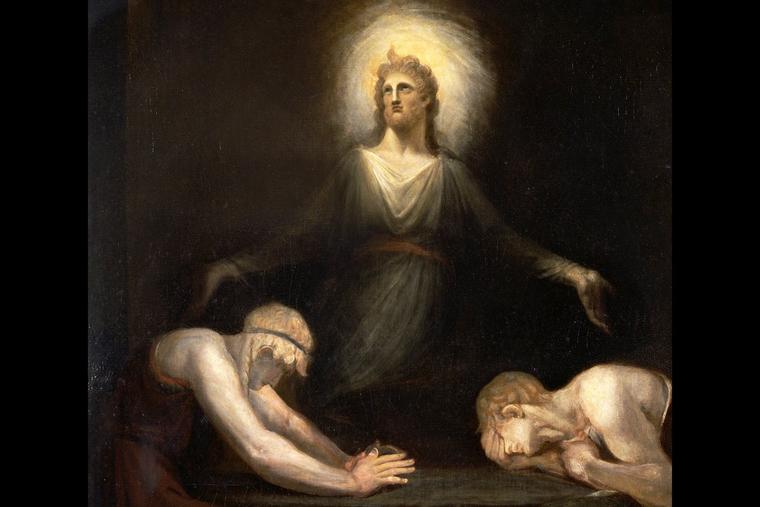
When the resurrected but still unrecognized Jesus sits at table with the two disciples in Emmaus, he “took bread, said the blessing, broke it, and gave it to them” (Luke 24:30). Immediately, several things happen: Their eyes were opened; they recognized him; he vanished from their sight (Luke 24:31).
Why does Christ vanish? An important passage from the Old Testament can help us find our bearings.
The Old Testament Background: Judges 6
Judges 6:1-24 recounts the call of Gideon. The chapter opens by recounting a familiar story: God’s people have sinned and broken the covenant. As a result of their unfaithfulness to the covenant, Israel has fallen under the terrible power of the Midianites.
However, the Lord God will act to save his people. In the person of his angelic messenger, God visits the unlikely Gideon and tells him, “The LORD is with you, mighty warrior!” (Judges 6:12). The formula “The LORD is with you” evokes the covenant, by which God binds himself to his people — and in fact, the call of Gideon concludes with a renewal of this covenant:
The messenger of God said to him: ‘Take the meat and unleavened cakes and lay them on this rock; then pour out the broth.’ When he had done so, the messenger of the LORD stretched out the tip of the staff he held. When he touched the meat and unleavened cakes, a fire came up from the rock and consumed the meat and unleavened cakes. Then the messenger of the LORD disappeared from sight (Judges 6:20-21).
By juxtaposing this passage with Christ’s actions at Emmaus in Luke 24, some noteworthy parallels appear. In both passages, there is a ritualistic meal involving God, whose presence is veiled in some way (he is represented by an angel in Judges, and the risen Jesus is unrecognized). Further, in both passages, the ritual meal consummates a covenant. It is worth pausing on this point for a brief moment.
Leviticus 9:22-24 describes the dedication of the altar — and so the inauguration of the sacrificial system of Israel — by describing a covenantal meal. In this meal, divine fire miraculously consumes the offering placed on the altar, thereby revealing the overwhelming glory of the Lord God. Since this fire was miraculous in origin, Israel was to keep it perpetually burning. It was the fire by which the daily morning and evening sacrifices were offered in the Temple:
Aaron then raised his hands over the people and blessed them. When he came down from offering the purification offering, the burnt offering, and the communion offering, Moses and Aaron went into the tent of meeting. On coming out they blessed the people. Then the glory of the LORD appeared to all the people.
Fire came forth from the LORD’s presence and consumed the burnt offering and the fat on the altar. Seeing this, all the people shouted with joy and fell prostrate.
Far from describing a strange or shamanistic ritual, the meal recounted in Judges 6 is a renewal of the covenantal meal of the Old Testament. The miraculous fire by which God consumes the offerings of Gideon displays his wondrous presence and affirms the establishment of the covenant. Once the meal is miraculously consumed, God disappears, since his continual presence is now guaranteed by the renewed covenant and the sacral fire.
The Supper, Emmaus and the Mass
All of this stands in the background of Christ’s actions in Luke 24. Like the offering provided by Gideon in Judges 6, or by Moses and Aaron in Leviticus 9, Jesus also offers a ritualized meal. The two disciples invite Jesus to stay with them as their guest but, in a surprising turn of events, the guest becomes the host of the meal. And in Luke’s Gospel, important things happen at table with the Lord.
Jesus takes the bread, blesses and breaks it, and gives it to them. These four verbs, which Scripture scholar R. Allen Culpepper calls “Jesus’ signature,” repeat the same actions of Jesus at the Last Supper.
That Christ’s fourfold action with the bread recalls the Supper is key. At Emmaus, we see the Lord’s action only. The Supper, however, gives us his words also:
Then he took the bread, said the blessing, broke it, and gave it to them, saying, ‘This is my body, which will be given for you; do this in memory of me.’ And likewise the cup after they had eaten, saying, ‘This cup is the new covenant in my blood, which will be shed for you’ (Luke 22:19-20).
The Supper makes explicit what is unspoken at Emmaus. Christ has established a new covenant, not with the blood of bulls and goats, but with his own Blood. Both the Supper and Emmaus point to Calvary — the Supper in anticipation, Emmaus in memorial, even as he commanded.
That is to say, the Supper can be repeated. And, in its repetition, the new covenant is commemorated. Why can it be repeated? Because it bears “Jesus’ signature,” by which the bread and wine become his Body and Blood offered on Calvary and yet made present as true food and drink in the new sacral meal, the Mass. The Eucharist guarantees that the Last Supper, the cross, and the repeated memorial meal at Emmaus, are somehow all the same event, since the same body offered on the cross is both present and offered sacramentally in the breaking of the Bread, the Eucharist.
Just as in the renewal of the covenant with Gideon the Lord God disappears when the fire consumes the offering, so here Christ also vanishes the moment the Eucharist is offered. The Eucharist becomes the perpetual sign, the sacrament, of the new covenant, by which his true and resurrected Presence is guaranteed in perpetuity to his Church.
The Road to Emmaus helps us to recognize the Risen Lord as present in the Eucharist. In this sense, the episode has an apologetic aim, explaining how we, who have not seen the Lord with our eyes, nevertheless still have access to the life of his resurrection. The Road to Emmaus enacts, as it were, Christ’s words in the Bread of Life Discourse of John’s Gospel: “I am the living bread that came down from heaven; whoever eats this bread will live forever; and the bread that I will give is my flesh for the life of the world” (John 6:51).
Along these lines, St. Thomas Aquinas explains that the Eucharist contains Christ invisibly, in order that our faith may grow and flourish. The Eucharist helps our faith, says St. Thomas, because:
It belongs to the perfection of faith, which concerns His humanity just as it does His Godhead, according to John 14:1: You believe in God, believe also in Me. And since faith is of things unseen, as Christ shows us His Godhead invisibly, so also in this sacrament He shows us His flesh in an invisible manner.
And what of the sacral fire that miraculously consumed the offerings of Moses, Aaron and Gideon? The fire of the new covenant is poured into our hearts through the Holy Spirit (see Romans 5:5). Just as Jesus in Luke 12:49-50 announced that he had come to kindle fire upon the earth, so now the hearts of the two disciples are ignited. “Then they said to each other, ‘Were not our hearts burning within us while he spoke to us on the way and opened the Scriptures to us?’” (Luke 24:32).
They return with haste to Jerusalem, to announce what is still true today for us in the celebration of every Mass: that the Risen Lord was made known to them “in the breaking of the bread” (Luke 24:35).
Father Michael Johns is a priest of the Diocese of Little Rock, Arkansas.
- Keywords:
- resurrection
- emmaus
- eucharist