Easter Sunday: We Too Are Witnesses to the Resurrection
The Gospel from Matthew features Jesus’ appearance to the women early on Easter morning, while the one from John’s Gospel features the examination of the empty tomb.
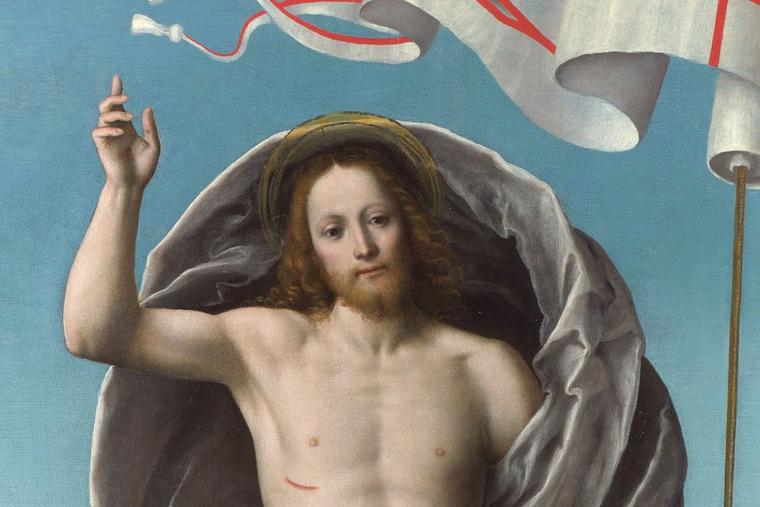
Sunday, April 5, is the Resurrection of the Lord. Mass readings: Acts 10:34a, 37-43, Psalm 118:1-2, 16-17, 22-23; Colossians 3:1-4 or 1 Corinthians 5:6b-8; John 20:1-9 or Matthew 28:1-10.
There are two options for the Gospel on Easter Sunday. One is from John’s Gospel, featuring the examination of the empty tomb by Peter and John (see reflection at end of this post). The other text is from Matthew and features Jesus’ appearance to the women early on Easter morning. Let’s look at Matthew’s account in four stages.
After the Sabbath, as the first day of the week was dawning, Mary Magdalene and the other Mary came to see the tomb. And behold, there was a great earthquake; for an angel of the Lord descended from heaven, approached, rolled back the stone, and sat upon it.
The earthquake signals a new reality. Having encountered a fearful tremor and the trauma of the Crucifixion, the women are drawn into the Paschal mystery and toward the Risen Christ. But they haven’t seen him yet or even heard he is risen.
Then the angel said to the women in reply, “Do not be afraid! I know that you are seeking Jesus the crucified. He is not here, for he has been raised just as he said. Come and see the place where he lay.
This declaration is rooted in God’s promise and in his word that he would rise on the third day. They are invited to grow in their faith by pondering the word of Jesus Christ and coming to trust in the truth of his promise. There is also evidence that the angel provides of the empty tomb, but, at this point, they are called to live and walk by faith, not by sight of the Risen Lord.
“Then [the angel said] go quickly and tell his disciples, ‘He has been raised from the dead, and he is going before you to Galilee; there you will see him.’ Behold, I have told you.”
Having been instructed in the Paschal mystery, the Lord sends them to inform others. In a way, the angel demands from them the obedience of faith. And this sort of faith is rewarded.
Then they went away quickly from the tomb, fearful yet overjoyed, and ran to announce this to his disciples. And behold, Jesus met them on their way and greeted them. They approached, embraced his feet, and did him homage. Then Jesus said to them, “Do not be afraid. Go tell my brothers to go to Galilee; there they will see me.”
Their faithful obedience to the Lord’s angel is rewarded by sight. They now become firsthand witnesses to the Resurrection.
This is a journey that we must make. We follow the path set out by faith. In the laboratory of our lives, we see increasing evidence that the Lord is alive and that he is changing our lives as we go from the darkness of this world to the brightness of faith and deeper understanding of the power of the Resurrection. Happy Easter!
Additional reflection on the Gospel of John.
Journey to the Resurrection With Mary Magdalene and John the Beloved
The Gospel paints a portrait of a journey to resurrection faith. While the account begins with St. Mary Magdalene, the focus quickly shifts to St. John; let’s study his journey.
“On the first day of the week, Mary of Magdala came to the tomb early in the morning, while it was still dark, and saw the stone removed from the tomb. So she ran and went to Simon Peter and to the other disciple whom Jesus loved, and told them, ‘They have taken the Lord from the tomb, and we don’t know where they put him.’”
The text describes these opening moments as “still dark.” This does more than tell us the time of day; the deeper point is that there is still darkness that envelops everyone’s mind.
Mary Magdalene sees direct evidence of the Resurrection but presumes the worst: that grave robbers have snatched the Lord’s body. It doesn’t even occur to her to remember that Jesus had said he would rise on the third day.
The text goes on to describe a subtle move from reaction to reflection.
“So Peter and the other disciple went out and came to the tomb. They both ran, but the other disciple ran faster than Peter and arrived at the tomb first; he bent down and saw the burial cloths there, but did not go in.”
Mary’s panic triggers that same reaction in Peter and John. Now they are all running.
A mad dash to the tomb begins. But note a subtlety: John runs faster than Peter. Something is happening within John. He moves from reaction to reflection, likely recalling the Lord’s promise to rise on this, the third day.
Scripture says, “But those who hope in the LORD will renew their strength. They will soar on wings like eagles; they will run and not grow weary, they will walk and not be faint” (Isaiah 40:31).
The Reassessment
In life we must often reassess our initial reactions as further evidence comes in. Peter and John must take a fresh look at the evidence from their own perspective.
The text says, “When Simon Peter arrived after him, he went into the tomb and saw the burial cloths [lying] there, and the cloth that had covered his head, not with the burial cloths but rolled up in a separate place.”
Grave robbers typically sought the fine linens in which the dead were buried.
Yet here the linens remain while the body is gone. The Greek text describes the clothes as “lying outstretched in place.” It is almost as if they simply “deflated” when the body they covered disappeared.
Also, the most expensive cloth of all, the face cloth, lies folded in a separate place. This does not look like grave robbers. John is reassessing.
“Then the other disciple also went in, the one who had arrived at the tomb first, and he saw and believed. For they did not yet understand the Scripture that he had to rise from the dead.”
John has gone from fear to faith. He has not yet seen Jesus alive, but the text says he believes based on the evidence of an empty tomb and the careful condition of the grave clothes.
He also believes what his own heart and mind recall — the word of Jesus that he would rise on the third day. He believes even though he has not seen the Lord and does not yet understand all the Scriptures that Jesus had to rise.
The text says simply: He saw and believed.
- Keywords:
- easter sunday
- sunday guide
- risen christ
- resurrection