When a Nativity Scene Becomes a Partisan Billboard
COMMENTARY: The display in Dedham, Massachusetts, is more of a political prop than a call to a deeper relationship with Christ.
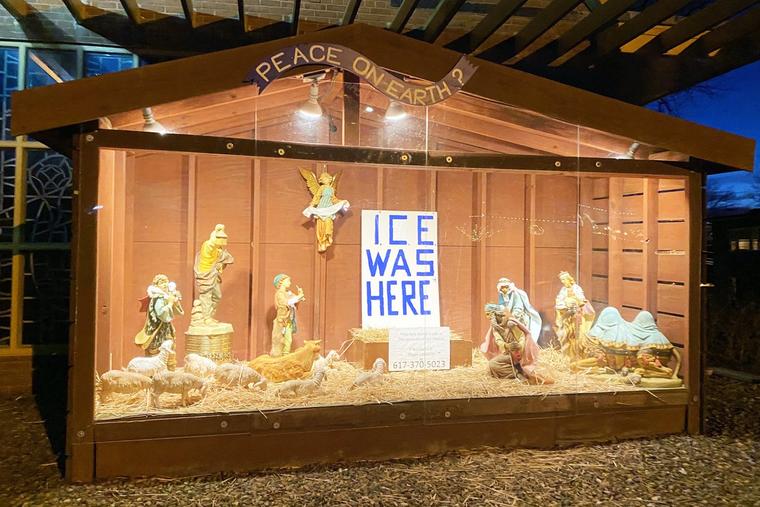
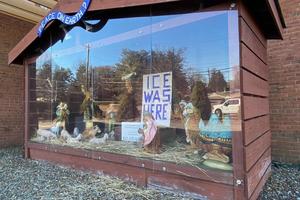
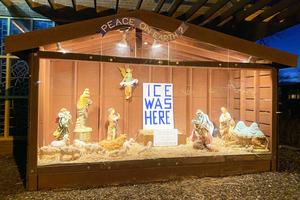
At St. Susanna Church in Dedham, Massachusetts, the Holy Family has been removed from the parish’s Nativity scene — not by an indifferent innkeeper, but by a pastor intent on sending a message.
St. Susanna unveiled a “Nativity” without Jesus, Mary or Joseph. In their place: a sign reading “ICE WAS HERE,” and another urging passersby to contact a local activist coalition if they see immigration enforcement officials. The pastor, Father Stephen Josoma, says the display will remain until he can have “further dialogue” with Archbishop Richard Henning of Boston.
The archdiocese has already done what prudence requires. It issued a clear statement calling the display “politically divisive,” reaffirmed that sacred objects are for worship, not messaging, and asked that the crèche be restored to its “proper sacred purpose.” At that point, wise leadership does not escalate; it steps back. There is nothing to gain from being drawn into parish‑level controversy.
What makes this “protest Nativity” troubling beyond ordinary pastoral overreach is that it rests on a falsehood. “ICE WAS HERE” is not a metaphor for an actual raid. Nothing of the sort occurred. For immigrant parishioners — some possibly in the U.S. without legal documentation — that phrase is not clever symbolism; it is a trigger for fear. It suggests that their parish grounds have been the site of enforcement action.
In Catholic moral theology, truthfulness is not optional. Even prophetic witness must be anchored in truth and ordered toward charity, as the Catechism teaches (2464). Using a sacred symbol to dramatize a fabricated event crosses the line from conscience to manipulation.
Father Josoma has framed the division caused by the display as a reflection of “American society today.” But in doing so, he assumes a burden no single parish can carry — attempting to address national political tensions through a crèche meant for prayer.
The suffering of migrants is real, and the Church’s call to welcome the stranger is nonnegotiable. Yet selective emphasis risks distorting the Church’s balanced moral witness, which upholds both the dignity of the migrant and the legitimate role of law.
Imagine, for comparison, a parish erecting an empty crèche with a sign reading “PLANNED PARENTHOOD WAS HERE” to represent the loss of unborn life. The reaction in certain quarters would be swift: solemn lectures about the separation of church and state, warnings against “politicizing” sacred symbols, and demands to keep contentious debates outside the sanctuary. The norms that are so elastic in one context would suddenly become rigid.
And if every Catholic parish took it upon itself to “message” through the Nativity scene, the Church would quickly find itself with hundreds of competing crèches — each reflecting a pastor’s preferred cause rather than the unity of the Incarnation. The result would not be prophetic clarity but liturgical fragmentation, with the faithful forced to navigate a different ideological tableau every time they entered a different church.
This is the heart of the problem.
The Nativity scene is no longer being treated as a locus of worship but as a versatile prop — available to whichever cause a particular clergy member favors. When that happens, the symbol ceases to belong to the whole Church and becomes a partisan billboard. Catholics who come seeking prayer and peace instead encounter a performance.
The irony is that the Catholic Church’s social teaching on immigration is serious enough to stand on its own without gimmicks. Archbishop Henning has been a national leader on the issue, coordinating the efforts of the U.S. bishops to issue a “special pastoral message” that clearly states Catholic social teaching on human dignity and the moral obligation to accompany vulnerable immigrants.
As the USCCB teaches in “Strangers No Longer,” the call to welcome the stranger is not a partisan talking point; it is a genuine moral claim rooted in the Gospel.
But when a pastor wraps that claim in theatrical falsehood and manufactured fear, he undercuts it. People stop seeing the Gospel and start seeing the stunt.
Here, the archdiocese’s restraint is not weakness; it is a needed counterwitness. Having restated sacred norms, the most effective path is quiet consistency. Not every provocation demands a reply.
Sometimes the strongest institutional move is to speak once and refuse the encore.
Christmas proclaims a mystery quiet and vulnerable: no slogans, no stunts, just a Child who needs no staging to compel belief. Dedham’s true scandal is treating faith’s tenderest symbol as a prop in a personal production.
The Archdiocese of Boston’s task now is simple and profoundly countercultural: Restore the crèche, reclaim its meaning and let the peace of Christ prevail.
John Corcoran is the founder of Trinity Life Sciences and lives in the Archdiocese of Boston. He serves on multiple nonprofit and Catholic boards, with extensive experience in institutional governance and mission stewardship.
- Keywords:
- nativity scenes