Anti-ICE Display Still Up at Boston-Area Church, a Week After Archbishop’s Spokesman Said It Should Come Down
The pastor said during Sunday Mass on Dec. 7 that he has received a letter from the archbishop asking for the display to be removed.
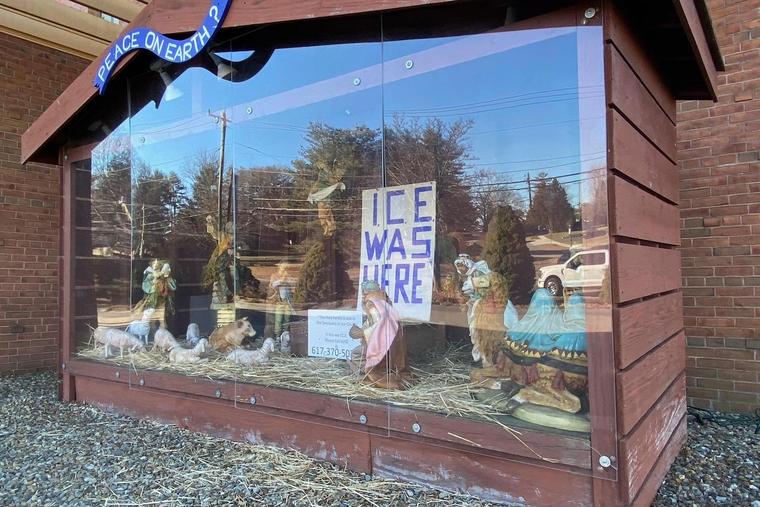
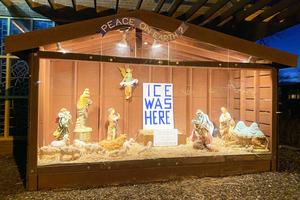
A week after the archbishop of Boston asked a pastor to remove an anti-immigration-enforcement display from a Nativity scene outside his church, it remained up as of Friday, with no word on what happens next.
Meanwhile, two Protestant churches in northern Illinois have erected Nativity scenes with comparable anti-immigration-enforcement messages, The Associated Press reported.
In Massachusetts, a sign above a manger outside St. Susanna Church in Dedham reads, “ICE was here,” while another sign says figures depicting Jesus, Mary and Joseph are “safe in the Sanctuary of our Church.” A spokesman for Boston Archbishop Richard Henning told the Register on Friday that the archdiocese has no update on the situation. The pastor, Father Stephen Josoma, did not respond to a request for an interview.
The display went up Nov. 29, the day Advent began liturgically. Six days later, on Dec. 5, a spokesman for Archbishop Henning called for the display to be removed, describing it as “divisive political messaging” and saying, “The Church’s norms prohibit the use of sacred objects for any purpose other than the devotion of God’s people.”
Three days after that, on Dec. 8, Father Josoma announced after a parish council meeting that the display would remain, and he asked publicly for a meeting with the archbishop.
The pastor also rejected the archdiocese’s contention that the parish’s display is a cause of divisiveness.
“Any divisiveness is a reflection of our polarized society, much of which originates with the changing, unjust policies and laws of the current United States administration, not emanating from a Nativity display outside of a church in Dedham,” Father Josoma said during a press conference Monday. “It’s a prophetic reflection that challenges the faithful to find new paths to bring the Good News announced at that first Christmas to all of God’s people.”
The archdiocese has had no comment since Father Josoma made the statement four days ago.
C.J. Doyle, executive director of the Catholic Action League of Massachusetts, described Father Josoma’s statement as “defiance” and said that the pastor “compounded sacrilege with scandal,” which the Catholic Church defines as “an attitude or behavior which leads another to do evil.”
“Archbishop Henning should quickly disabuse Father Josoma of the misconception that priestly obedience entails a negotiation between a pastor and his bishop,” Doyle said in a written statement.
A canon-law expert told the Register that Archbishop Henning is within his rights to order the display to be removed and that there are several courses of action the archbishop could take against Father Josoma, if he chooses.
“The pastor could face censure, ranging from a formal rebuke to public penance, the prohibition of specific duties, suspension from the office of pastor, or even the initiation of proceedings to deprive the pastor of his office permanently,” said David Long, assistant professor of canon law at The Catholic University of America in Washington, D.C., and dean of the university’s School of Professional Studies, by email. “Of course, suspension and deprivation are extreme penalties in a matter such as this, but theoretically, they could be used as a threat to change behavior.”
Father Josoma said during Sunday Mass on Dec. 7 that he has received a letter from the archbishop asking for the display to be removed.
“The pastor now has a ‘suitable time’ to remedy the scandal (Canon 1347 §1), but the precise amount of ‘suitable time’ is left to the archbishop’s discretion,” Long told the Register.
Nativity scenes, also known as crèches, at Catholic churches typically go up around the beginning of Advent without a figure of the Baby Jesus, which is usually added on Christmas Eve. They are typically removed around the Solemnity of the Epiphany, which in Latin Rite dioceses in the United States is celebrated Sunday, Jan. 4, unless a congregation is using a pre-1970 liturgical calendar.
That means there’s a coming natural end to the dispute in about three weeks if the two sides don’t resolve it before then.
According to canon law, once an “offending action” at a parish stops, the pastor “would no longer face censure for this offense.”
“Therefore, if the pastor refuses to change the display, any action by the archbishop would need to happen relatively quickly before the display would come down ‘on its own’ as directed by the liturgical calendar, presumably after the feast of the Epiphany,” Long said.
The Nativity display at St. Susanna’s has drawn many reporters and onlookers during the past two weeks.
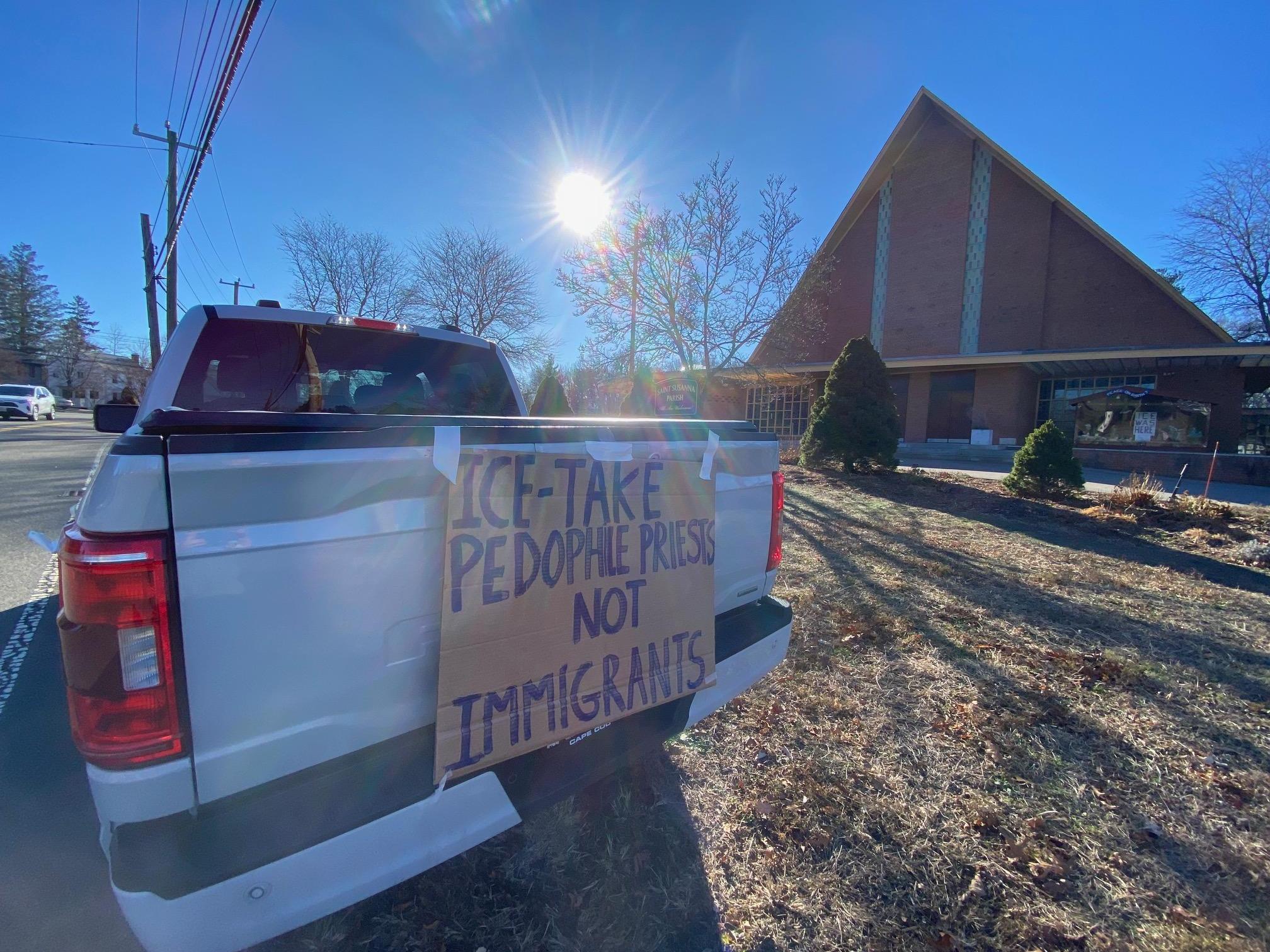
On Friday morning, a lone protester parked a white pickup truck near the church with a sign suggesting that immigration authorities should deport clergy sex abusers instead of illegal immigrants.
In Illinois, meanwhile, Lake Street Church, an American Baptist congregation in Evanston, has a doll representing Baby Jesus with zip ties on its hands, a figure of Mary wearing a gas mask, and figures of Roman soldiers identified as U.S. Immigration and Customs Enforcement officers, the AP reported on Friday. Urban Village Church, a United Methodist church in Chicago, has a sign saying that “the Holy Family is in hiding,” according to the AP.
- Keywords:
- nativity scenes
- immigration crisis