St. Margaret Clitherow: A Good Friday Martyr for the Catholic Faith
On Good Friday 1586, the young English wife and mother chose fidelity to Christ and his Church over her life, sealing her witness in suffering and prayer.
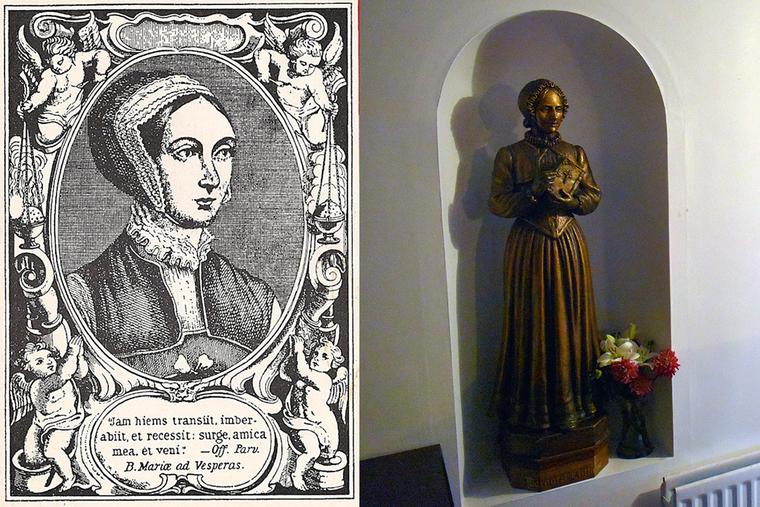
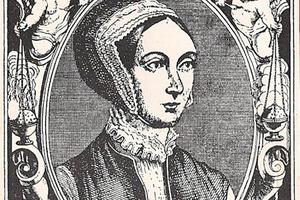
On March 15, 1586, 28-year-old Margaret Clitherow, a convert to the Catholic Church during the reign of Queen Elizabeth I, stood smiling before the hateful stares and uproar in the assizes court of York, England.
After a two-day trial, the judge had failed to break her resolve not to plead to the charges against her, namely harboring Catholic priests, or, as the judge called them, “traitors to the Queen’s majesty and her laws,” and for hearing Mass, both considered acts of treason. For according to the Acts of Supremacy and Uniformity, the Queen declared herself head of the Church, outlawed the Catholic Church, nullified papal authority, and required mandatory attendance at Protestant church services.
Margaret, however, remained of good cheer and refused to plead, saying, “I see no cause why I should do so in this matter. I never knew nor have harbored any such persons or maintained those which are not the Queen’s friends. God defend I should. I refer my cause only to God and your own consciences.”
Angry, the judge shifted uncomfortably as he heard the accused once again refer the matter to his own conscience. He called her a naughty, willful woman, then sentenced her by force of law to peine forte et dure (“hard and forceful punishment”).
The horrific details followed. “You must return from whence you came,” he said, his voice menacing, “and there, in the lowest part of the prison, be stripped naked, laid down, your back upon the ground, and as much weight laid upon you as you are able to bear, and so to continue three days without meat or drink, except a little barley bread and puddle water, and the third day to be pressed to death, your hands and feet tied to posts, and a sharp stone under your back.”
Margaret was executed on March 26, the date that year falling on Good Friday. This year marks the 440th anniversary of her martyrdom. A model of faith and courage for all time, she witnessed to the conviction of her conscience, saying one last time, “I am, according to the Queen Majesty’s laws, to die. Therefore, my desire is to die a member of the Catholic Church. My cause is God’s, and it is a great comfort to me to die in his quarrel.”
Indeed, following her conversion, God’s quarrel became the center of Margaret’s life as she followed the teaching of Jesus: “Whoever loves father or mother more than me is not worthy of me, and whoever loves son or daughter more than me is not worthy of me; and whoever does not take up his cross and follow after me is not worthy of me. Whoever finds his life will lose it, and whoever loses his life for my sake will find it” (Matthew 10:37-39).
Although she had been married as a Protestant, after her conversion, Margaret accepted the cross, walking a separate path from her husband, her mother, and stepfather, each of whom remained Protestant. For the sake of God’s cause, twice she was imprisoned for recusancy from Protestant church services, the second time while heavily pregnant, and bore the cross of misunderstanding, false rumors and accusations from opponents whom she never spoke ill of or failed in kindness.
At home she was faithful to her daily duties, helping her husband to manage their prosperous butcher shop and to raise their three children, and with great care raised her children in the Catholic faith and taught them how to pray.
We learn more about Margaret’s prayer life in A True Report on the Life and Martyrdom of Mrs. Margaret Clitherow by Father John Mush. Father Mush was Margaret’s spiritual director and one of the priests she provided shelter for in a secret chamber she had created in her home as well as in other locations near her home.
Father Mush began with a description of her personality. “She was of sharp and ready wit, with a rare discretion in all her actions.” Early each morning, he said, Margaret meditated on the Passion of Christ while kneeling in prayer in a private chamber she had created for herself.
Afterward, if not busy with necessary household duties, she attended Mass with other recusants, and strove the rest of the day, Father Mush said, “to keep her mind fixed on God.” Finally, in the afternoon, she returned to her chamber one more time for evening song, and there, upon her knees, she would “shake off the world, praying one hour with her children about her.”
This lovely ritual, however, was disrupted on March 10, 1586, when, after first luring Margaret’s husband away for a meeting with the Council of York, the sheriff and his assistants arrived at the Clitherows’ home and burst in upon Margaret, her children and other children there at the time, and began scouring the premises in search of priests.
Although the priests managed to escape through a secret passage, the intruders discovered vessels and vestments used for Mass. That was enough evidence for the sheriff to prove Margaret’s guilt. At that moment, then, her road to Calvary began as she and her children, along with the other children, were arrested and paraded through the streets in a public display of mockery. In prison, Margaret was allowed a final visit with her husband before her execution, but she would never see her children again.
She spent her final days praying and fasting within the filthy confines fraught with foul odors, rodents and insects. She performed acts of charity, sharing her rations of food with other prisoners, and offering words of hope. Still, her heart was broken, and like Jesus in his Passion, she underwent her own “agony in the garden.”
Father Mush recounts her inner struggle as reported to him by a fellow prisoner to whom Margaret said, “The Sheriffs have told me that I shall die on Friday next and now I feel the frailty of mine own flesh, which trembleth at the news. Therefore, for God’s sake pray for me and desire all good folks to do the same.” Overcome with grief, she then knelt and prayed for a long while, and afterward rose to her feet in peace, Father Mush reported, “the fear and horror of death having departed her.”
Before her execution, Margaret was allowed final arrangements. To her husband, she gave her hat, a bonnet-like head covering that all married women wore during that era as a sign of their loving duty to their husband. To Anne, her 12-year-old daughter, Margaret bequeathed her shoes, which Anne understood was a sign from her mother to follow her example and remain faithful to the Catholic Church. In fact, all three of Margaret’s children remained faithful. Henry, her oldest and only son, was ordained a Catholic priest, and both of Margaret’s daughters entered the religious life.
As we prepare to celebrate Easter, perhaps a wonderful way to celebrate the life of St. Margaret Clitherow is to seek the help of her prayers. As Father Mush wrote, asking her intercession, “May I honor God by imitation of thy happy life, and by my death, which he will give me, to be partaker with thee and all holy saints of his kingdom, to whom be all glory and honour, now and forever. Amen.”
- Keywords:
- st. margaret clitherow
- english martyrs
- 127 spanish civil war martyrs
- cardinal corti good friday