The Cross Demands an Answer: Where Do You Stand?
COMMENTARY: During Holy Week, the Passion confronts each of us with a question no one can evade: Will we stand with Christ at the Cross — or turn away from its costly love?
Unless a sudden attack of amnesia stripped away your memory, leaving no recollection of where you are in time or space, the next few days will certainly prove to be the most solemn and consequential week in the entire history of the world. Everything changes because of the memories we recall during Holy Week.
Even if the world fails to notice — either because there are so many who still haven’t heard the Good News, or others who, having heard it so often, no longer find it newsworthy — the story remains true and deserves retelling.
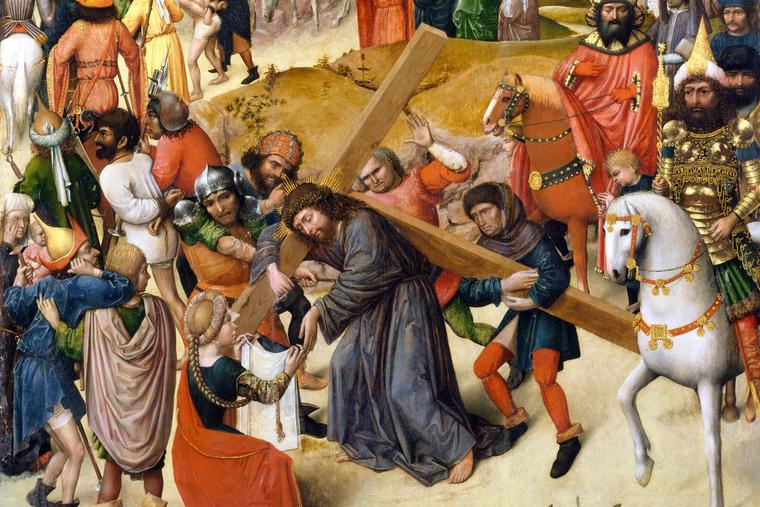
Now it is not any sort of discourse or idea that we should be thinking about this week, but rather a series of events positively horizon-shattering, into which we are being asked to enter so that, in walking with Christ along the way of his Passion, we may go with him all the way to the Cross. Nothing less than full conformity to the shape and the texture of the wood on which the Son of God was nailed, for our salvation and the world’s, will do.
So, where exactly do we stand in relation to all that? From what precise angle are we to view the Death of God? And make no mistake about it — it is the Crucified God whom we see hanging before us in mortal agony. And there in the acutest possible agony he shall remain, as Pascal reminds us, “until the very end of the world. There must be no sleeping during that time.”
And why not, if we are the ones, after all, who put him there? By our sins we conspired to kill God. There is enough guilt to go around to implicate the entire human race; we needn’t scapegoat anyone besides ourselves. We are what’s wrong with the world. That indeed has long been considered the most obvious and proximate cause of Our Lord’s suffering and death, i.e., the sheer weight of the world’s iniquity. In Adam’s fall, we sinned all. Why else would Christ suffer himself to be slowly tortured to death?
And yet human sin was never the ultimate or even the most decisive reason for Christ going up to Golgotha to suffer and die. We mustn’t take ourselves too seriously, as if it were only our sins that prompted Our Lord’s coming among us. The true catalyst has always been God’s love for the world, a love so madly consuming, by human reckoning, that it drove Christ toward that final extremity of pain and loss, which remains the deepest, the darkest mystery of all, namely, his Descent into Hell.
What wondrous love is this, O my soul, O my soul!
What wondrous love is this, O my soul
What wondrous love is this, that caused the Lord of bliss
To bear the dreadful curse for my soul, for my soul,
To bear the dreadful curse for my soul!
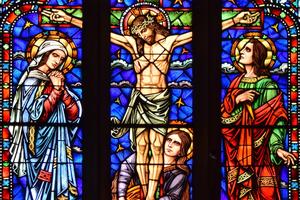
So, once again, the question needs to be asked: Where do we stand — where do I stand? — in relation to the Christ Event, the high point of which is the Cross and all the horrors that follow upon it? Do I stand squarely in front of the Cross with Mary, the Mother of God, and with John, his beloved disciple, resolutely determined to configure my life to its meaning? Annealed, as it were, in the hope that here is where salvation begins and ends, that nothing will ever tear me away from its life-giving witness, the sheer power of the Cross to redeem and transform the world?
Or do I stand in neurotic fear and flight from the Cross lest it make too heavy a demand upon my life, including, God forbid, that I might be asked to lose my life for his sake, for the sake of the Absolute Other? Surely that would be a bridge too far.
And yet, notwithstanding the world’s reluctance to embrace the Cross, indeed, its derisive dismissal of the entire Christian proposal of faith, there were those who from the beginning did not refuse the invitation, who in fact put on the armor of Christ and on the strength of his saving presence succeeded in overturning an entire pagan world. How can one explain an upheaval of such proportions? But, then, hadn’t Christ himself assured those early enthusiasts not to give way to despondency and despair, that despite all the odds against them, including the ferocity of an Empire bent on their destruction, they would finally prevail?
“Fear not,” he said, “for I have overcome the world.”
What was it that enabled those early Christians, not only to weather the storms then raging against them, but in fact to surmount every obstacle thrown in their way? What became the flashpoint of their complete conquest of the pagan gods? It was nothing less than their complete willingness to let go and to let God, to cling to Christ, without whom they could not have summoned the courage to become saints. Here is the alpha point on which everything in the Christian life depends, which is to say, the sheer mystery of God in Christ, who remains the point from whom and toward whom we are to live. And my encounter with him in the life of the Church changes everything.
“Here lies the secret of grace,” writes Romano Guardini in his magisterial work The Lord, “participation in the divine mystery; hence the impossibility of ‘analyzing’ any true Christian. All one can do is demonstrate from ever new points of departure how all attributes, all characteristics of Christ terminate in the incomprehensible, an incomprehensibility, however, of measureless promise.”
How many examples of Christian heroism are strewn about the pages of history, illustrating the point!
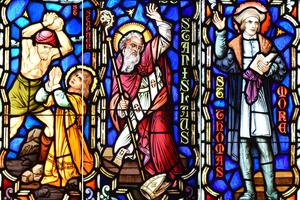
One in particular stands out. In Robert Bolt’s splendid play, A Man for All Seasons, we are taken to the Tower of London. It is the climactic scene of the play. And there we find Sir Thomas More under sentence of death for high treason.
He is entirely innocent, of course, but owing to the perjured testimony of Richard Rich, he stands condemned. To persuade him to submit to the king, acquiescing to a marriage the Church cannot and will not approve, Master Cromwell sends in his family to try and convince him. His daughter Meg appeals to her father to sign the oath so that he may come home to his family. “But in reason, Father! Haven’t you done as much as God can reasonably want?”
To which More answers, not as a father who loves his family, but as a Christian who must love God more: “Well, finally, it isn’t a matter of reason. Finally, it is a matter of love.”
It is the witness we must all try to make, especially during this high and holy week. This is where we are to stand in relation to the Christ Event.
- Keywords:
- holy week
- passion of christ
- cross of christ
- lent