Sixth Word from the Cross: Fulton Sheen and the Declaration of Dependence
Father, into thy hands I commend my spirit!
Editor’s note: Father Raymond J. de Souza recorded meditations on the Seven Last Words at St. Mary’s Cathedral in Ogdensburg, New York. They will air on EWTN on Good Friday at 1 p.m. (EDT). They will also be available at ewtn.com and EWTN+. The Register will publish those meditations through Good Friday.
* * * * *
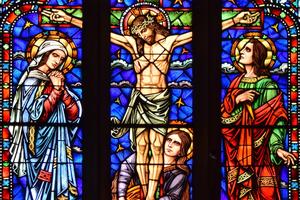
“It was now about the sixth hour, and there was darkness over the whole land until the ninth hour, while the sun’s light failed; and the curtain of the temple was torn in two. Then Jesus, crying with a loud voice, said, “Father, into thy hands I commend my spirit!” And having said this he breathed his last” (Luke 23:44-48).
Jesus commends himself into the Father’s hands. How could it be otherwise? He was sent into the world by the Father (John 3:16) and will return to the Father.
Jesus spoke of his crucifixion ahead of time: “So Jesus said, ‘When you have lifted up the Son of man, then you will know that I am he, and that I do nothing on my own authority but speak thus as the Father taught me. And he who sent me is with me; he has not left me alone, for I always do what is pleasing to him’” (John 8:28-29).
Does that sound like dependence upon the Father, or independence from him? To celebrate a “declaration of independence” is not easy for those who seek to follow Jesus.
St. Paul tells us that Jesus “emptied himself, taking the form of a servant, being born in the likeness of men. And being found in human form, he humbled himself and became obedient unto death, even death on a cross” (Philippians 2:7-8). Would such a man have signed a declaration of independence?
In 1941, Fulton Sheen published a book entitled A Declaration of Dependence. Sheen worried that a political document, such as the 1776 Declaration of Independence, might become a sort of American gospel, which it was not intended to be.
“Because God made us free, we have rights,” wrote Sheen. “Because God made us creatures, we have duties.”
We have rights against the state because we have duties to God. The Declaration speaks directly about the former and only implicitly about the latter. Nevertheless, the Declaration’s most famous sentence makes it clear that faith in a Creator is foundational for America:
We hold these truths to be self-evident, that all men are created equal, that they are endowed by their Creator with certain unalienable Rights, that among these are Life, Liberty and the pursuit of Happiness.
A self-evident truth is one that cannot be demonstrated unless certain premises are simply granted — or revealed by God, namely that all men are made in his image and likeness. Fulton Sheen clarified that in 1941:
Our Declaration of Independence affirms that liberty is an ‘unalienable’ right, because a gift of the Creator. In other words, it makes us independent of tyrannies and dictators by making a Declaration of Dependence on God. What, therefore, our ancestors in the Declaration of Independence called ‘self-evident’ was, in reality, a matter of faith and tradition. … Our Constitution puts politics under theology, democracy under God.
Sheen continues:
We are independent of dictators because we are dependent on God. God is the necessary factor of our salvation. As a result, he is to be the center of our lives. His ways ought to permeate every aspect and area of our lives: education, employment, pleasure, mourning, socializing, etc. All is done in sight of the omnipotent Lord, and all we do should be done reflecting this knowledge. Our every interaction should be filled with the love of our Savior.
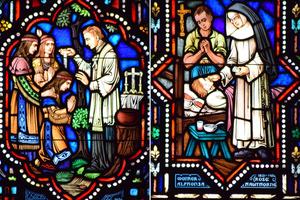
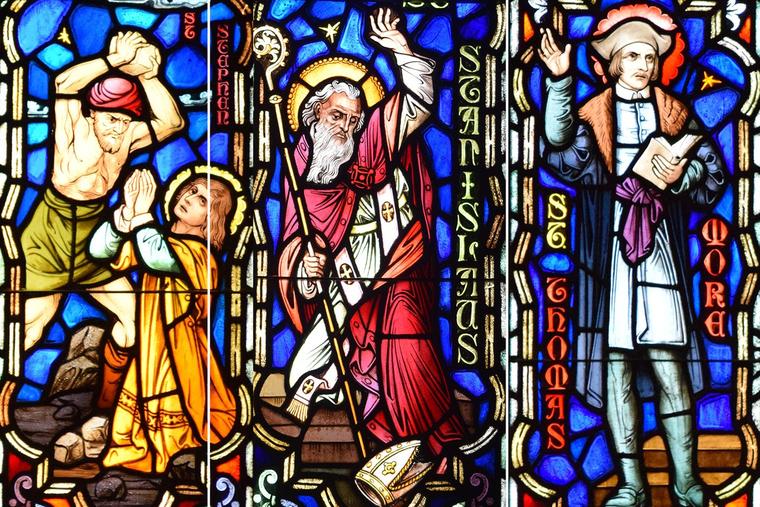
We claim rights against tyrants, insist on our duties against the directives of dictators. The martyrs in these windows here teach us that, long before 1776, from St. Stephen in the apostolic age, to St. Stanislaus in Kraków in 1079 to St. Thomas More in London in 1535.
Everything thus belongs in the hands of the Father, as Jesus commended his Spirit on the Cross.
“Father, into your hands, I commend my spirit.”
Venerable Fulton Sheen, pray for us!
“We adore Thee, O Christ, and we praise Thee, because by Thy holy cross Thou hast redeemed the world.”
- Keywords:
- seven last words
- holy week