Looking to the East for Liturgical Peace
EDITORIAL: The Diocese of Duluth’s ‘ad orientem’ liturgical trial could serve as a guidepost for alleviating the tensions in the Church regarding celebration of the Mass in Latin.
Many Catholics who have been personally impacted, or deeply unsettled, by the “liturgy wars” dividing our Church are understandably disappointed that liturgical matters were not, in the end, discussed during Pope Leo XIV’s now-concluded meeting with the College of Cardinals in Rome.
Liturgy had been one of four announced agenda items for the Holy Father’s first extraordinary consistory since his election in May. That plan, however, proved too ambitious for a gathering that lasted only a day and a half, and the cardinals were asked to pare down the schedule to focus on just two topics. They chose synodality and evangelization, leaving liturgy and church governance for the Pope’s next consistory, scheduled to take place in June.
We hope and pray that the cardinals do get a chance later this year to consult with the Holy Father on the liturgy, an issue that has preoccupied many Catholics for decades, most intensely so in the four years since Pope Francis imposed sweeping restrictions on the traditional liturgy in his motu proprio Traditiones Custodes. In the meantime, they might look for what’s taking place in the Diocese of Duluth, Minnesota, for insights about how to achieve greater liturgical harmony.
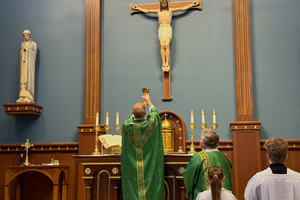
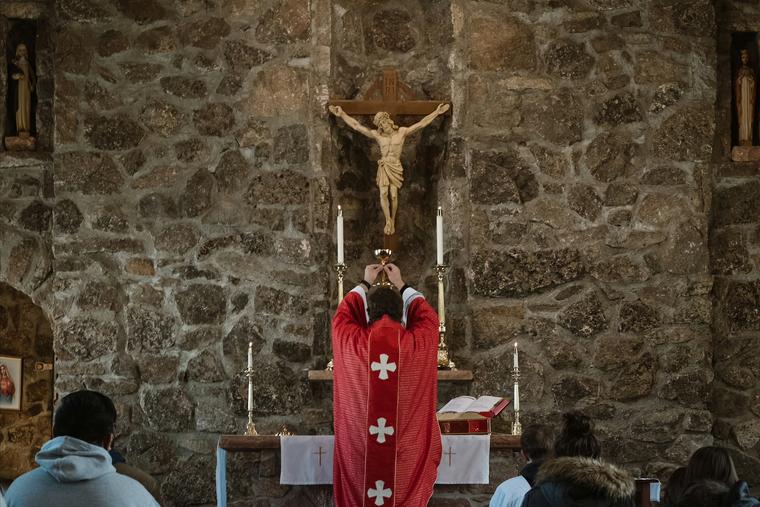
There, for the last year, Bishop Daniel Felton has authorized regular celebration of the Mass ad orientem on a trial basis.
Ad orientem (literally, “to the east”) refers to the priest primarily celebrating the Mass facing in the same direction as the lay faithful gathered in the pews, as opposed to the more common practice since the Second Vatican Council of the priest facing versus populum, “toward the people.”
As Bishop Felton noted to his diocesan priests in an instruction he circulated ahead of the start of the trial, proponents of versus populum cite the enhanced participation of the laity that they believe it facilitates. Ad orientem proponents, for their part, cite the greater sense of transcendence that they believe results from this liturgical orientation.
Bishop Felton believes both groups make valid points. So, rather than an “either/or” decree favoring only one side, his trial has instituted a “both/and” approach at nine parishes that mandates Masses be celebrated regularly according to both practices. The final verdict isn’t in yet, but feedback to date has been highly favorable, both from priests and parishioners.
The ad orientem discussion touches only partially on the broader and more complex controversy surrounding the Latin Mass issue, since the traditional liturgy is always celebrated in this manner. Even so, Bishop Felton’s underlying approach, of consulting meaningfully with local Catholics on both sides of a substantive liturgical debate and collaborating with them to craft an outcome that constructively addresses the concerns of all, would surely serve well in the Latin Mass context, too.
And it stands in sharp contrast to the hardline stance toward traditional liturgical practices we see playing out in the Archdiocese of Detroit and the Diocese of Charlotte, North Carolina, among other places. Indeed, the approach taken to date by Charlotte Bishop Michael Martin, which reportedly has prompted an extraordinary appeal for guidance and clarity signed by roughly a quarter of the diocese’s priests, offers a case study on how not to handle liturgical disharmony.
Exactly where Leo stands on the celebration of the Latin Mass remains to be seen, but it’s already clear that the Holy Father regards the liturgy as crucially important. In his Nov. 9 homily for the Solemnity of the Dedication of the Lateran Cathedral, for example, the Holy Father described it as “the summit toward which the activity of the Church is directed ... the source from which all its power flows.” And he emphasized the need to celebrate the liturgy with particular care within his own Diocese of Rome, in order that the See of Peter “can serve as an example for the whole people of God.”
Cardinal Gerhard Müller, prefect emeritus of the Congregation for the Doctrine of the Faith, for one, feels confident that the Holy Father will guide the Church prudently on this issue, telling EWTN’s Raymond Arroyo, “I think Pope Leo will come up with a good solution for everybody.”
What a blessing that would be for our Church. It’s important that we continue to pray for the Pope and support him as he discerns the best path forward.
- Keywords:
- ad orientem