Let the Little Sisters of the Poor Be Faithful
COMMENTARY: At stake is more than health coverage — the Little Sisters’ case highlights a broader battle over conscience rights and the limits of government power.

In the 1968 encyclical Humanae Vitae, Pope Paul VI reaffirmed the Catholic Church’s teaching “that each and every marital act must of necessity retain its intrinsic relationship to the procreation of human life.” He further declared:
This particular doctrine … is based on the inseparable connection, established by God, which man on his own initiative may not break, between the unitive significance and the procreative significance which are both inherent to the marriage act.
While much maligned when first issued, Humanae Vitae is understood by some to have aged extraordinarily well. But even if it has proven to be nothing short of prophetic in important ways over the past half-century, the vast majority of Americans in 2025 don’t accept its instruction. In part, that’s because most of our neighbors embrace the principle of individual autonomy as their moral baseline for human sexuality. This means that they find this aspect of the Catholic Church’s teaching to be somewhere between mystifying and dangerous.
Even for many Protestant Christians, questions of artificial contraception are placed within the realm of prudential judgment when considered within the bond of marriage, though they tend to join their Catholic brethren in condemning contraceptives that may act as abortifacients.
In terms of law and policy, the federal government has, since 2011, mandated private employers, including religious organizations, to provide contraceptives in their health insurance plans based on ambiguous statutory language in the Affordable Care Act (2010).
In sum, Catholic teaching condemning artificial contraception is widely rejected in American culture and law.
What, then, is to be done about Catholic institutions devoted to remaining true to the Church’s teachings in ways that put them at odds with much of the rest of American society? How much protection should be afforded to those holding convictions that make little sense to most of the country?
These critical questions are at the heart of religious freedom. And the short answer is that while religious freedom is not an absolute right, any just society will maintain a strong presumption in its favor on behalf of all of its citizens, and their institutions, especially those holding minority views.
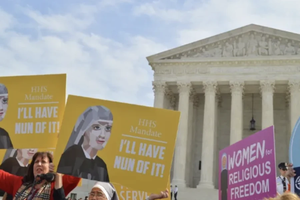
Enter the Little Sisters of the Poor, whose mission “is to offer the neediest elderly of every race and religion a home where they will be welcomed as Christ, cared for as family and accompanied with dignity until God calls them to himself.” And they seek to fulfill this mission in a manner consistent with the teachings of the Catholic Church, including the part about upholding the “inseparable connection” between “the unitive significance and the procreative significance” of sexual intimacy. In other words, they understand contraception to be immoral and do not want to be implicated in distributing the means of practicing it through their employee health plans, which cover many lay medical, administrative and other professional staff working for the Little Sisters. To do otherwise would force them to make the unconscionable choice of violating the very Catholic identity that grounds their religious life and service.
Yet that is exactly what the Little Sisters were mandated to do by the U.S. Department of Health and Human Services’ (HHS) contraceptive mandate, promulgated in 2011 during the Obama administration. Even the purported 2013 accommodation offered to religious objectors still required the filing of a “self-certification” that would trigger their health insurance provider to cover their employees’ contraceptives directly. Which meant that objectors like the Little Sisters still had to participate in a system — and act to set in motion a process — that they wanted nothing to do with.
Driven by conviction, the Little Sisters refused to comply with the mandate or participate in the accommodation, and instead pursued legal relief. Their first round of court battles began in 2013. By 2016, their case made it to the U.S. Supreme Court, which sided with the Little Sisters in a unanimous decision that vacated the lower court judgments against them and remanded the case to the appropriate federal appellate court. The justices did not make a decision on the merits of the case, however, particularly the Little Sisters’ claims under the Religious Freedom Restoration Act (RFRA).
In 2018, HHS, now under the first Trump administration, issued a rule with a religious exemption consistent with the provisions in RFRA that protected the Little Sisters and other faith-based organizations from the contraceptive mandate. On the same day, HHS issued a second rule establishing a similar moral exemption. These regulations should have resolved the matter.
Unfortunately, Pennsylvania, New Jersey and other states sued the Trump administration to rescind the exemptions, alleging that the new rules violated the Administrative Procedure Act (APA) and improperly applied RFRA. Finding themselves again in legal jeopardy, the Little Sisters appealed their case to the Supreme Court, which in July of 2020 held in their favor again by affirming the Trump administration’s exemptions and refuting the APA and RFRA-based challenges the states put forth.
At that point, the Little Sisters had been dragged through the courts for more than seven years, but 2020 did not mark the end of their tale of legal woe, thanks to a decision last week by Judge Wendy Beetlestone of the Eastern District of Pennsylvania.
As religious freedom expert Andrea Picciotti-Bayer recently wrote, Judge Beetlestone struck down the rules providing a legal refuge to the Little Sisters, “finding them ‘arbitrary and capricious’ under the [APA]” and “not the product of ‘reasoned decisionmaking,’ blindly following the suggestion to do so in Justice Elena Kagan’s concurring opinion [in the 2020 ruling].” Picciotti-Bayer contends that Judge Beetlestone should have adopted the reasoning in Justice Samuel Alito’s concurring opinion where he argued that, far from impeding a religious exemption, RFRA actually “compels an exemption for the Little Sisters…” (19)
Much more can be said about last week’s decision, which Picciotti-Bayer ably does, but for now we’ll note only that if the decision is not reversed on appeal, the Little Sisters will again face the very ultimatum — obey government or obey God — that ignited this whole shameful episode.
A society committed to upholding religious freedom must work creatively and resolutely to avoid imposing such an ultimatum whenever possible. The surest way to achieve that outcome here would have been for Pennsylvania not to have challenged HHS’s religious and moral exemptions in federal court in the first place, and, more fundamentally, for HHS not to have issued a rule pushing access to contraceptives by compelling private employers to provide them in their health plans nearly 15 years ago. Tragically, the federal and state leaders who made these decisions have shown, and continue to show, a casual disregard for religious freedom and an ideological zeal for enforcing radical sexual autonomy. And the Little Sisters have paid the price, over and over again.
Many Americans undoubtedly look with suspicion and even contempt on the Catholic convictions surrounding artificial contraception that the Little Sisters of the Poor receive as true and binding. But it is precisely in such circumstances that religious freedom is intended to provide its most robust protections. No more ultimatums. Leave them alone and let them serve.
David K. Trimble is the president of the Religious Freedom Institute. Nathan A. Berkeley is associate vice president for U.S. Strategies, Religious Freedom Institute.