The Catholic Chapel Beneath Dodger Stadium
Before Dodger Stadium rose over Chávez Ravine in Los Angeles, a tight-knit Catholic community centered on a humble chapel — a way of life displaced, but not entirely forgotten.
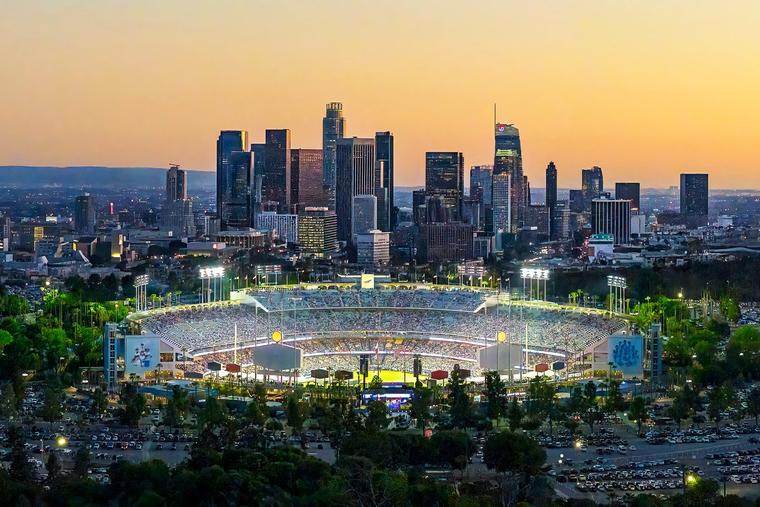
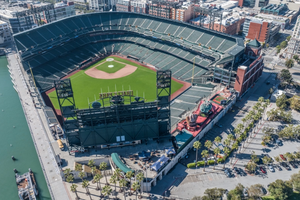
For tonight’s home opener, the lights will once again illuminate Dodger Stadium. The fans will no doubt welcome the defending World Champions with an ovation that will demonstrate that in a city saturated with sports, the Dodgers remain L.A.’s favorite team. Generations pass the game down as an inheritance. Scorecards are kept like family records. Los Angeles summer evenings are measured in innings.
Baseball, more than any American institution, understands memory. It proudly keeps its past close. And yet, beneath this field — beneath the cheers, the rhythm of the game, the perfectly aligned park dimensions — there was once another kind of inheritance.
Not long ago, Chávez Ravine was not a stadium but a collection of villages: Palo Verde, La Loma, Bishop. It was, as one observer would later recall, something closer to a world apart.
On his first day at the nearby police academy in 1946, officer and author Gary Wean remembered turning into the ravine and encountering something wholly unexpected:
The street wound into a narrow, shady canyon. Suddenly I had a totally unexpected surprise, for an instant I thought I was somehow whisked to a tiny village in Old Mexico … slowing to five miles an hour, I drove through Chávez Ravine. Time had stood still here, women in colorful dresses walked along the road with wicker baskets on their heads. Small children playing happily darted among goats, chickens and dogs flocking the dusty, twisting road leading through the village. Chávez Ravine was mercifully hidden and protected from the frantic, raging city of L.A., surging around it only a few blocks distant.
And at the center of that life was something even more enduring.
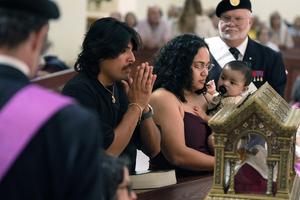
In the homes of Chávez Ravine, the Christ Child — El Santo Niño — was not an abstraction. He was present — in small domestic shrines, in candles lit at dusk, in the quiet devotions of families who marked time not by contracts or construction schedules, but by feast days and fasts. Indeed, it was also the name of the Catholic chapel in the Palo Verde section.
Nearby stood Mission San Conrado — a place that remains today, offering Mass in Spanish and serving as the liturgical anchor of the community through baptisms, marriages, funerals, and the slow sanctification of ordinary life. The calendar here was not simply civic, but particularly liturgical, where the year unfolded in sacred time.
The language that came for Chávez Ravine in the early 1950s was the language of progress, of public interest, of efficiency. Residents were told their land would make way for modern public housing. And many sold, trusting the promise of what would follow.
What followed did not come.
Public housing plans were abandoned. The land, cleared in anticipation of one future, was redirected toward another. By the end of the decade, the hills had been cut and leveled. Families who remained were removed — some peacefully, others by force, in scenes that would briefly flicker across television screens before fading from public memory.
Wean would later describe what he foresaw in stark terms:
Soon giant caterpillars would gouge the earth … Chávez Ravine would be filled, then leveled with the excess dirt. On the large flat area, Dodger Stadium would be built. A strange monument, a multi-million dollar cement and steel headstone marking the grave of Chávez Ravine.
But this is not a condemnation against baseball. As demonstrated, it absorbs memory and patience, and waits for the marathon of the season to become a sprint to October.
Which makes Chávez Ravine all the more striking.
For here is a place where one kind of memory — carefully tended, passed down in homes and at a humble chapel — gave way to another, more visible, more celebrated, but built upon ground whose earlier story is rarely told.
Even now, that story has not entirely settled into the past. In 2024, California lawmakers introduced a bill to study reparations for the families displaced from Chávez Ravine — to reckon, in some measure, with land taken and lives uprooted. The proposal would have created a task force, a formal accounting, perhaps even a path toward restitution.
It did not pass.
And so the question remains where it has long been: acknowledged, but unresolved; remembered, but not fully accounted for.
This week, as Holy Week begins and the Church once again enters into the memory of loss and redemption, the timing is difficult to ignore. The Christian tradition does not move past suffering by forgetting it. It returns to it — year after year — in solemn contemplation.
Tonight, the crowd will rise again. The first pitch will be thrown. The game will unfold as it always has — ordered, deliberate, faithful to its own rhythms. It is not wrong to rejoice in that.
But it is worth remembering that before the first pitch, there was another order of life here — quieter, humbler, but no less real. A people who marked time not in innings, but in feast days. Who built not for a season, but for generations.
A society is not only defined by what it builds, but by what it chooses to remember.
- Keywords:
- major league baseball
- baseball
- los angeles
- la dodgers