Returning to the Moon, Returning to God
COMMENTARY: NASA’s Artemis program reignites enthusiasm for space exploration and faith.
As Dante enters the first celestial sphere in the Paradiso, he asks Beatrice about the dark spots on the moon.
“If the opinion mortals hold falls into error when the senses’ key cannot unlock the truth,” she replies, “you should not be struck by the arrows of amazement once you recognize that reason, even when supported by the senses, has short wings” (Canto 2).
Thanks to the Apollo missions of the late ’60s and early ’70s, the wings of reason — and indeed the sense data supporting them — have been drastically extended since Dante Alighieri wrote the Divine Comedy in the 14th century. And yet those wings were suddenly clipped after Apollo 17 splashed down, for humans have not returned to the moon since Gene Cernan and Harrison Schmitt left their footprints in the Taurus-Littrow Valley in December 1972.
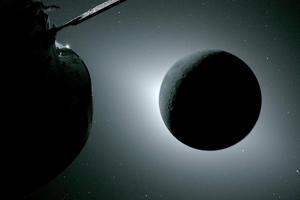
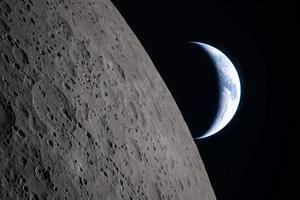
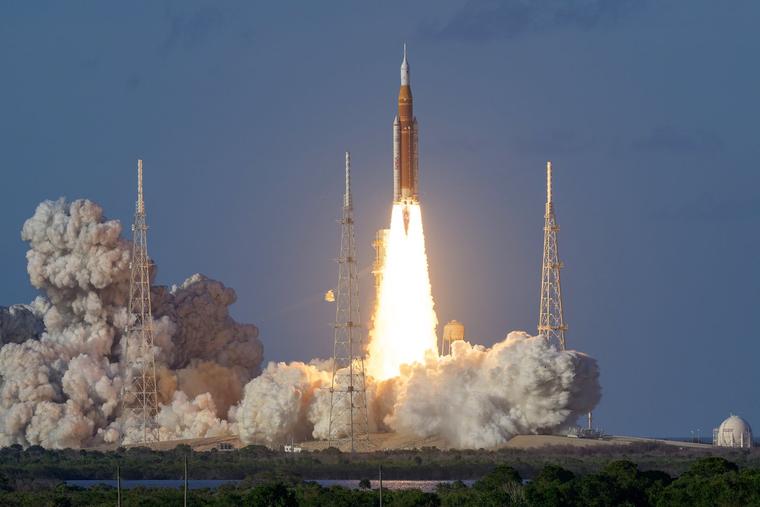
All of that is about to change. NASA’s Space Launch System (SLS) thundered into the Florida skies yesterday evening with four crew members aboard. None of them will descend to the lunar surface this time, but they will execute key tests to pave the way for Artemis IV to touch down in 2028.
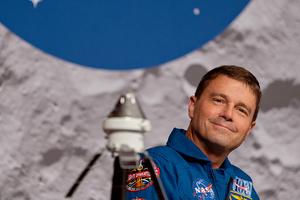
On board the Orion crew module are the first woman to travel beyond low Earth orbit (Christina Koch), as well as the first person of color (Victor Glover) and the first Canadian (Jeremy Hansen) to participate in a lunar mission. They are accompanied by Commander Reid Wiseman, who will soon be the oldest person to visit the lunar environment.
Wiseman’s impressive CV includes flying Navy fighters and commanding the International Space Station, but he “considers his time as an only parent as his greatest challenge and the most rewarding phase of his life.” Wiseman has raised his two daughters, Ellie and Katherine, on his own after losing his wife, Carroll, to cancer in 2020. Carroll herself was no less a hero for saving the lives of newborns as a registered nurse in an intensive care unit.
I suspect Wiseman has no less respect for the fragility of life than his wife did. He and his three comrades know perfectly well the risk their mission entails. They have prepared for it, talked to their families about it, and accepted it as a sacrifice worth offering to expand the horizons of human knowledge.
Before boarding the Orion capsule, Wiseman embraced his two teenage daughters, who are equally aware of the mission’s dangers. Wiseman expresses pride in their understanding of “the value of human exploration, human ingenuity,” and “that drive of humanity to go see what is on the other side of that mountain, to go see things that no human has ever seen before.”
I have no reason to doubt that Commander Wiseman confronts that risk with his Christian faith, a faith he shares with pilot Victor Glover, who brought a Bible and items for personal worship to the International Space Station (ISS) in 2020. After seeing his astonishing sunrise photos in 2021, no one can pray Psalm 30 in the same way again. Glover tweeted with the images: “Weeping may endure for a night, but joy cometh in the morning” (6).
Sacred Scripture was no less fitting for man’s first journey to the moon in 1968.
Apollo 8 crew members William Anders, Jim Lovell, and Frank Borman took turns reciting from the Book of Genesis in a Christmas Eve broadcast to Earth: “In the beginning, God created the heaven and the Earth,” came the crackled voice of Anders. The astronauts later explained that, try as they might, they could not come up with better words to express the awe of gazing at our celestial neighbor from such a close distance.
Buzz Aldrin, who, after Neil Armstrong, was the second to step on the moon in 1969, brought along a small container and vial with bread and wine for a private prayer service as an elder of the Presbyterian Church.
“I am the vine, you are the branches,” he read from John 15:5. “Whoever remains in me, and I in him, will bear much fruit; for you can do nothing without me.”
As much as the Artemis mission now underway reminds us of the power of human ingenuity and invention, it no less heightens the perception of our dependence on God. The moon is no less inhospitable now than it was 50 years ago. Our ability to express God’s unfathomable power to fashion the universe will never surpass the words of Genesis 1, and our inability to do anything without him is no more eloquently expressed than in John 15.
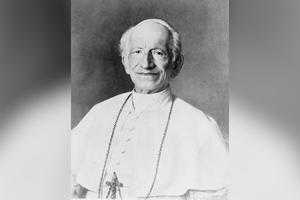
God willing, Artemis IV will reach the moon’s surface in 2028. When it does, I imagine Pope Leo XIV will be as transfixed by the television as his saintly predecessor in 1969. Paul VI sent a handwritten note to the Apollo 11 crew that sits undisturbed on the historic landing site:
When I see your heavens, the work of your fingers, the moon and stars that you set in place — What is man that you are mindful of him, and a son of man that you care for him? Yet you have made him little less than a god, crowned him with glory and honor. You have given him rule over the works of your hands, put all things at his feet … how awesome is your name through all the earth!” (Psalm 8).
NASA is returning to the moon for several reasons: to get there before China, to establish a staging area for future missions to Mars, to look for water and other resources necessary for such a mission, and to discover further secrets our natural satellite can reveal about the planet we live on.
But as Wiseman, Glover, Aldrin and the deceased members of the Apollo 8 crew would tell you, it’s also to humble ourselves and praise our God.
Maximus the Confessor, who expounded the cosmic dimension of the sacred liturgy better than anyone, noted that “only wonder can comprehend his incomprehensible power.”
In a world bent on replacing his power with our own, perhaps wonder alone will ultimately hold the remedy for restoring our faith in the One who created us and the One for whom we — and the entire universe — were created.
- Keywords:
- space exploration
- artemis
- nasa
- moon
- awe