A Time to Look to the Heavens
EDITORIAL: The awe-inspiring Artemis II moon mission comes at a providential time for humanity.
There are no mere accidents in this life, so it’s clearly providential that the Artemis II moon mission has taken place at such a fraught moment in human history.
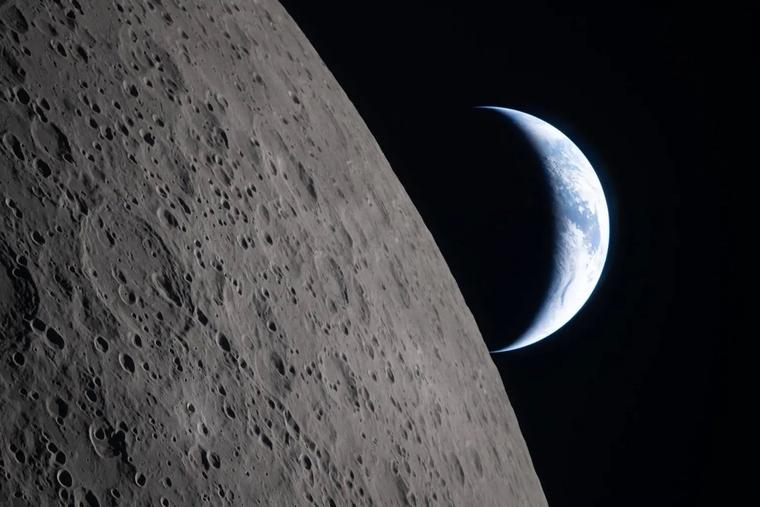
Down here on Earth, the war in Iran has commanded our attention. Yet up in the sky, something uplifting and even more commanding has unfolded right before us. The breathtaking images of the moon and the Earth, and the Artemis crew’s faith-centered comments, have drawn our gaze heavenward in contemplation of God’s glory and the goodness of the universe he has created for us.
Perhaps most providentially of all, the space mission — whose central objective was a traverse around the far side of the moon, during which the four Artemis astronauts ventured farther from their home planet than any other persons in history — took place at Easter. The joy Catholics and other Christians shared at witnessing this stellar human achievement was consequently combined with our rejoicing in the resurrection of Jesus, the central event in salvation history.
Artemis II pilot Victor Glover took note of this juxtaposition in a compelling Easter message that highlighted the beauty of creation. And on Easter Monday, Glover held up Jesus’ teaching to an attentive world audience.
“As we get close to the nearest point to the moon and the farthest point from Earth, as we continue to unlock the mysteries of the cosmos, I would like to remind you of one of the most important mysteries there on Earth, and that’s love,” he said in the live feed from the Orion capsule.
“Christ said, in response to what was the greatest command, that it was to love God with all you are. And he also, being a great teacher, said the second is equal to it. And that is to love your neighbor as yourself.”
In many intriguing ways, the Artemis II mission parallels the 1968 Apollo 8 mission. Both missions were lunar flybys, undertaken to test the capacity of their respective spaceships to land humans on the moon itself in subsequent missions and return them safely home afterward. Like Artemis II, Apollo 8 took place in conjunction with a Christian holy day — except that it was at Christmas that time. And like Glover, Apollo 8 astronauts Bill Anders, Jim Lovell and Frank Borman marked the religious occasion from the depths of outer space through an eloquent Christmas Eve message, during which they recited the first 10 verses from the Book of Genesis.
Christmas 1968, just like Easter 2026, was a time of significant turmoil for the United States. But as a recent commentary in Crisis magazine noted, in both cases, these moon missions have served as powerful reminders of what humanity can accomplish when we dedicate ourselves in support of a higher and more noble objective.
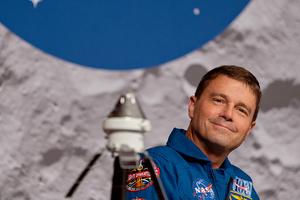
Decades after his own Apollo 8 mission and shortly before he died last year, Apollo veteran Lovell recorded a message that was played to Glover and the three other Artemis II astronauts — Christina Koch, Jeremy Hansen and commander Reid Wiseman, whose late wife was honored movingly with the naming of the “Carroll” crater during the mission — as they made their closest approach to the moon on April 6, welcoming them “to my old neighborhood.”
“When Frank Borman and Bill Anders and I orbited the moon on Apollo 8, we got humanity’s first up-close look at the moon and got a view of the home planet that inspired and united people around the world,” Lovell said.
“I’m proud to pass that torch on to you as you swing around the moon and lay the groundwork for missions to Mars for the benefit of all. It’s a historic day, and I know how busy it will be, but don’t forget to enjoy the view.”
This moon mission has indeed been an Easter torch, one that has brightened the hearts and minds of the entire planet. Thanks from all of us, and Godspeed, Artemis II!