The Seven Last Words and America’s 250th
INTRODUCTION: Two hundred and fifty years is significant in the life of a nation.

Editor’s note: Father Raymond J. de Souza recorded meditations on the Seven Last Words at St. Mary’s Cathedral in Ogdensburg, New York. They will air on EWTN on Good Friday at 1:00 p.m. (EDT). It will also be available at ewtn.com and EWTN+. Throughout Holy Week, those meditations will be published at the National Catholic Register site.
Many consider Archbishop Fulton Sheen to be the greatest preacher in American Catholic history. He marked every Good Friday for 58 years by preaching on the Seven Last Words, the seven times that the Lord Jesus speaks from the cross. On Sept. 24, when Archbishop Sheen will be beatified in St. Louis, he will be a new American blessed in the very year in which Americans celebrate the 250th anniversary of the Declaration of Independence. Accordingly, I ask his intercession for my preaching in these meditations, as he loved the United States, but loved Jesus and his Church more, as is right and just.
Fulton Sheen often preached from the pulpit of St. Patrick’s Cathedral in New York. Just two months ago, Cardinal Timothy Dolan retired from that pulpit after 17 years as archbishop of New York. I dedicate these meditations this year to him, as they focus upon his academic specialty, American Catholic history. It is a fitting time to thank him for his long service to the Church, which included years when he was my rector in the seminary, years that definitively shaped the entire course of my priesthood.
Cardinal Dolan: May God bless you abundantly in retirement!
In preaching on the Seven Last Words, the preacher often chooses a particular theme. This year, in this place, the theme is the anniversary of the Declaration of Independence — America 250. It’s called the “semiquincentennial,” literally meaning halfway to five hundred years.
Two hundred and fifty years is significant in the life of nations; many are not nearly that old. There are nations, too, which are much older; this year, Poland will celebrate the 60th anniversary of its celebrations in 1966 of the 1,000th year since its baptism. The millennium of Polish Christianity was an important moment in their resistance to communist tyranny.
The author of the Declaration of Independence, Thomas Jefferson, wrote a letter to Benjamin Rush when he was running for president in 1800. Words from that letter are inscribed in the Rotunda of the Jefferson Memorial in Washington: “I have sworn upon the altar of God eternal hostility against every form of tyranny over the mind of man.”
The Declaration of Independence, signed on the 4th of July 1776, has taken its proper place in the history of human liberty. Pope Leo XIII would write in 1888 that human liberty is the “greatest of all natural endowments.” St. Paul wrote much before that for “freedom Christ has set us free” (Galatians 5:1).
But on Good Friday we realize, more than on any other day, that the “glorious liberty of the children of God” (Romans 8:21) does not look like political liberty. The Cross does not look much like independence at all. If there was any revolution on Good Friday, it was a revolution of sacrificial love, not the “sacred honor” of men pledged to new political arrangements.
Good Friday had political figures to be sure – Pontius Pilate, King Herod, even Caiaphas – but the great drama of the day was not principally about politics, a timely reminder for those today – and in every age – who seek salvation in politics, who seek a Messiah among presidents and prime ministers, kings and emperors. There is a true King on Good Friday, and he is upon his throne, but neither the king nor the throne are what the world expects.
Providence is often not what we expect. As God unfolds his purposes in history, we seek to understand our lives, and the lives of nations in that light. This Good Friday, we look at American Catholic history in light of the Seven Last Words of Christ from the Cross.
We are here in St. Mary’s Cathedral in Ogdensburg, just a few miles from the St. Lawrence River. Those who live here call it the “North Country.” The St. Lawrence River is the northern border of New York State. Canada is on the other side, and I live there, north of the North Country. It’s just over 20 miles from the bridge to my parish of Holy Cross in Kemptville, and I often visit this Diocese of Ogdensburg, where I have good friends. I am grateful to Bishop Terry LaValley and to Father Joe Morgan, the rector of the cathedral, for their kind welcome here.
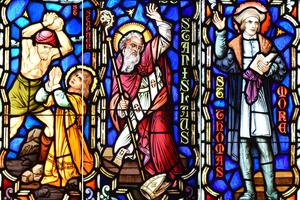
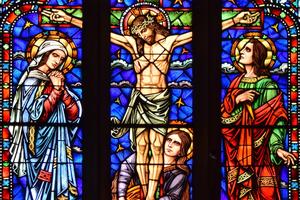
St. Mary’s has magnificent stained-glass windows. This cathedral is relatively recent, built after a fire consumed the previous cathedral in 1947. How new is this cathedral? When it was consecrated on Oct. 22, 1952, Fulton Sheen himself was present.
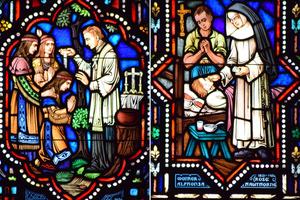
The stained glass here was designed and executed by Edward W. Heimer and his studio. What distinguishes his design — and makes it suitable for the semiquincentennial of the Declaration — is that each of the 10 principal windows in the nave is accompanied by three smaller panels from American history. And yes, there is a window depicting the signing of the Declaration of Independence.
The design chose historical moments that somehow matched the biblical scenes above. For example, the first nave window is the birth of Jesus; the three historical scenes below are of the faith being “born” in the New World: Christopher Columbus planting the Cross upon arrival in the Americas; Father François Picquet founding Ogdensburg in 1749; Samuel de Champlain arriving in 1609 at the lake that would later take his name.
The second nave window is of the Sermon on the Mount, Jesus as the teacher of the crowds. It is accompanied by three windows related to the history of Catholic education: the laying of the cornerstone of the first building of the Catholic University of America in 1889; the founding of Wadhams Hall in 1924, the local seminary for Ogdensburg; and Mother Elizabeth Ann Seton, who founded the first order in the United States dedicated to teaching.
In his 1953 booklet recording the rich significance and symbolism of the stained-glass windows, Father Joseph Bailey of Ogdensburg writes that: “the plan of the nave windows [symbolizes] that Christ lives on in his Church. Christ’s life and teaching are alive in the living members of his Church in every age of history. The life-history of the Church in the United States is the life-history of Christ being more and more fully realized in the growth and spread of the Catholic faith throughout our nation, our state and our own north country.”
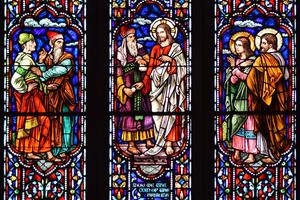
The biblical scenes chosen for the main nave windows are what you would find in other places — the Wedding at Cana, Peter receiving the keys from Jesus, the Last Supper. Yet there is one biblical scene that is rarely chosen for prominent treatment in stained-glass windows: Jesus teaching about the relationship of what much later would be called “church and state.”
The scene is Matthew 22. Jesus is asked about paying taxes. He takes the coin and asks whose image is upon it. When told that it is Caesar’s, Jesus replies: “Render therefore to Caesar the things that are Caesar’s, and to God the things that are God’s” (22:21).
This foundational text on the duties owed to civil authorities, and the limits of their authority, is accompanied by three historical scenes: the Maryland Religious Toleration Act of 1649; Charles Carroll signing the Declaration of Independence in 1776, the only Catholic signer; and Abraham Lincoln commissioning Archbishop John Hughes of New York to be his envoy to European powers in 1861, where he would attempt to persuade them to support the Union cause in the Civil War.
The cathedral windows teach us that the proper measure of political history is salvation history. We shed the light of the Gospel upon our countries, not the other way around. We give thanks to God when we don’t have to choose between the flag and the cross, but if we must choose, the teaching of the Church — and the saints of every time and place — makes it clear that we choose the Cross, every time.
The late Lord Jonathan Sacks, distinguished Chief Rabbi of Great Britain, offers us a key insight for our meditations today. On a visit to Washington, D.C., he noticed that American memorials were different than British memorials. The latter did not include words, aside from the name of the person being honored.
Rabbi Sacks noticed that American memorials have plenty of quotations. The Lincoln Memorial includes the Gettysburg Address as well as the Second Inaugural. The Jefferson Memorial has quotations from the Declaration he drafted in 1776 and from the Virginia Act of Religious Freedom in 1779. The FDR memorial has his “Four Freedoms,” and the Martin Luther King memorial has some 16 texts.
Why so many words? Rabbi Sacks argues that America understands itself to be a “covenantal nation” — the people are bound together not principally by ethnicity but by adherence to the principles of a creed, expressed in due course in a written and ratified constitution. Covenants are made by words. Political covenants require many words. Biblical covenants are much more concise: I will be your God, and you will be my people (cf. Exodus 6:7). So said the Lord God in Exodus; the new covenant in Christ Jesus will be written in blood more than words.
Abraham Lincoln invoked the covenantal character of the American founding when, on the way to his first inauguration, he spoke of Americans as an “almost chosen people.” The great test of Lincoln’s presidency would be whether the people could endure “half slave and half free”; whether the covenant of the Declaration — “that all men are created equal” — had been broken beyond repair.
There are many words in the Declaration, the Constitution, the Bill of Rights — to say nothing of the Federalist Papers and various founding assemblies. The words from the Cross are few.
On the Cross the time for words is almost past. It is too painful to speak. From the pulpit of the Cross Jesus speaks seven times, only a few words each time. Even to breathe has become a burden. And so we draw close and pay keen attention to what he chooses to say. We draw close, we listen, we pray.
We adore Thee, O Christ, and we praise Thee,
because by Thy holy cross Thou hast redeemed the world.
- Keywords:
- seven last words
- holy week