Leo XIV’s Early Outreach Shows Vatican Continuity on Interreligious Dialogue
COMMENTARY: In two quiet but telling moves, Pope Leo signals continuity with the spirit of Nostra Aetate.

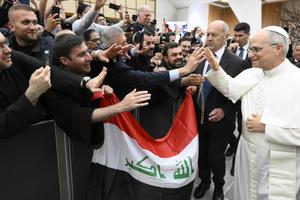
The Vatican’s Dicastery for Interreligious Dialogue on May 12 issued a letter addressed to Buddhists who were celebrating their feast of Vesak. It cited the teaching of Nostra Aetate, the Second Vatican Council’s document that signaled a new era in the Catholic approach to non-Christian religions. This was shortly after Pope Leo XIV issued a short letter to the Jewish community assuring them of his ongoing commitment to Nostra Aetate, as well.
I think this is an important sign, very early in Leo’s papacy, that he will continue the tradition of his modern papal predecessors of engaging in dialogue with the representatives of other religions. I do not think anyone seriously entertained the idea that Pope Leo would act any differently, and so now we have confirmation that he will be in continuity with the trajectory begun by Vatican II on this issue.
Nevertheless, this is bound to disappoint those who claim that it is precisely this teaching of Vatican II that has opened the doors to let into the Church a dangerous religious relativism. And, in one sense, it must be admitted by any fair-minded observer that their concerns are valid on their face.
Who can deny that there has been a steep increase in the number of Catholics in the West who think in the categories of modern relativism? Who can deny that much of the “dialogue” that has taken place on an official level often seems to mute the teaching of the gospel in favor of a benign conviviality that is superficial in the extreme and lacking in theological substance?
On the other hand, the fact remains that at least in theological theory, there is some truth to be found in other religions. This can serve as a foundation for a mutual exchange of views. Furthermore, the reasoning that Vatican II caused the rise in religious relativism in the Church is betrayed by the historical reality that this relativism had already invaded the world and the Church long before Vatican II. Catholic thinkers from St. John Henry Newman to a young Father Joseph Ratzinger had already noted this erosion of the faith within the Church in the singularity of Christ’s salvific work, and this at a time when the Church had a far more contrarian view of the value to be found — if any at all — in non-Christian religions.
These facts cannot be disputed, and it is precisely why the Council fathers decided that it was time for the Church to take a closer look at her relations with the religions of the world in the hope of creating a theological context that allows Catholics to make better judgments about how to approach those of other faiths.
Like so many other areas of conciliar teaching, the approach adopted was a classic Catholic “both-and” theology. The singular truth of Christ as the sole savior of the human race was affirmed, but also that the other religions of the world do contain “seeds of the Word” that the Church can recognize, affirm and build upon.
In so doing, the Council, which ended 60 years ago Dec. 8, avoided the false “either-or” approach of both the progressives and traditionalists. Progressives held that one could not affirm the goodness found in other religions without relativizing the unique role of Christ. They therefore developed a “pluralism of religions” theological model where Christ became just one savior figure among many others.
Traditionalists held the same view, but they reached an opposite conclusion. Since only Christ is the unique savior of mankind, they held that we must approach non-Christian religions as little more than “error machines,” or even as demonic deceptions.
This is all well and good, of course, and I think the Council got the theology exactly right. But one does wonder if a certain naivete was in play here. Even Pope Benedict XVI once said that the problem with the Council was that it was so focused on “getting the theology right” that it ignored the potential downstream pastoral consequences of its deliberations. In this regard, in a cultural atmosphere already saturated with religious relativism, the Council underestimated how its “opening to dialogue with other religions” would be misinterpreted — often deliberately — in a relativist direction.
The real Council soon was reduced to “the council of the media” (another Pope Benedict phrase) and in this media council the narrative that emerged was that the Church was now dropping its claims to exclusivity in favor of a “new paradigm” of radical “inclusion.”
Entire theology departments in major Catholic universities became the mouthpiece for this new approach, and all attempts to argue against this trend by orthodox theologians were simply dismissed as “reactionary triumphalism.” I spent the better part of my theological career in that environment, and it was an excruciating experience of frustration and marginalization.
What was lost was not only a proper theology of world religions — the actual theology of the Council — but also a proper sense of what all of the “dialogue” is for. What are the goals of dialogue with other religions from a Catholic perspective? Are we engaged in dialogue only for the purpose of dialogue as such, making dialogue a kind of end in itself? Is the goal only to increase mutual understanding in the interests of generating a kind of global fraternity of irenic partners? But partners in what, exactly?
What needs to be recovered, and I hope Pope Leo XIV begins this process, is that the goal of dialogue is the furtherance of knowledge in the interest of religious truth. Mutual understanding is laudable but insufficient since “understanding,” devoid of a commitment to truth, easily degenerates into the impasse of an epistemological stance of agnostic cynicism: “Well, you have your ‘truth’ and we have ours.’” And this attitude eventually morphs into a thoroughgoing relativism. But in the end, what it affirms is that “all religions are equal because they are all equally trivial.” In other words, where truth is lost as the primary concern, all positive religious constructions are deemed mere projections of a deeper and ineffable “religious experience” that is pre-conceptual and resistant to truth formulations.
There needs to be a fundamental commitment up front to the notion that there is a genuinely objective religious truth that is important and normative precisely because it is true. Dialogue, therefore, must be viewed as a subset of evangelization. To be sure, and as any good teacher will affirm, the Catholic should avoid a “both guns blazing” approach that is more a subset of apologetics than of evangelization.
Apologetics has a key role to play, especially when done well and not by bull-in-the-china-shop popularizers, but it is not to be confused with evangelization as such. Evangelization is a deeper reality, grounded in a profound love for concrete persons with whom you have developed a genuine interpersonal rapport. And this can happen even at a distance when the teacher/evangelizer, be it in a classroom, a parish or online, so articulates the gospel from within the deep categories of our common humanity that the listener immediately feels an internal spiritual kinship with the speaker.
Interreligious dialogue, therefore, is both necessary and a stepping stone to the truth. There is an art to this, and the best evangelizers are those who begin with intellectual kinship and then slowly proceed to steer the dialogue boat into deeper waters.
For example, if one recognizes in Buddhism the truth that true spiritual “enlightenment” cannot be reached without the “right conduct” of a life of charity, one could then press on and ask the question: Why is this so? Why does charity lead to spiritual insight and why can such insight not be gained where charity is absent? Is charity therefore something deeply constitutive to our nature and indeed to the very fabric of reality? Is there not therefore something profoundly true in the Christian proposal that God, the very foundation of all things, is in himself the fullness of charity? The Christian evangel thus emerges out of the very depths of dialogue and does so precisely as a truth claim, but a claim which is not made arrogantly but from within a spirit of mutual questing.
This is but one example of what I mean by “deeper waters.” My hope and my prayer is that Pope Leo steers the ecclesial boat into those deeper waters. Because we have for too long been languishing in the shallow waters of a dialogue to nowhere.