Living the Catholic Faith in the Heart of Muslim Morocco
COMMENTARY: In Morocco’s Muslim-majority culture, the Catholic community endures with humility, steadfast in its witness to Christ.
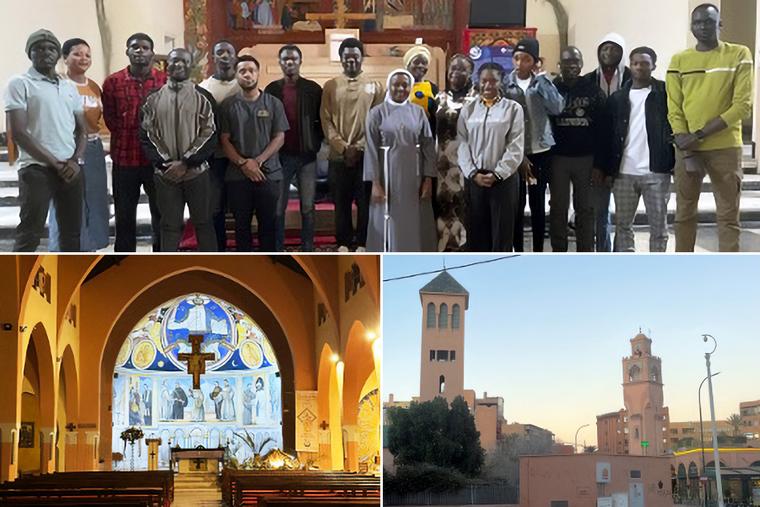
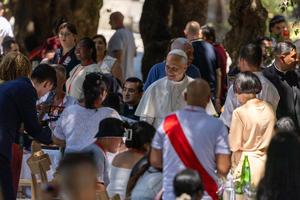
“My Father, I abandon myself to you … I am ready for all, I accept all.” There I knelt in Adoration in Rabat, Morocco, surrounded by 800 university students from dozens of African nations, singing the Prayer of Abandonment written 130 years before by the recently canonized St. Charles de Foucauld.
A retired French soldier, “Charles of Jesus” had traveled to Morocco in 1883, disguised as a Moroccan Jew, mapping the country and venturing into the most remote regions. A lover of North Africa, his legacy lived on through the prayers of hundreds of youth gathered for a weekend of prayer and fellowship hosted by the Diocese of Rabat.
A Church Few Expect to Find
Such a sight is certainly not what most imagine exists in Morocco. Upon hearing of this North African kingdom, perhaps images of colorful markets and sand dunes come to mind. Few seem to know of the vibrant reality of the Church in Morocco, roots planted through martyrdom, grown by religious congregations giving their lives in service, and sustained by diverse, faithful youth.
With a Catholic population of less than 1%, Morocco is home to around 30,000 Catholics, with reports varying due to a lack of data regarding Moroccan converts to Christianity. While conversion to Christianity is socially discouraged and “proselytism” strictly prohibited, churches host diverse congregations. Students from across Sub-Saharan Africa make up a large majority of Catholics in Morocco. At my parish of St. Francis of Assisi in Fes, some 30 countries are represented, nearly all being students in their 20s studying in Fes for several years. The archbishop of Rabat, Cardinal Cristóbal López Romero, has reported that Morocco hosts Catholics from “100 different countries.”
When I first came to Morocco as a George Mason University student to study Arabic, I wasn’t sure what I would find when it came to the Church. I was honored to be quickly welcomed into a joy-filled community where my faith could flourish.
Martyrs and Missionaries
The modern church in Morocco, separated from the early Roman North African church following the expansion of Islam, truly has its roots in religious orders crossing the Strait of Gibraltar as missionaries. As a religious sister described to me, Morocco has long since been “Franciscan territory.” St. Francis himself selected five brothers to bring the gospel to Morocco. Consisting of the Arabic-speaking St. Berard of Carbio, along with four companions, the brothers arrived in the city of Marrakech in 1220, preaching the Good News in the market. After unsuccessful efforts to expel them back to Europe, the Sultan finally took matters into his hands, personally beheading the five brothers. Upon hearing the news of the brothers’ martyrdom, St. Francis remarked, “Now I can truly say that I have five Friars Minor,” emphasizing the courageous brothers’ worthiness of the title.
Despite political difficulties, missionaries continued arriving in Morocco. During the period when thousands of Europeans were kidnapped by Barbary pirates and taken as slaves to Morocco, certain clergy were granted access to serve the Christian captives. Trinitarians and Mercedarians — such as the French priest Dominique Busnot, who published a work about the reality under the infamous sultan Moulay Ismaïl — worked to negotiate the freedom of the enslaved Christians.
A key figure in Moroccan Catholicism, and that of North Africa as a whole, is St. Charles de Foucauld. Canonized in 2022, he is considered a beloved patron of the Church in Morocco. His deep appreciation for North Africa and his Muslim brothers lives on in multiple religious orders inspired by his life, one of which is the Little Sisters of Jesus. In my home of Fes, four Little Sisters of Jesus live in the old, historic quarter of the city, working among locals and living out the charism of living the quiet life of Jesus in Nazareth. They embrace the simplicity of Christ’s hidden life and seek to live as humble witnesses of the Gospel among their Muslim friends, coworkers and neighbors.
Religious Orders
The work of religious orders has in no way ended in Morocco. Following graduation from university with a major in Global Affairs and a minor in Arabic, I returned to teach English in Fes, where I have now lived for a year. During this year, I had the opportunity to discover more of the country, and at every parish I visited, I interacted with wonderful religious serving the community in various ways. I met Missionaries of Charity in Tangier, a lively bunch of Franciscans in Marrakech overseeing the church named after the martyrs of the city, and spent the day with a few Franciscan brothers living in Meknes and running the St. Anthony language center, where they host language classes for low-income Moroccan students at nearly no cost.
However, perhaps my most impressionable encounter with a religious order in Morocco occurred in the city of Oujda, located on the Moroccan border with Algeria. Here, three Consolata Missionary priests — an Italian, a Kenyan and a Congolese — as well as a few religious sisters, work to serve the many migrants entering Morocco. As the priests gave me a tour of their center to host migrants, I was shocked to hear that many of these young men came from across Africa, escaping war and violence in countries such as Sudan. Seeing the needs of these migrants, the Consolata Missionaries labor tirelessly in this vineyard bestowed upon them.
Observing a day in the life of these priests was truly impressive. Despite the constant news of sickness, hardship and even death throughout the migrants’ dangerous journey with Europe as the goal, these three priests radiated nothing but joy. They joked with the refugees, some as young as 14, and I heard them singing as they went about their daily chores. They generously opened their doors to all in need, providing free medical care, food, and a place to sleep to those passing through. Simultaneously, they made sure all guests played their part, functioning as a family in preparing the meals, cleaning dishes and washing clothes. At Mass that evening, the priests prayed together fervently that the prayers of these migrants may be answered, that they may be able to find the security and stability they seek.
Honoring the Past
On All Souls’ Day, I joined my parish pastor, Father Matteo Revelli, in Fes and a few other parishioners to go for the annual blessing of the tombs at the local Christian cemetery. Entering revealed a peaceful patchwork of what had once certainly been ornately decorated tombs, the details fading over decades. The names were mostly French in origin, though inscriptions also revealed Spanish, Italian and German names. Past a large area of graves of World War II soldiers, my pastor pointed out the graves of some 90 religious sisters. They had given their lives in service through various ministries in Fes, starting the school of St. Therese, which is still in operation, working as nurses, and even running a milk sterilization factory. Next, Father Matteo gestured to a large tombstone, labeled as “Franciscan Fathers.” Here, he explained, was buried Father Michel Fabre, a Franciscan priest killed in Fes in 1912 as part of the anti-French uprising.
Two elderly men, a Spaniard and a Frenchman raised in Fes, joined us, reminiscing over their childhood memories in French Morocco. In the 1950s, the Catholic population in Fes alone was over 10,000. A total of 1,360 children frequented catechesis classes, and marriages and baptisms occurred every month.
With the Catholic population plummeting to mere hundreds in Fes now, it may seem as though there is no vibrancy. However, I had come to learn this was far from the truth.
Life in the Parish Today
Students at my parish celebrate life together, with the choir hosting soirées throughout the year, the Legion of Mary organizing Marian celebrations in May, and the Charismatic Renewal Group offering all-night prayer vigils, just to name a few. Serving on the leadership team at the parish this past year allowed me to gain insight into the way ministry functions at a parish level. As a parish that functions largely in French, we hoped to better represent language minority groups, specifically the English, Spanish and Portuguese speakers who can sometimes feel left out among the French-speaking majority. Our pastor makes it a point to pray the Eucharistic Prayer in different languages, and each week the Second Reading is proclaimed in one of the smaller represented languages.
As an English-speaking minority at the parish, we strived to create a community where we can gather, pray and grow together through hosting retreats, dinner parties and Bible studies. It has been a blessing seeing this group grow and students finding a place where they feel comfortable connecting to God and like-minded individuals.
Living as a Christian in Morocco can feel isolating at times, and thus, this strong community from the church plays an important role. Morocco is a deeply religious country where Islam seems to permeate every aspect of life. It boasts a long history of tolerance and people tend to be very respectful of Christianity, while also curious to hear about my religion. It’s also a country where Islam is the religion of the state, and the king is seen as the commander of both the government and the faithful. The U.S. State Department’s 2021 International Religious Freedom Report states that Morocco “criminalizes acts and speech undermining the Islamic religion.”
I am asked nearly every day about my faith, whether it be a taxi driver, a vegetable seller or a kid playing soccer on the street. I have quickly had to refine my Moroccan Arabic skills to be able to explain my beliefs when asked and emphasize our shared Abrahamic lineage. While these conversations and interreligious respect prove to be phenomenal traits in an often-divisive world, the need for community between like-minded individuals remains.
As one priest in Morocco explained to me, we are like trees in need of water. While living in Morocco, a country where another religion is devoutly practiced, our roots can grow deeper as we search for answers and ways to consider our own Faith. Yet at the same time, our branches above ground can grow thinner and weaker if not often nourished through the sacraments, prayer and Christian community.
Lent and Easter
This past spring, I spent my first Lent and subsequently Easter in Morocco. This year, Lent overlapped with most of Ramadan, and so I decided to try fasting from food and water from sunrise until sunset, Ramadan-style, as a part of my Lenten practice. It proved to be a beautiful way to unite with my Muslim brothers and sisters and opened up many great conversations about faith, fasting and prayer. Every evening during the month of Ramadan, as the sun set, cannon fired from castles surrounding the medieval city of Fes, alerting residents that it was time to eat. Everything stopped, the streets were entirely empty, and families gathered in homes to break the fast and give thanks to God. I had the honor to participate in these meals with many friends, neighbors and even the families of my English students. It was an opportunity to offer the difficult fasting of the day for a specific intention and thank God for the gift of nourishment and people to share it with.
Then came Holy Week, my first time celebrating the Triduum away from family. I was blown away by the beauty and intensity with which my fellow brothers and sisters in Fes entered into the passion. Students came together on Holy Saturday to craft the decorations that would beautify our church for the Easter Vigil, at which multiple new members were welcomed into the Church, and our pastor prepared refreshments to treat us for a post-Easter Vigil gathering.
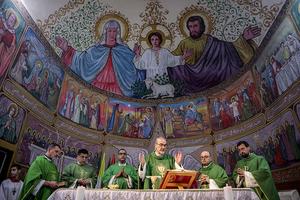
The Easter Vigil Mass proved to be one of the most joyful expressions of faith I have seen in my life. Even after the long Mass had finished, people stayed in the sanctuary singing the glory and praise of the Resurrected Lamb late into the night, accompanied by ecstatic cries of joy and dancing.
The next day, following the Easter Sunday morning Mass at which multiple Moroccan Muslims attended to experience and learn about our Easter holiday, I hurried home to prepare a roasted leg of lamb and enough side dishes to compose a feast fit for the holiday. My roommate and multiple other Muslim friends were sure to wish me a very happy “Easter holiday” and shower me with poetic blessings and well wishes, typical of the beautiful Arabic language. Friends from church began to arrive, and as the sun set, we gathered on my rooftop to feast and celebrate Christ’s resurrection.
Sharing Life, Sharing Faith
As the call to prayer sounded from mosques across the old city of Fes, I took a moment to observe the scene. I was surrounded by Catholic friends from various backgrounds as well as dear Moroccan friends, laughing and enjoying good food, celebrating Easter thousands of miles from my home country. I was reminded of St. Charles de Foucauld’s writing: “It is not necessary to teach others, to cure them or to improve them; it is only necessary to live among them, sharing the human condition and being present to them in love.”
This is exactly what the Church in Morocco has offered to me, and what I hope to offer to others in return.