Like His Predecessors, Pope Leo Extols the Evangelizing Role of Catholic Radio
COMMENTARY: People again are listening, streaming and watching the new Pontiff. And they are responding favorably.

Editor’s note: Matthew Bunson, the vice president and editorial director of EWTN News, delivered the keynote address at the EWTN Catholic Radio Conference on Aug. 28 in Tysons Corner, Virginia. His speech, titled “The Popes and Catholic Radio,” is reprinted below. The text has been edited for length and clarity.
We have, all of us, been on a remarkable journey over these last months, starting on Feb. 14, with Pope Francis’ entry into Gemelli Hospital in Rome. He began that day the final stages of his extraordinary life and pontificate. We kept vigil over his final days, and all of us can remember seeing his last Easter Sunday on the loggia of St. Peter’s, where his pontificate had begun publicly 12 years before.
His passing began the great spiritual and ecclesiastical journey of the interregnum, the sede vacante that culminated on the afternoon of May 8, with the announcement that Cardinal Robert Francis Prevost, from Chicago, had been elected the 266th successor to St. Peter and had taken the name Leo XIV.
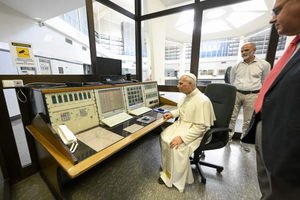
One event, however, in the first weeks of the new pontificate garnered very little media attention. On June 19, on the 43rd anniversary of his priestly ordination, Pope Leo XIV traveled to the Vatican Radio shortwave transmission center in the town of Santa Maria di Galeria, just outside of Rome, and expressed gratitude for the work carried out “with fidelity and continuity, even on a feast day,” and for a service that reaches places “where few broadcasters are able to go.”
It was a demonstration of our new Pontiff’s keen interest in the use of all the means of social communications for the Church, but it was also emblematic of the way Pope Leo XIV has placed himself in deep continuity with his predecessors. It was, in fact, only the latest moment in the very long relationship between the popes and Catholic radio. It’s a story, a celebration, that’s more than just about technology. It is about evangelization, the relationship between faith and culture, and the enduring human need to listen and be heard.
I mention continuity because much like Pope Leo XIV in 2025, on Feb. 12, 1931, Pope Pius XI paid a visit to the newly established broadcast center of Vatican Radio in the beautiful gardens of the Vatican City State. Welcomed by the famed Italian radio pioneer Guglielmo Marconi, the Holy Father blessed the facilities; and then, at exactly 4:49 p.m., he became the first pope in history to have his voice broadcast over the radio.
It is easy to forget what a moment it was in modern Catholic social communications.
That inaugural broadcast was literally a global moment. In London, nearly 4,000 Catholics stood for hours in Westminster Cathedral waiting to hear the voice of the Pontiff played over the loudspeakers, and the New York Herald newspaper declared: “Few events in the history of the world can compare with the profound impact that the Head of the Holy Roman See made during his address directed to the entire planet. ... This is a miracle of science, and no less a miracle of faith.”
Pius XI’s first broadcast declared to the world that the See of Peter now had a voice carried by the airwaves. Radio became a way for the Pope to transcend borders, speaking directly to the faithful across continents. This invention became especially vital during World War II. Under Pius XII, Vatican Radio provided not only religious instruction but humanitarian services. Families searched for information about prisoners of war, and the broadcasts often carried appeals and messages that provided solace and, in some cases, helped reunite loved ones.
Here we see a principle emerging: The popes understood that radio had a role to evangelize, to proclaim Christ Jesus and to be a profound cultural service — a service to truth, to justice, and to human dignity.
Starting off in Latin, Italian, French and Spanish, Vatican Radio’s broadcasts soon added German and English, and the programs emanating from the Vatican Gardens were heard in Europe and the United States and in mission lands and brought hope to many dark corners of the world, including behind what was then the Iron Curtain. Today, the programs of Vatican Radio are offered in some 45 languages and remain a key component in the wider Vatican Media.
In the postwar era, Catholic radio proliferated across Europe, the Americas, and Africa. Missionaries, bishops, and lay leaders came to see radio as an indispensable tool for catechesis. Why? Because radio was inexpensive, portable, and accessible even in far-flung communities and corners of the world.
It took some years for Catholics in the United States to embrace the vision and potential of Catholic radio. And, to be sure, in that time Non-Catholics were busy starting Christian and Evangelical radio stations. Consider, for example, that Protestants and Evangelicals run more than 1,600 radio transmission facilities in the U.S. alone and regularly apply for thousands of FM translators throughout the country.
But Catholics have long made our voices heard. In 1992, EWTN began short wave radio service, followed four years later by worldwide AM/FM radio service. Today, there are 460 EWTN radio affiliates, including such venerable affiliates being honored this year as the Guadalupe Radio Network celebrating 25 years — including 15 years here in the DC area — and St. Gabriel in Columbus for its 20th anniversary.
Catholic radio has long served — and continues to serve — as one more key means of evangelization. St. Paul used his sandals, parchment and stylus, and the sprawling network of Roman roads to send his epistles along the Roman postal system — the so-called cursus publicus — to proclaim Christ Jesus. The enterprising and indefatigable cathedral builders of the Middle Ages used stained glass — the Bible for the illiterate — to explain salvation history, the sacraments, and the vital truths of the faith to kings and serfs alike.
That is why the achievement of Pope Pius XI was not lost on Pope Pius XII. In 1957, he highlighted the importance of radio for religious programming. He exhorted bishops to increase and enhance programs dealing with Catholic affairs, emphasizing the need for well-trained priests and laypersons in this field, seeing radio as a new means to fulfill Christ’s command to “preach the Gospel to every creature” (Pope Pius XII, Miranda Prorsus). He stressed that radio should not lead minds away from truth or toward vice, but rather promote virtue, propagate sound doctrine, and offer wholesome entertainment and solace to listeners.
Venerable Pius XII’s endorsement also underscored that technology, when used ethically and skillfully, can be a powerful ally in the service of faith. In words that are just as true today as 1957, he wrote:
“Let listeners to the Radio be aware that they are obliged to encourage reputable programmes, and particularly those by which the mind is directed towards God. In this age in particular, when false and pernicious doctrines are being spread over the air, when, by deliberate ‘jamming,’ a kind of aerial ‘iron curtain’ is being created with the express purpose of preventing the entry of truth which would overthrow the empire of atheistic materialism, in this age, We say, when hundreds of thousands of the human race are still looking for the dawning light of the Gospel message, when the sick and others likewise handicapped look forward anxiously to taking part in some manner in the prayers and the ceremonies of the Mass of the Christian community, should not the faithful, especially those who make daily use of the advantages of the Radio, show themselves eager to encourage programmes of this kind?” (Pope Pius XII, Miranda Prorsus)
In the Second Vatican Council’s important document on the means of social communications, Inter Mirifica, the bishops made sure to include radio in the list of the great forms of expression that must be put to use by the Church because they “can, by their very nature, reach and influence, not only individuals, but the whole of human society” (“Decree on the Media of Social Communications,” Inter Mirifica, 1).
Pope St. Paul VI expressed even more vividly the power of radio when he wrote of TV and radio: “They have given society new patterns of communication. They have changed ways of life. Broadcasting stretches out, further and further, towards every corner of the earth. Instantaneous transmissions break through political and cultural barriers. What they have to say reaches men in their own homes. Broadcasters have access to the minds and hearts of everyone. Rapid technological advances … have done still more to free the media from the restrictions of time and space and these promise still more effectiveness and influence” (Pope St. Paul VI, Communio et Progressio, 148).
Pope St. John Paul II further articulated Catholic radio’s mission, stating that it is “entrusted with the task ‘of proclaiming the Christian message with freedom, fidelity and efficacy, and linking the center of Catholicism with the various countries of the world by spreading the voice and teaching of the Roman Pontiff … and paying constant attention to the signs of the times’” (Pope St. John Paul II, “Address to the Managers and Staff of Vatican Radio on the Station’s 70th Anniversary,” 2001). He saw Vatican Radio as a modern, professional contribution to the New Evangelization, particularly in an age of expanding global communications. St. John Paul consistently encouraged Catholic radio to intensify its programming, including catechesis and the teachings of the Church Fathers, demonstrating a clear vision for radio not just as a news outlet, but as a comprehensive platform for theological education and spiritual formation.
For the popes, involvement in media is not merely about strengthening the preaching of the Gospel; it is about integrating the Gospel message into the “new culture” created by modern communications. This means that the Church must not only use radio to spread its message but also understand and engage with the new forms of language, technology and psychological attitudes that characterize this “new culture.” The goal is to proclaim the Gospel while maintaining its content unchanged, yet rendering it comprehensible to the contemporary mind. Pope John Paul II also stressed that radio can penetrate the conscience of each individual, eliciting a personal commitment to the Gospel.
Pope John Paul II frequently referred to the world of communications as the “first Areopagus of the modern age,” drawing a parallel to the place in Athens where St. Paul preached the Gospel. This metaphor highlights the immense cultural influence of media, including radio, in shaping individual, family and social behavior. But it is especially powerful in the face of the trends of the “nones,” the spiritual but not religious, the cynics, and the secular atheistic materialists who seek to command the high grounds of culture, thought and information.
For all of its capacity to send out a signal that blankets the airwaves, Catholic radio is still able to serve as an instrument of intimate evangelization. How many of us have heard stories of fallen-away Catholics who have come back to the Church because one day they were turning the dial and heard by accident a Catholic program that seemed to respond to the long-standing wound — the deep-seated anger — that had caused them to be separated from the Church, perhaps decades before. Or perhaps you too have been able to use Catholic radio to bolster your own efforts at evangelization and healing.
And how many of us have friends and co-workers who have been drawn into the Catholic faith because of what they heard on the Sonrise Morning Show, Catholic Connection, The Journey Home, Catholic Answers, or even some rebroadcast of the late Fulton Sheen, a show that at first blush should have no business being sent out across the country and yet remains poignantly effective not just because the “Venerable” archbishop was such a good speaker but because the logic, truth and transforming power of the Gospel can never age and will be forever meaningful.
Of course, as Michael Warsaw can attest, the lives changed by the seemingly chance encounter with the voice of Mother Angelica are too numerous to count.
And we should not make the mistake of thinking that culture today is no longer receptive to what we have to say. Pope Francis and now Pope Leo XIV are proof of that.
From the night that Cardinal Jorge Mario Bergoglio was introduced on the loggia of St. Peter’s Basilica, Pope Francis rewrote the rules of communications for popes. Based on the number of times over his 12 years I was a guest on the Sonrise Morning Show, Kresta in the Afternoon and now Ave Maria in the Afternoon trying to help people understand what happened during a papal press conference on a plane — or trying to explain what the Pope actually wrote or said in an interview instead of what the secular media claimed he said — Francis certainly created both challenges and immense opportunities for Catholic media, especially Catholic radio.
We could spend an hour just on those and many others today, but lost in the drama of the controversy was a simple reality: Pope Francis stood as one of the foremost opportunities we will ever have in modern culture to evangelize, touch hearts, and bring souls to Christ.
Francis brought an intense pastoral style to the papacy that is combined with his powerful call to remember God’s loving mercy, defending human dignity, and building cross-generational and cross-cultural bridges. People were thinking.
It is ironic that a pope of such powerful images — of Francis cradling a suffering child … or a grandmother facing her last years alone in a home — should be so good for Catholic radio.
Francis’ prophetic voice was tailor-made for culture today because it was so radically countercultural. As we are awash in material goods, Francis reminded us that we also exist in a throwaway culture that disposes of babies as we would an unwanted pair of shoes, kills the elderly to cut costs in health care, and allows the destruction of people and the environment in other countries because we want the latest fashion or expensive toys and gadgets.
Francis may have said and written things that needed explaining, but he overwhelmed nearly two decades of relentlessly negative publicity because of the sex-abuse crisis, and people were willing to hear our arguments.
In 2013, during a visit to Brazil and World Youth Day, he stopped at the studios of Rio de Janeiro’s Cathedral Radio. He said, “I would say that a radio station, a Catholic radio station today, is the most immediate pulpit we have. Here, through the radio, we can proclaim human values, religious values, and especially we can proclaim Jesus Christ, the Lord; we can graciously make room for the Lord among our affairs …”
We could argue over whether he said enough about this or chose the right word in a speech. Put simply, Catholic media enjoyed a moment of massive public interest, and that only grew exponentially from the moment he entered Gemelli Hospital and the Church on April 21 entered the sede vacante, the interregnum.
And now, we are blessed by Pope Leo XIV.
A little more than 100 days into the Leonine pontificate, we continue to witness and report on the steady unfolding of this new era.
I have said on air that it is very rare indeed to be able to say that something is unprecedented in the 2,000-year history of the Church. And yet here we are. Pope Leo XIV is the first Augustinian, the first North American, the first U.S.-born pope, the first Chicagoan, the first White Sox fan to be elected pope.
People again are listening, streaming and watching the new Pontiff. And they are responding favorably.
Authentic Catholic radio — like any valid and authentic Catholic apostolate — must be built from the ground up with a strong Catholic identity.
It is not enough, of course, to say that you are Catholic. Sadly, too many Catholic institutions today declare themselves Catholic and then reject — both publicly and privately — the truths of the faith. A station must take as the chief expressions of that Catholic identity fidelity to the teachings of the Church.
The challenges you face are truly immense. But we can derive consolation from the continuity in the papacy’s vision and encouragement to Catholic radio. Pius XII wrote in 1957: “We should like particularly to speak words of encouragement to Catholic radio stations. We are fully aware of the almost countless difficulties which have to be faced in this sphere; yet We trust that this apostolic work which We value so highly, will be pursued by them with energy and with mutual collaboration” (Pope Pius XII, Miranda Prorsus).
Energy and mutual collaboration describe perfectly the EWTN affiliates gathered here. … You are the bedrock of Catholic radio. All of you truly embody the finest qualities of Catholic radio and stand in the proud tradition first begun in 1931 by Pius XI. As a Catholic, and as it happens, a listener, I thank you for your generosity, for your yes to Christ in your commitment to Catholic radio despite so many challenges, and your confidence that you will continue to grow and to proclaim the truths of the faith that we all love. God bless you.
- Keywords:
- catholic radio
- church communications
- ewtn radio