Bishop Barron Warns Catholic University Graduates: Secularism Is a ‘Poison to the Soul’
Bishop Robert Barron challenged the new graduates: ‘Contrive a way to make your life a gift. Do not endeavor to fill up your ego; rather, endeavor to make it a conduit of grace …’

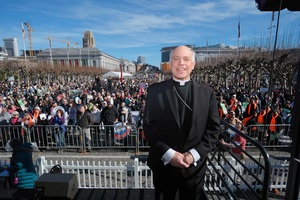
Bishop Robert Barron of the Diocese of Winona-Rochester, Minnesota and the founder of Word on Fire addressed the graduating class of Catholic University of America on May 17, 2025. As an alumi himself, he spoke fondly of his own time on the campus and the impact that not only theology but philosophy had on him.
The prelate also warned against the "poison of secularism" and challenged the graduates to "not ignore this holy longing that resonates in your hearts!"
In the commencement speech, Bishop Barron reflected on his time as a student 43 years ago saying:
"I know it’s a cliché to say it, but it seems like six months ago. It was a bright, sunny day, and the commencement speaker was Frank Reynolds. Most of you probably don’t remember him, but he was the anchorman for the national ABC news, a very well-known personality at the time. I will confess to recalling not a word of what he said, but I remember the moment very well. It felt joyful, exciting, full of future promise. I hope all of you feel that way today. I want to offer, of course, a word of very sincere congratulation to my fellow graduates, but I also want to thank with all my heart your parents, friends, teachers and mentors who have brought you to this day of celebration."
Attending the university in the heart of the nation's capital came in a critical time in history. Bishop Barron recalled how Ronald Reagan had been elected president "during my time here, and I had the opportunity to attend his inauguration on an unusually beautiful January day."
The shepherd of Winona-Rochester attended the university during other pivotal moments in history including the shooting of the president and shortly after, Pope John Paul II was nearly assassinated.
"But while all of this upheaval and excitement was proceeding in the outside world, I was largely preoccupied with my studies, which amounted to an opening up of a higher world, for I was a student of philosophy," Bishop Barron reflected.
"Plato speaks of the escape from the cave, which is to say, from the world of ordinary experience, in order to find a world of mathematical and philosophical truth, a dimension of reality that does not change and that brings us closer to God."
He also expounded on the richness of the liberal arts and how much he learned from Aristotle "and I learned it here — is that the liberal arts, which is to say, those that are liberi, free from practicality, are higher than the practical arts, for they are focused on things that are good in themselves".
Bishop Barron stressed how important these higher goods are telling the graduates:
"All of the values I just mentioned are good, but not in an unqualified sense. This means that they cannot, even in principle, satisfy the deepest longing of the human heart, which is for not simply beautiful things, but Beauty itself, not simply morally upright acts, but Goodness itself, not simply for knowledge of particular truths, but Truth itself. As C.S. Lewis pointed out, the longing for God becomes most vividly true not when we suffer and fall short, but precisely when we have achieved some great worldly excellence. At those moments of most intense satisfaction, we know, paradoxically, that nothing in this world satisfies us."
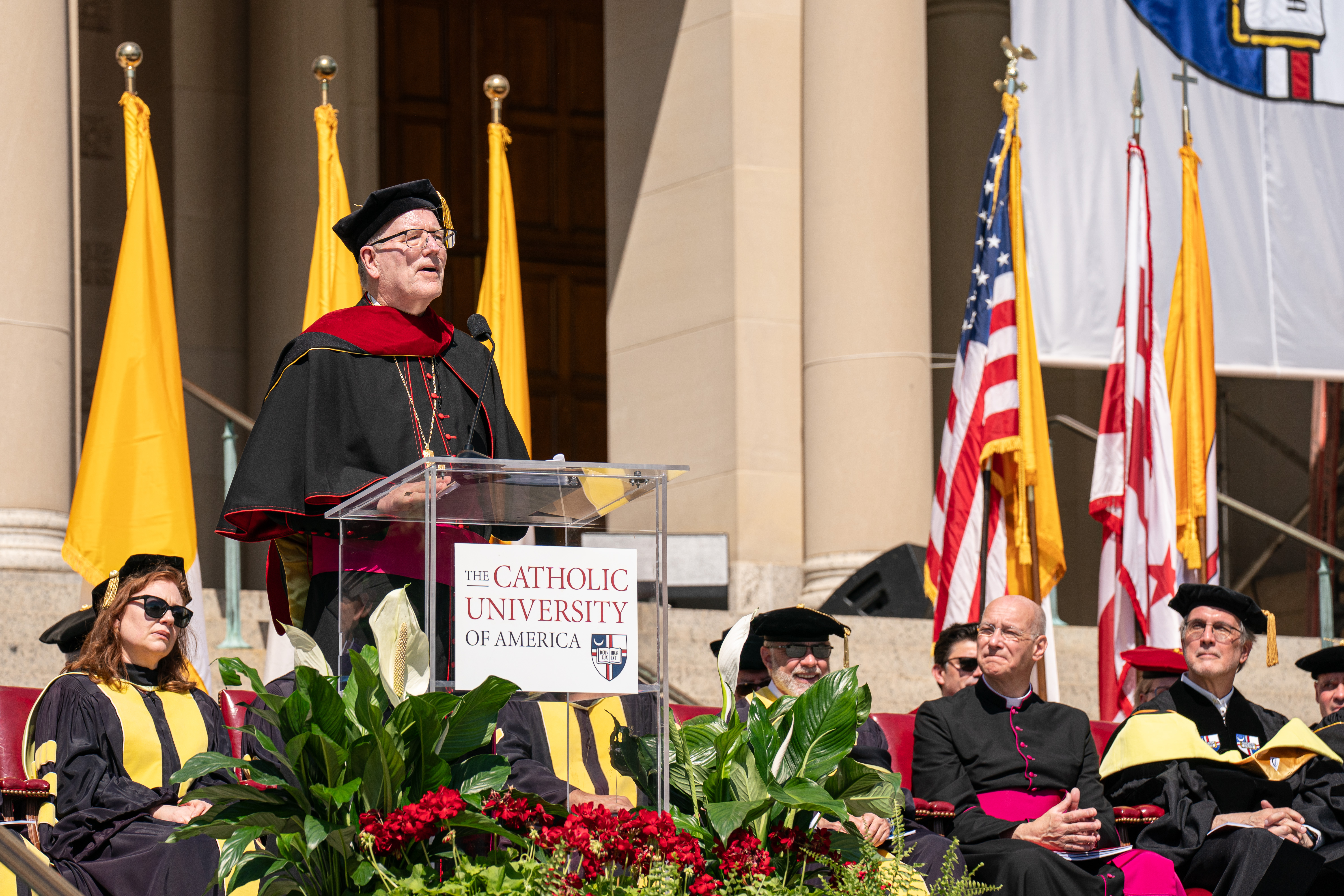
Touching on the temper of our time in such a secularized world, Bishop Barron had this message: "Do not ignore this holy longing that resonates in your hearts! I know that there is a secularist ideology that has worked its way into the minds of many and into our institutions. It is a poison to the soul. When we live within the stuffy confines of what philosopher Charles Taylor calls “the buffered self,” which is to say, the self which is cut off from connection with the transcendent, we dry up. We might become rich, famous, powerful, and widely loved, but we will not be happy apart from an orientation to the highest good. As St. Augustine, the great spiritual father of our new Pope, put it long ago, 'Lord, you have made us for yourself, and therefore our heart is restless till it rests in you.'"
Pointing to staggering numbers of young adults and teens suffering from depression and anxiety, he questioned why they "are spiking among your peers?"
"There are undoubtedly many reasons we could give," Bishop Barron answered, "but I would suggest that first among them is the loss of contact with God and the things of God."
"To be told that there is no creative source of your existence, no objective moral values, no ultimate purpose to life, and no transcendent home produces, unsurprisingly, a sort of metaphysical depression."
Secularism and those that don't believe in God "have planted in the mind of many a suspicion of God, a keen sense that God threatens our freedom and flourishing: The more we surrender to God, the less alive we are; so wouldn’t it be better to wriggle free of the divine oppression? The answer to this must be an emphatic No!"
The bishop prompted the graduating class to surrender to God, pointing to the First Letter of St. John that characterizes God as love.
"The sacred author is not saying that God loves or that love is one of God’s many attributes; rather, he is saying that love is what God is, that love is the very nature of God. But what is love? Thomas Aquinas says, with typical economy of expression, that love is “willing the good of the other.” Therefore, to make God absolutely central in your life is to conform your life to love: What you have received as a gift, you must give as a gift. And, my young friends, here is a bit of high-octane spiritual physics: When you give away what you have received, you find the grace increasing in you, not diminishing."
Bishop Barron remembered another former graduate of the university, Cardinal Francis George of Chicago, his own former mentor:
"One of his most famous adages was this: 'The only things you will take into heaven with you are those things that you gave away on earth.' Cardinal George was making the same point that I am today: Conform your life as fully as you can to love and you will find the joy and the heaven that you seek."
- Keywords:
- bishop robert barron
- catholic university

Alyssa Murphy Alyssa Murphy is the Register's Managing Editor of Digital Assets. Starting her career on the airwaves in San Francisco, she has worked in all facets of media. Alyssa enjoys writing and covering stories that inspire and uplift. Register readers may be familiar with her voice from EWTN radio's Morning Glory. Alyssa currently lives in New Jersey just outside Manhattan with her husband Andrew and young daughter, Annabelle.