Bodies, Souls and Mummies: What Catholic Teaching Reminds Us
COMMENTARY: A mummy in a museum not only teaches us about ancient culture, but also reminds Catholics of our duty to pray for the dead.
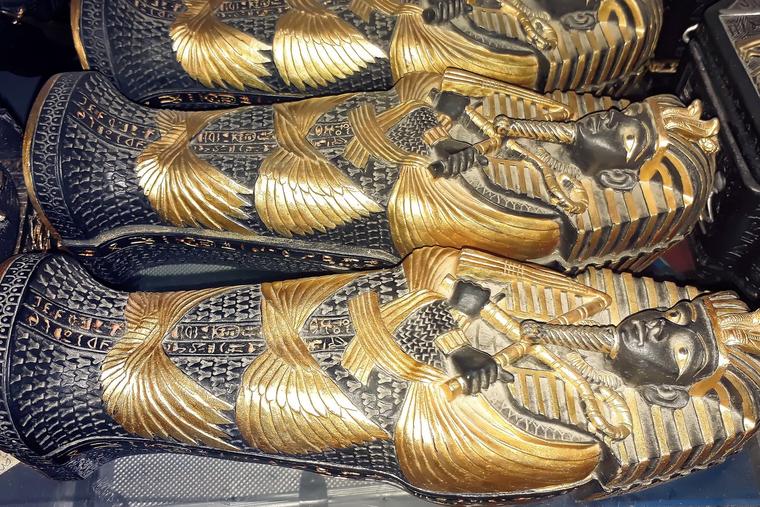
Do mummies belong in museums? The instinctive answer may be “yes,” but that answer might change when you consider what a mummy actually is.
A mummy, simply put, is a body that’s unusually well preserved — often artificially. Mummies have taken center stage in museums for the invaluable education they offer regarding ancient life and death, not only in Egypt but also in South America, the Torres Strait, and many other parts of the world.
If mummies provide such educational value about humanity, then what is there to question? And why should we, as Catholics, care?
The Catechism of the Catholic Church (364) says that “the human body shares in the dignity of ‘the image of God.’” It also states, “It is a human body precisely because it is animated by a spiritual soul.” These definitions give unprecedented honor to the human body. In fact, the Church fights vehemently against the heresy known as “gnosticism,” which teaches that the body is “less than” or even “bad.” On the contrary, the Church holds to that first truth declared in Genesis: “God saw everything that he made, and behold, it was very good.”
Even after death, the Church affirms the body’s dignity. In the Rite of Christian Burial, the body is sprinkled with holy water, draped with a pall to symbolize salvation through baptism, and even incensed. Furthermore, the Church teaches that the body (even when cremated) must be interred or buried, giving it a peaceful, final resting place as it awaits the resurrection of the body.
This view of the human body, both during life and after death, is distinctive to Christianity but not exclusive. In ancient cultures — Egyptian, Roman, Greek — there also prevailed a sense of the afterlife. This is why mummification exists in the first place: Egyptians believed that the body was the vessel of the soul and feared that if the body decayed, the soul would be lost. Thus, mummification was meant to aid the soul in finding its eternal resting place. Even ancient pagan peoples retained a sense of an early truth: man, both soul and body, was holy and good.
Sadly, this viewpoint is often lost in modern day — though not entirely. The Ethiopian Orthodox bishops subtly and beautifully asserted this truth when the famous remains of Australopithecus afarensis — dubbed “Lucy” — were about to embark on a six-year tour in 2007. Lucy was an unprecedented discovery in 1974, and while scientists focused on preventing damage to the bones, the bishops raised a different question: How would the remains be treated? What, exactly, was Lucy — and how would that understanding affect how people viewed and handled her?
As a result of this inquiry, the exhibit was handled with remarkable respect. Lydia Pyne, author of Seven Skeletons, shared that when she saw the exhibit, it wasn’t bustling, loud or brightly lit. Instead, she described it as “subdued and reverent” and “unlike any paleoexhibit I had ever seen”: “The public filed past the fossil much as if attending a wake.”
Lucy’s exhibition is perhaps one of the best secular examples of how ancient remains can be respectfully displayed. And such is the case with remains that clearly belong to the species Homo sapiens. Though thousands of people may learn something valuable about a mummy’s way of life — and may even do so with reverence — few are likely to consider the mummy’s actual life or personhood.
Nevertheless, it is our duty as Catholics to uphold the dignity of the human person. Should you encounter mummies at your local museum, do take the opportunity to learn about their way of life. But also take a moment to recall that these mummies once walked the earth and were made in the image and likeness of God. And perhaps offer a prayer for their souls as they await the resurrection of their bodies on the last day: Eternal rest, grant unto them, O Lord, and let perpetual light shine upon them. May they rest in peace. Amen.
- Keywords:
- prayer for the dead
- mummies
- burial

Allison Barrick Allison Barrick is an active member and volunteer catechist at Christ the King Parish in Ann Arbor, Michigan. In her free time, Allison is usually trying out a new hobby or recipe, working on her Etsy shop, hanging out with friends, running (or at least attempting to), or reading a book on some obscure topic. You can find more of her work at alliebeecreates.com, follow her on Instagram at @alliebeecreates, or shop her creations at alliebeecreates.etsy.com.




![‘The Holy See has made clear that the clergy of the Society [of St. Pius X] are now to be regarded as schismatic,’ Bishop Frank Caggiano said in a statement.](https://publisher-ncreg.s3.us-east-2.amazonaws.com/pb-ncregister/swp/hv9hms/media/2026070617078_0ab6902d-8c02-4eac-aba4-1ec174e52618.png "‘The Holy See has made clear that the clergy of the Society [of St. Pius X] are now to be regarded as schismatic,’ Bishop Frank Caggiano said in a statement.")