Easter Reveals Who We Are: Sons and Daughters of God
COMMENTARY: During the Easter Octave, the Church points us to our true identity: through the Cross and Resurrection, we are not merely pardoned but remade as sons and daughters of God.
As we celebrate the Easter Octave, the Catholic Church is not simply inviting all of us to meditate upon the most dramatic events in human history. The Church is also pointing us to an identity, a belonging, a name.
Before the noise of our cultural moment answers the question of who we are by measuring our worth by power, productivity or ideological belonging, the Cross answers first. And its answer renders every other thing:
We are sons and daughters of God.
The Church calls this reality divine filiation — from the Latin filius, meaning son or child. Through baptism, we become adopted children of God. This is not a metaphor. It is a supernatural fact.
But divine filiation cost something extraordinary. When Adam and Eve turned away from God, they did not simply break a rule — they fractured a relationship. We, their children, inherited that fracture. Yet God the Father, in the fullness of time, sent his Only Begotten Son so that we might be restored. We are not merely pardoned, but remade as daughters and sons.
Easter is a perfect opportunity to contemplate our divine filiation. When we kissed the wood on Good Friday, when we heard the Passion read aloud, when we sat in the silence of Holy Saturday, we stood at the very source of our identity as children of God.
One scene in Scripture makes this luminously clear:
Standing by the cross of Jesus were his mother and his mother’s sister, Mary the wife of Clopas, and Mary of Magdala. When Jesus saw his mother and the disciple there whom he loved, he said to his mother, “Woman, behold, your son.” Then he said to the disciple, “Behold, your mother.” And from that hour, the disciple took her into his home (John 19:25–27).
These words, spoken through unimaginable pain with his last reserves of breath, are Jesus’ final testament. With them, he invites us into his family.
Christ’s words from the Cross were not just an act of provision for Mary but also a gift to John: a mother. And in John, who stood as representative of all disciples, they were a gift to each one of us.
In his General Audience of May 1997, Pope John Paul II reflected on this moment with particular care. “With these words, he reveals to Mary the height of her motherhood: as mother of the Savior, she is also the mother of the redeemed, of all the members of the Mystical Body of her Son.”
At the very moment Jesus was giving his life to restore our relationship with God the Father, he was also giving us a mother. These two gifts are inseparable.
Notice, too, what Mary herself was doing. She stood at the foot of the Cross — Stabat Mater. She did not flee. She stood in love and sorrow, already acting as our mother. In her, we see what it looks like to love without limit, to remain, to hold fast.
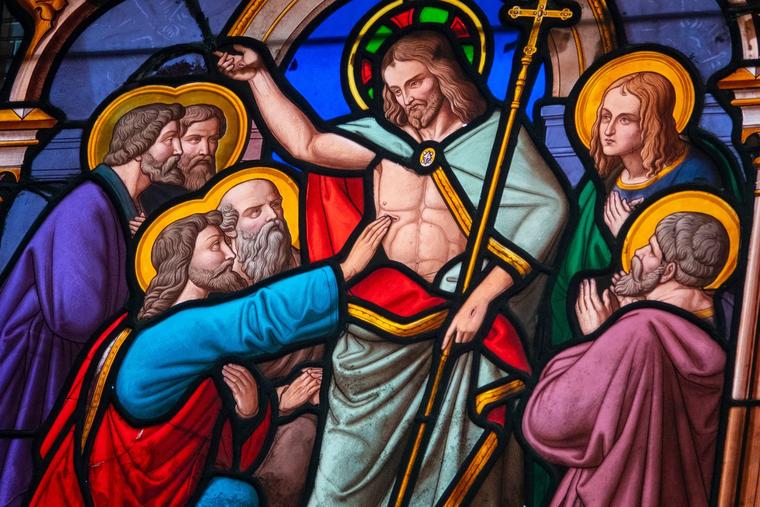
The silence of Holy Saturday has given way to Easter and with it, the full confirmation of everything the Cross had won. The Risen Christ appears to Mary Magdalene and commissions her with astonishing words: “Go to my brethren and say to them, I ascend to my Father and your Father, to my God and your God” (John 20:17).
Not my Father alone — but your Father. The Resurrection confirms what the cross had won. St. Paul in his Letter to the Romans captures the interior experience: “You have received the spirit of adoption, by which we cry out, ‘Abba! Father!’” (8:15). Abba — the intimate cry of a child who knows he or she is loved. Not striving. Not proving. Simply, entirely, permanently loved.
St. Josemaría Escrivá, the founder of Opus Dei, explained that divine filiation is the very foundation of the Christian life. In Christ is Passing By, he wrote, “Divine filiation is a joyful truth, a consoling mystery. It fills all our spiritual life, it shows us how to speak to God, to know and to love our Father in heaven. And it makes our interior struggle overflow with hope and gives us the trusting simplicity of little children.”
Once people know they are beloved children of God, they no longer look to the world to tell them who they are.
As you move through this joyful season, carry this truth not as an idea but as a fact. Like John, take Mary into your home, into the home of your heart. We are sons and daughters of God. Mary is our mother. The Cross is our inheritance. The Resurrection is our destiny.
Our divine filiation was not voted on, argued for, or negotiated. It was purchased. And the price was everything.
- Keywords:
- divine filiation
- divinization
- salvation