Ancient and New Wisdom on AI, One Year After ‘Antiqua et Nova’
COMMENTARY: Amid rapid advances in artificial intelligence, the Vatican’s 2025 note ‘Antiqua et Nova’ draws a clear distinction between technological power and human intelligence.
Last year, the Vatican issued Antiqua et Nova, examining the relationship of artificial and human intelligence. The document offers timely insights that can help us appreciate the contributions AI can make to society, as well as the moral dangers presented by this new phenomenon.
The idea that technology can imitate and surpass the power of the human mind, while popular in this age of artificial intelligence, is not new. The 18th-century French philosopher Julien de La Mettrie famously asserted that man is no different from a machine. The century in which he lived witnessed various attempts to produce “automatons,” or mechanical devices, that could imitate human actions.
The development of digital computing in the mid-20th century gave renewed confidence to the belief in the power of technology to replicate human behavior.
In a 1950 paper, English mathematician and computer scientist Alan Turing devised a famous test — now known as the “Turing Test” — as a way of assessing whether machines can replicate human intelligence. He predicted that by the end of the century, it would be possible to program computers so that an interrogator would not have more than a 70% chance of distinguishing a human from a computer after five minutes of questioning.
In 1956, Dartmouth computer scientist John McCarthy organized a summer research project on artificial intelligence, which is today recognized as a foundational moment for AI. A group of mathematicians and scientists met on the top floor of the Dartmouth Math Department to brainstorm, starting from the idea that “every aspect of learning or any other feature of intelligence can in principle be so precisely described that a machine can be made to simulate it.” The event articulated principles that would later develop into some of the key principles used in AI today, such as enabling computers to use language and simulating human neurons to engage in activity bearing a certain likeness to human reason.
In later decades, the technology experienced what are known as “AI summers,” moments of optimism marked by technological breakthroughs, as well as “AI winters,” when progress slowed and pessimism prevailed regarding the grand ideals of artificial intelligence.
The Turing standard was widely recognized not to have been achieved by the end of the 20th century. Nonetheless, advances in later years have ignited widespread enthusiasm for AI’s possibilities.
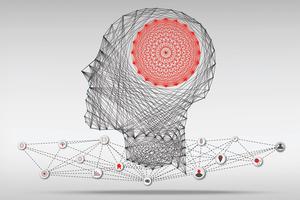
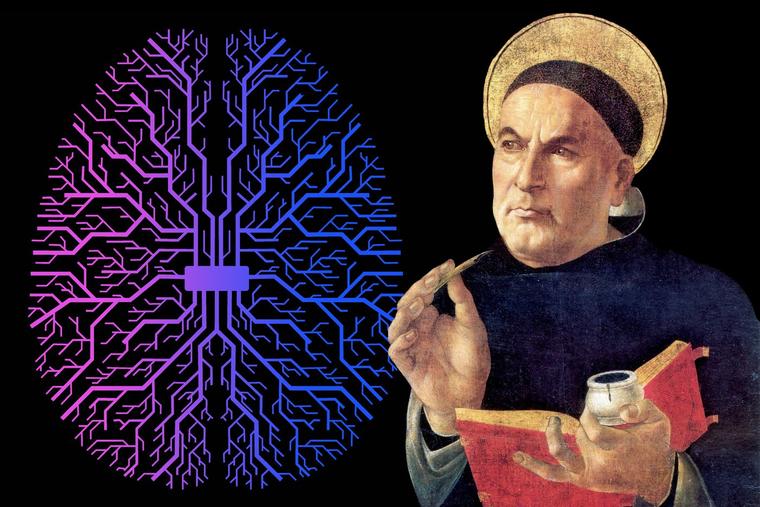
One key model that has guided artificial intelligence throughout its long and multifaceted history has been the human brain, insofar as science has been able to understand this complex organ.
As early as 1943, Warren McCulloch and Walter Pitts, two researchers at the University of Chicago, first proposed the concept of “neural networks,” a vast system of “nodes” modeled after neurons in the brain. These nodes are computational units that transmit signals to each other by means of a network that operates somewhat like the synapses connecting neurons in living organisms.
The development of computing technology in recent decades has allowed for the creation of vast, multi-layered systems of artificial neurons, capable not simply of carrying out programmed tasks, as in traditional computing, but of making inferences from patterns too complex to be defined in code. Such processes bear at least a loose resemblance to human intelligence.
One important reason for these developments in AI capability has been the application of Graphics Processing Units (GPUs), high-powered microchips originally used for video games and PC graphics. By 2011, researchers in the field of AI had discovered that GPUs made by the California technology company NVIDIA — today the world’s largest company — were capable of handling the immense quantity of processing power required to train neural networks.
Using the large amounts of data produced by the internet and other sources, such networks have been trained through a process known as “deep learning” to produce a desired output, whether a realistic image, a judgment about a complex situation, or other useful information.
The development of such technology has no doubt taken computing technology to a new level. Computers in the age of AI no longer simply follow a defined set of rules; they possess a certain autonomy to produce their own way of solving a given problem based on patterns identified in human knowledge.
But is AI capable of thinking? While this technology is capable of receiving and processing information at a high level, many commentators have noted the essential distinction between it and actual human intelligence.
Canadian psychiatrist Ralph Lewis comments that AI falls short of the intelligence characteristic of the human being. Current AI systems, he notes, lack the ability to continually adapt to new information and incorporate that learning into what has been previously learned. They are highly capable, Lewis states, of “sophisticated statistical pattern matching” but lack the ability to form an authentic understanding of the world.
Some argue that it is only a matter of time before AI matches the abilities of the human mind. However, the recent Vatican document, while appreciating the capabilities of artificial intelligence, maintains that this technology remains essentially different from human intelligence.
Human beings, as the philosophical tradition has long appreciated, possess a unique ability to abstract and to grasp the “nature and meaning of things” as Antique et Nova observes. The human mind is capable of analysis and argumentation, but also of intelligence, by which it carries out what Thomas Aquinas describes as “an intimate penetration of the truth.”
This capacity for intellectual understanding, the Vatican document reminds us, is rooted in the human person’s bodily existence. At the same time, the document states that “the human person transcends the material world through the soul,” by which — in the words of the Second Vatican Council’s pastoral constitution on the Church in the modern world, Gaudium et Spes — the human person “shares in the light of the divine mind.”
From this perspective, the advances in AI, however impressive, only serve to highlight more clearly the exalted dignity of the human person, created in the image and likeness of God. With his body and soul, the person is able to continually interact with the world and come to understand its meaning in a way fundamentally distinct from the information processing that artificial intelligence carries out, however vast and complex such operations might be.
Antiqua et Nova also highlights the specifically relational aspect of human beings, who possess “the capacity to know one another, to give themselves in love, and to enter into communion with others.” Genuine relationships require not merely intellectual knowledge, as the document points out, but empathy and the desire to seek the good of the other.
In light of this reality, the document cautions against the idea that AI can replace human beings, particularly in such fields as education and health care, as well as in human relationships more generally.
With these and many other salient points, the Dicastery for the Doctrine of the Faith and the Dicastery for Culture and Education — which jointly produced the document — have offered some key points of reference to guide Christians and all people in approaching recent technological advances and the vast media hype surrounding them.
Most protagonists of the current AI revolution pay little attention to such principles.
Archie McKenzie, a young executive at an AI startup based in San Franscisco who was invaluable in providing background for this essay, tells me that in his industry very few people apply Christian thinking to these topics.
Given the great possibilities, but also the serious risks, of this new technology, perhaps the most pressing next step is to rediscover the richness of the human person and his exalted dignity. In this area, the Church’s philosophical and theological tradition remains a sure guide, so that technological progress might genuinely serve the good of society.

Father Joseph Thomas Opus Dei Father Joseph Thomas, based in Princeton, New Jersey, is dedicated to ministry that focuses on college students. He writes regularly on theological topics and is the author of The Theology of Divine Grace (Scepter, 2023). He also serves as the U.S. representative for the Pontifical University of the Holy Cross in Rome.