U.S.–Iran Accord Draws Applause From Bishop Zaidan
The bishop said he prays for a permanent peace between the U.S. and Iran and hopes to see more progress toward long-term peace in Lebanon.
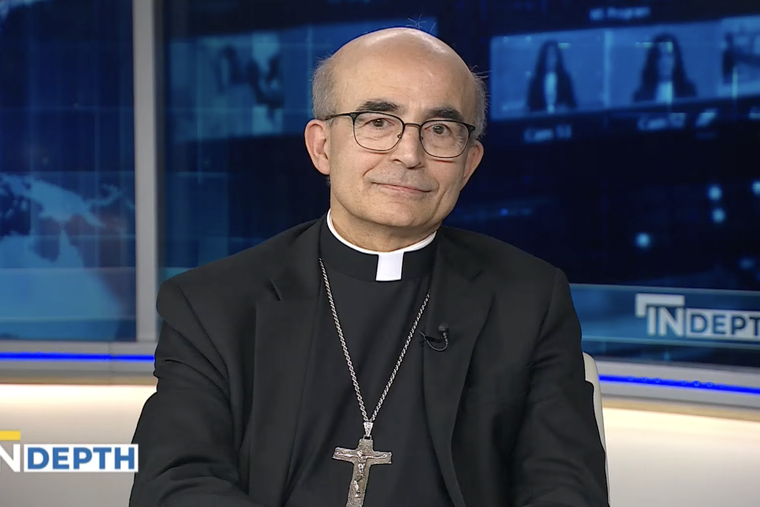
A 60-day Memorandum of Understanding (MOU) — which strengthens the ceasefire between the U.S. and Iran and seeks to pave the way for permanent peace — has garnered applause from the U.S. Conference of Catholic Bishops (USCCB).
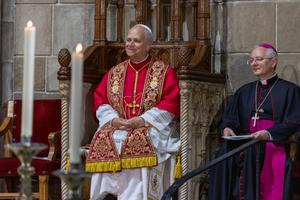
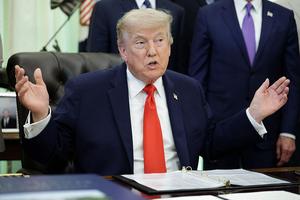
Bishop A. Elias Zaidan, who chairs the USCCB Committee on International Justice and Peace, commended both President Donald Trump and Iranian President Masoud Pezeshkian on the progress and expressed hope for a long-term deal in a June 17 statement.
Both countries’ leaders, Bishop Zaidan said, have taken a “vitally important step,” which is aimed at “ending hostilities” and “advancing deeper dialogue for lasting peace in the region.” He added that “preventing further proliferation of nuclear weapons is critically important for avoiding a dangerous escalation of conflict in the Middle East.”
Bishop Zaidan asked all parties involved to engage in good faith and pray for Pope Leo XIV’s intention that “this agreement may help strengthen mutual trust, security and stability in the Middle East, promoting paths of dialogue and cooperation among peoples.”
The bishop, who was born in Lebanon and serves as eparch of the Eparchy of Our Lady of Lebanon of Los Angeles, encouraged the U.S., Iran, and Israel to prioritize peace efforts in Lebanon, which is meant to be covered by the U.S.-Iran deal but is still facing Israeli strikes in spite of the MOU.
“I call on the United States, Iran, and Israel to now also prioritize an end to the fighting in Lebanon,” Bishop Zaidan said.
“The disarming of Hezbollah is necessary for peace and development in Lebanon,” he said. “Over one million people have been internally displaced, including 400,000 children, and thousands have fled to neighboring Syria, potentially adding to the region’s instability. If the fighting and humanitarian catastrophe continue in Lebanon, I fear that peace across the wider Middle East will remain unreachable.”
The bishop urged prayers for a resolution to the conflicts.
“Let us pray that the Holy Spirit, creator and vivifier, may breathe wisdom, compassion, and perseverance into the minds and hearts of the negotiators, so that peace in the region may finally become a reality,” Bishop Zaidan prayed.
The agreement between the U.S. and Iran puts a hold on military combat and reopens the Strait of Hormuz, an important waterway for international trade. Both the U.S. and Iran agreed not to prevent the passage of any ships. There is gradual sanction relief for Iran, which has already resulted in Iranian oil sales, and a $300 billion fund for development in Iran supported by private investment.
Iran must agree it will never develop a nuclear weapon, which is aligned with its position since 2003 when former Supreme Leader Ali Khamenei issued a fatwa declaring the development of nuclear weapons as inconsistent with Islamic law. Questions about whether Iran will be allowed to enrich uranium — or to which level nuclear enrichment will be permitted — will be decided in the 60-day window.
- Keywords:
- iran deal
![In his [2002] World Day of Peace message, John Paul II taught a truth many Catholics have seemingly forgotten: that ‘peace,’ in the classic Catholic sense of the term, is a matter of order, the order that is built through law and politics.](https://publisher-ncreg.s3.us-east-2.amazonaws.com/pb-ncregister/swp/hv9hms/media/2023041608044_75d11fdb96e18653aedf08d75a42f89e5c2313225a417aec6f1f8d73eb8c525f.jpg "In his [2002] World Day of Peace message, John Paul II taught a truth many Catholics have seemingly forgotten: that ‘peace,’ in the classic Catholic sense of the term, is a matter of order, the order that is built through law and politics.")