This Is the Deepest Division of All
You either believe the Word became flesh or you don’t. And there’s no neutrality in that decision.

The historian Arthur Schlesinger, Jr., who died in 2007 — and whose specialty was partisan hagiography, particularly on behalf of the Kennedy brothers — was once asked, “If you had to say that the world was divided into only two kinds of people, not counting the sexes, what would they be?” He replied almost at once: “Roundheads and Cavaliers.”
Now it is no surprise that a historian of his ideological bent, with an intelligence wholly informed by worldly concerns, would answer in that way. Indeed, no intellectual so steeped in secularity would have found it the least bit odd or unnatural to divide the world along such simplistic lines. Why not reduce everything to disagreements about politics and power? Isn’t that how the world works according to the liberal mind? And then, of course, to prefer one faction to the other, the Roundheads over against the Cavaliers, inasmuch as the former were viewed as more enlightened and therefore the more liberal of the two. It makes perfect sense.
He was utterly mistaken, to be sure, having missed out on the whole realm of mystery, of a God who actually impacts our history by the event of his becoming incarnate in that history. But before getting to that, which raises the question of what really divides us, it might be fun to run that same test on Professor Schlesinger: Of the two kinds of people in the world, there are those who have heard of him, and those who haven’t. And of the two, which group may boast of the greater number? I suspect those who have never heard of him — those who would fail to recognize him even if his owlish face were suddenly to appear outside their front door. Such is the fleeting nature of fame.
So, where is the real and abiding line of division these days?
Well, it hasn’t gone anywhere. Not since the coming of Christ more than 2,000 years ago when, having first burst through the clouds to encamp among us, the line got drawn in the sand and the dirt of human history, producing “in the great sea of our usual life,” to quote a line from Luigi Giussani, “a continual newness.” So that, on the strength of the claim made by Christ, confirmed by all the followers of Christ down through the centuries, especially the Church he fashioned from his pierced and crucified body, the world is now permanently divided between those who accept the fact of God’s presence among us, and those who refuse to believe it.
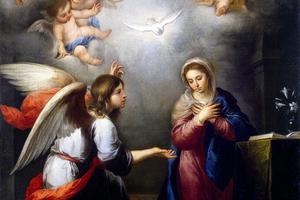
There is no third way. Either he came, or he didn’t. The language of Nicaea is perfectly plain about the matter, eschewing all possible ambiguity. “For us men and for our salvation,” it declared back in the early fourth century, “he came down from heaven, and by the Holy Spirit was incarnate of the Virgin Mary, and became man.”
So, did God enter into the very theater of our world, moving about the same stage on which all of humanity must make its way from birth to death, or didn’t he? Was this child — who was first conceived in Nazareth, then born in Bethlehem nine months later, destined to suffer and die 33 years later upon a cross — the Son of God or not?
It is the only question that finally matters. Whether eternity erupted into time, glory into grit, mystery into history. On the answer to that everything depends, including the sort of history men write. Neutrality is not an option. Not to choose, is to choose.
“Children, it is the last hour,” warns the Apostle John in his First Letter. And how does he know this? Because, in the immediate aftermath of the fact that he has come among us, not as an idea but as God himself in human appearance, and thus wholly one of us, “many antichrists have also come,” persisting in their refusal to believe. It is they who stand athwart the truth which is Christ, the Incarnate God in our midst.
John has certainly got their number, and he will not relent in calling them out. “Who, then, is the liar,” he asks, “but he who denies that Jesus is the Christ? This is the antichrist, he who denies the Father and the Son.” If sin be a deliberate stupidity, then here is the stupidest thing of all, the sin of rejecting the Incarnation of God, an event indisputably rooted in history, in a very specific time and place. And so we must, John enjoins us, “test the spirits to see whether they are of God; for many false prophets have gone out into the world.” And how are we to know the false from the true? The acid test could not be more plain:
By this you know the Spirit of God: every spirit which confesses that Jesus Christ has come in the flesh is of God, every spirit which does not confess Jesus is not of God. This is the spirit of antichrist, of which you heard that it was coming, and now it is in the world already. Little children, you are of God, and have overcome them; for he who is in you is greater than he who is in the world (1 John 4:1-4).
Let us be confident, therefore, let us remain serene in the knowledge that Christ, who moved among us as both God and man — “the staggering alliance,” writes Joseph Ratzinger, “of logos and sarx” — has vanquished the world, unmasking the pretensions of those who would, in their post-modern sophistication, prevent the simple from ever seeing the human face of God. Or even wanting to do so, which may be the gravest affront yet to human dignity, to the desires of the human heart that define that dignity.
We have a right, given to us by God himself, to want to see the God who has come so near to us that we can reach out and touch him, actually take him into our bodies and souls in the unheard-of intimacy of the Eucharist, that most “scandalous particularity” of all, in which God breaks himself to become our food and drink.
Not even historians are exempt from having to know this.
- Keywords:
- Incarnation
- reality