Discover ‘The Unknown St. Francis of Assisi’ in New ‘EWTN Learn’ Series
Teresa Tomeo hosts in Italy, walking in the footsteps of Francis.
Looking to learn more about St. Francis during this Jubilee Year of St. Francis of Assisi?
Discover “The Unknown St. Francis of Assisi” in a new “EWTN Learn” series, hosted in Italy by Teresa Tomeo: from the places that shaped his mission 800 years ago — where he heard God’s call to conversion, served lepers, tamed a wolf in Gubbio, received the wounds of Christ, and established the Nativity scene in Grecco — to insights into his lasting legacy.
Traverse the “The Land of Saints” with Tomeo, starting in Santa Maria degli Angeli (St. Mary of the Angels) to see the little church, the Little Portion Church (the Portiuncula), near Assisi where Francis began his ministry.
"St. Francis brings us back to the basics of the faith,” Tomeo says, adding, “He teaches us about the importance of the Eucharist, about the Incarnational Lord, and he loved Jesus so much that he not only wanted to rebuild the Church spiritually, but physically as well."
Spoleto is where Francis was sidelined by illness and had a dream: “Follow the Master rather than the man.”
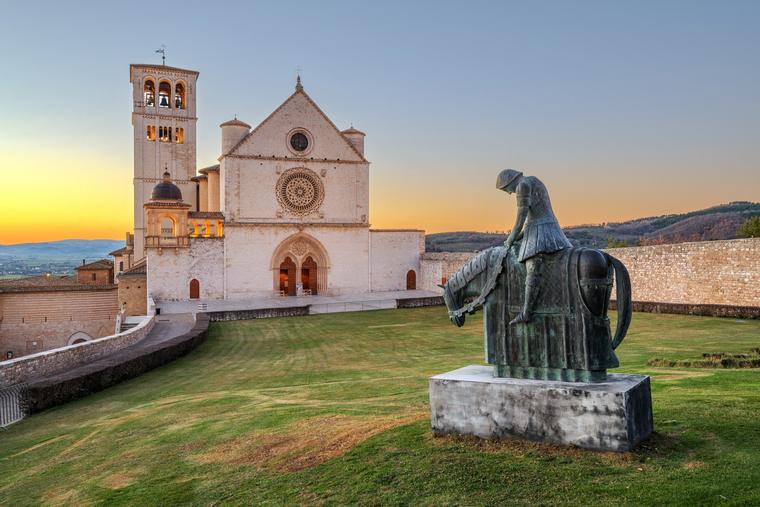
So Francis went back to Assisi to fight for the Church — a statue depicting him on horseback stands outside of the basilica in Assisi, a testament to his conversion. As Tomeo explains, “The Lord has a different plan. ... He was going to be fighting to save the Church.”
The Sanctuary of Rivotorto commemorates where Francis began his order and where he experienced a total change of heart, marked by his care for lepers in the area. A reconstructed hut shows how he lived, as Tomeo puts it, by “simplicity of life and the humility of God and helping people understand that more deeply."
Holy friendships where also cultivated here, including with the fellowship of St. Clare and St. Francis; Clare shared his faith-filled conviction and began the Poor Clares.
Tomeo’s takeaway eight centuries later: “The message, the simplicity of the Franciscans keeps grabbing people’s hearts. ... Holy friendships, they do matter.”
(St. Carlo, who is buried in Assis, also loved St. Francis and considered him a friend.)
Canonized within two years of his death, Francis’ legacy lives on 800 years later in the work of Franciscans like the Poor Clares (including Mother Angelica and her nuns and EWTN) and the Franciscan Missionaries of the Eternal Word.
As Father Patrick Mary reflects: “St. Francis wanted to do everything he could to live the Holy Gospel generously and draw many souls to heaven by his prayers and good example.”
LEARN MORE
- Keywords:
- teresa tomeo
- ewtn
- st. francis

Amy Smith Amy Smith is a Register senior editor who edits devotions and features for print and online. Fueled by prayer and coffee, she enjoys writing about everything from Jane Austen to saints for the Register. She is the author of The Plans God Has for You: Hopeful Lessons for Young Women (Emmaus Road Publishing). Her writing has also appeared in various other Catholic publications. She has a master’s degree in journalism and a B.A. in English.