St. Augustine’s Prescription for Catholic Schools: Conversion, Not Just Programs
St. Augustine’s retreat at Cassiciacum shows us that education is more than instruction — it’s a reordering of desire that leads to wisdom and communion.

In the fall of 386, a newly converted Augustine withdrew to the countryside villa of Cassiciacum with friends, family and students. Their goal? To seek the happy life, not by escaping the world, but by gathering around the Word in conversation, prayer and mutual search.
Augustine’s first work from this retreat, De Beata Vita (On the Happy Life), remains one of the clearest portraits of what education in an Augustinian key might look like: personal, philosophical, prayerful, and ordered toward the possession of wisdom as its ultimate goal. That vision can feel increasingly foreign compared to the contemporary educational landscape, yet it remains a living possibility. I am confident that this renewal is not only imaginable but imperative.
The Crisis Beneath the Crisis
In recent decades, Catholic education has been caught in a cycle of reform and reaction, marked by enrollment strategies, marketing language, curriculum tweaks and the search for more effective technology and techniques. These efforts are often well-intentioned, but many fail to confront the deeper disorder: the modern crisis of desire.
I know this first-hand, having served as a Catholic secondary school educator for more than 17 years. This disordered desire (a restless pursuit of success, relevance or security) has only intensified in the post-pandemic years, affecting young people, their teachers and even governing institutions. Without a renewed sense of what we are truly made for, we risk mistaking movement for meaning.
Here, contemporary thinker René Girard offers a prophetic lens. Girard’s theory of “mimetic desire” suggests that human beings do not desire objects directly, but through imitation: we want what others want. This imitation often escalates into rivalry and scapegoating, especially in communities where desire is unexamined and unformed.
“Man is the creature who does not know what to desire,” Girard writes. “He turns to others in order to make up his mind. We desire what others desire because we imitate their desires.”
But what happens when this logic takes root in the hallways of a Catholic school? When status, recognition, achievement and even virtue itself become arenas of comparison? When education becomes performance, not formation?
We create classrooms where students are subtly taught to compete for attention rather than rest in the truth — where desire is aimed not at wisdom but at applause.
Augustine anticipated this disorder in On the Happy Life. He describes a “volcanic mountain” standing before the port of true wisdom — a mountain that symbolizes the puffed-up pride of those who pursue knowledge for vainglory rather than for truth. These intellectual elites “enjoy looking down on everyone,” he writes, “and lure travelers away from the port while also discouraging them from actually climbing the mountain to join them.”
This is not merely a warning to scholars — it’s a warning to educators at every level, including staff, faculty, coaches, administrators and clergy. We must guard against the temptation to turn Catholic learning into cultural capital.
Reordering Desire at the Source
If the problem is disordered desire, the solution is not simply more content or control; it is the reordering of love. Here, too, Cassiciacum is instructive. In that hidden school, Augustine charts a way to fullness (plenitudo) — not through excess or lack, but through measure (modus). Wisdom, he writes, is not an accumulation of knowledge but the soul’s proper measure: “the balance that keeps us from being puffed up or shriveled in our thoughts.”
This echoes an insight from Pope Leo XIV (then-Father Robert Prevost) in his foreword to Basic Elements of Augustinian Pedagogy: “Our schools should be the places where students begin to recognize that education is a movement of the soul … a preparation for the joy of communion.”
That phrase — “movement of the soul” — reminds us that education is not simply instruction, but an opportunity for conversion. The Catholic classroom must form desire by directing it toward wisdom, not prestige; toward fullness, not frenzy; toward communion, not competition. This is akin to Augustine’s own Tolle Lege experience shortly before he arrived at Cassiciacum, which is later recounted in Book 8 of his Confessions.
However, conversion is not a static moment. It is, as Augustine himself discovered, a continual reordering of desire — a shift from domination to dialogue. As Pope Leo XIV once wrote, the Augustinian tradition offers decisive contributions to this process: “the search for truth, respect for the person of the student, dialogue and empathy as pedagogical tools, [and] attention to the mystery of the ‘Inner Teacher.’” These are not just methods; they are markers of an educational community rooted in love.
Still, the most urgent task for our schools is not merely to transmit values, but to embody them.
“The importance of transmitting ‘(Augustinian) values’… must not become the cause of forgetting something else much more important: the demand that we live and witness to these values… incarnating them in our human relationships.” Yet, this incarnational witness becomes nearly impossible when the deeper desires animating our schools go unexamined. Which leads us to a painful but necessary question: What happens when desire goes wrong?
From Scapegoat to Sacrament
Girard argues that when desire becomes rivalrous, it must be resolved, often through the scapegoating of others. “Human communities,” he writes, “stabilize themselves by uniting against a common enemy.” The tragic irony is that schools, even Catholic ones, can mimic this pattern: isolating the struggling student, the difficult teacher, or the disruptive family as the problem, rather than examining the system of desire we’ve built.
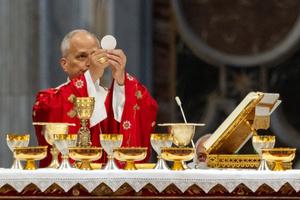
Yet, the Church offers an alternative: not the scapegoat, but the Blessed Sacrament. In the Eucharist, we are united not by rivalry, but by the shared reception of the One who gives himself entirely.
“O Sacrament of love,” wrote Augustine, “sign of our unity and bond of our fraternity, all who long for life have here its very source.”
This is not poetic idealism. It is the proper basis of Catholic education. Without a Eucharistic foundation, we cannot reclaim our schools. Without conversion, our best reforms will be limited to mere cosmetic changes. As the young Pope Leo XIV said in his doctoral dissertation from 1987, “No Christian community can be built up unless it has its basis and center in the celebration of the most Holy Eucharist.”
The first days of the school year offer Catholic educators an opportunity for clarity and renewal. Now is the time to honestly ask: What desires are being modeled in my classroom, my faculty lounge, my school culture? How can we reorder those desires?
School leaders can seek to ensure that faculty formation prioritizes spiritual friendship. Teachers can reflect on how to design classrooms that foster a shared pursuit, rather than a focus on performance. Coaches, too, can consider how team culture (on and off the field) might be reoriented toward virtue, discipline and sacrificial love rather than rivalry or mere results. Chaplains and campus ministers can build rhythms of prayer, silence and conversation into the schedule, planting seeds of Cassiciacum.
Now is the moment to create room for the right kind of rest — the kind that prepares us to love better.
A New Augustinian Age
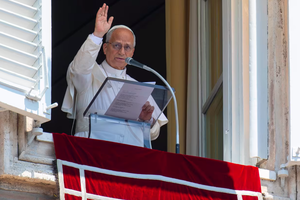
With the election of Pope Leo XIV, the Church enters a new chapter of possibility. As Prior General of the worldwide Augustinian Order, he wrote, “The Order of Saint Augustine is convinced that education is one of the most vital services it can render to society and to the Church.” Now, as the universal shepherd, he carries that conviction to the global stage. This moment calls us back to Cassiciacum — to that villa of conversation, prayer and reordered desire.
In the ancient world (as in ours), the path to safe harbor was often lost in storm and shadow, with many forgetting the way home. Yet Augustine, weary and wounded, found it again — not alone, but in communion. Let our Catholic schools become such places of return. Let our teachers become trustworthy beacons, and let our students be formed not only in truth, but also in unity and love.
In the Church’s new Augustinian age, our schools do not need perfect programs. They need a curriculum of conversion, a way of teaching and living that, under the shepherding of Pope Leo XIV, leads all of us to the longed-for shores of the happy life. There, Christ awaits us, not as a distant idea, but as our companion, our teacher, our joy and our rest.
- Keywords:
- st. augustine
- catholic schools

Brendan Towell Brendan Towell is the Director of Spirituality and Mission for Secondary Schools and Schools of Special Education in the Archdiocese of Philadelphia, where he lives with his family. His interests include Augustinian Studies, Ressourcement Theology and the theological legacy of Pope Benedict XVI. His website is BrendanTowell.com.