Church Leaders: Budget Cuts Hurt the Poor
As default looms, fiscal conservatives stress wealth creation over redistribution.
WASHINGTON — An alliance of American churches, including the United States Conference of Catholic Bishops, met with President Obama last week, urging that programs aiding the poor be exempted from any spending cuts.
The ecumenical appeal was cast as a non-partisan initiative, but some critics viewed it as a wrong-headed measure that will keep taxes high and prevent investments by small businesses that would lead to job creation.
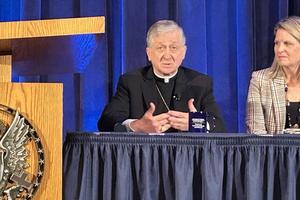
After meeting with Obama, the group held a teleconference with members of the media emceed by John Carr, the executive director of the USCCB’s Department of Justice Peace and Human Development. He called the alliance “unprecedented,” adding, “Across a broad spectrum of religious life, a group of leaders have come together around a simple and clear moral principle, which is the need to protect the poor and vulnerable in this budget process.”
The alliance of over 60 Christian leaders and organizations — named the “Circle of Protection” — was formed in April. Its founding statement calls on U.S. leaders to “consider tax revenues, military spending and entitlements in the search for ways to share sacrifice and cut deficits.” It also states that “a fundamental task is to create jobs and spur economic growth. Decent jobs at decent wages are the best path out of poverty.”
Among its members are two Evangelical social justice groups — Sojourners and Evangelicals for Social Action.
During their meeting with Obama and several senior administration officials, the religious leaders called on the White House to help form a “circle of protection” around poverty programs likely to face cuts as Capitol Hill struggles to resolve an acrimonious budget fight.
However, conservative Christian critics argue that the group’s efforts are counter-productive, penalizing the very people they are designed to protect.
Collette Caprara, editor of the DeVos Center for Religion and Civil Society, a spinoff of the conservative Heritage Foundation based in Washington, D.C., described the Circle of Protection as “well-intended.”
“But if programs are not achieving what was intended, you are not serving the people you are supposed to be helping by propping up such programs,” she said.
Father Robert Sirico, president of the Acton Institute, a conservative think tank based in Grand Rapids, Mich., suggested the Christian activists may not be aware “of the root causes of poverty and wealth.”
“Their statements are all about redistribution of wealth with almost nothing about wealth creation through production and labor,” he said.
Catholic members of the “Circle of Protection” include Bishop Stephen Blaire of Stockton, Calif., chairman of the USCCB’s Committee on Domestic Justice and Human Development; Sister Simone Campbell, a member of the Sisters of Social Service religious community and executive director of NETWORK, A National Catholic Social Justice Lobby, which supported Obama’s health insurance reform bill despite the USCCB’s opposition; Patrick Carolan, executive director of the Franciscan Action Network, and the Father Thomas Cassidy, president of Conference of Major Superiors of Men and provincial superior of the Priests of the Sacred Heart.
Matthew 25
During the tele-press conference, Catholic Bishop Ricardo Ramirez of La Cruces, N.M., told reporters: “Matthew 25 doesn’t say, ‘Whatsoever you do unto the forgotten middle class, you do unto me.’ We want to speak for ‘the least of these.’”
Bishop Ramirez described the current budget debate, as it played out in New Mexico: “There seem to be some givens in the debate: for Republicans: no new taxes — given. For some Democrats, no cuts to Medicare — given; for others, no cuts to military spending — given. For the Obama administration; some additional revenues are given. Sadly, it seems while listening to the debate that protecting the poor and the vulnerable is not a given and that is why we are there.”
The ecumenical alliance released its founding statement earlier in the year, counting among its signers representatives of the St. Vincent de Paul Society, Catholic Charities USA, the Jesuits, as well as 45 development or relief organizations.
The leaders of the alliance said they had been received sympathetically by Obama, but they declined to provide specifics about his actual remarks during the White House meeting. Their message appeared to be directed at church members, whom they hoped to reach through pastors and the news media.
Left-wing Evangelical leader Jim Wallis, founder of the Sojourners, said, “Almost every pulpit in America is connected to the Circle of Protection.”
David Beckmann, president of Bread for the World, a nondenominational lobby group devoted to urging the U.S. government to give international food and development aid, added, “At least a quarter of the people in the country are at religious services every week. If we could get 10% of those folks to contact their member of Congress, there would be no risk [to poverty programs].”
According to Beckmann and other members of the alliance, the most serious threat is that foreign aid programs, especially emergency assistance, would be cut. Lives were at risk, he contended.
Asked if the needs of the poor had been presented to Congressional Catholics, such as House budget committee chairman Paul Ryan, Carr said a “significant, substantial and constructive meeting” had been held with Ryan and other GOP members of Congress — though another prominent Catholic, House Speaker John Boehner, had so far been too busy to meet.
“We’re going to make this case everywhere we can because we think it’s a measure of us as a community of faith and a measure of us as a nation whether we provide liberty and justice for all,” Carr vowed.
Several speakers at the news conference asserted their lack of self-interest, claiming that this set them apart from other participants in the budget debate. However, the USCCB, for example, reported $58 million in government funding for its aid programs in 2009, while Catholic Relief Services netted $517 million.
Terry Heinrichs, chairman of the department of Political Science at Glendon College, York University in Toronto, described the Circle of Protection as “ an obvious, Democrat-driven initiative intended to pressure Republicans to drop their insistence on cuts — especially to entitlements — and agree to raising taxes as a way to deal with the debt ceiling and budgetary issues.”
Heinrichs said Obama wanted a long-term solution, so he wouldn’t have to face negotiations later on, while the Republicans sought to raise the issue in 2012, an election year. He suggested that the president’s direct appeals to the American people were increasingly ineffective. “The more he goes to TV the lower he gets in the polls. A lot of that zing is gone that he had when he first got into office and people saw him as rising above politics. He has turned out to be as partisan as any politician has ever been.”
Wrongheaded
Other critics viewed the Circle of Protection’s emphasis on preserving programs as wrong-headed.
“Any Christian would agree that we should put the poor and vulnerable first. The question is how,” noted Father Sirico.
He argued that taxes on the middle class destroyed its ability to grow the economy and to generate surpluses that can be used to assist the poor or to create new jobs.
“Redistributing wealth is the way to keep the poor in poverty. The way to lift them out of poverty is with jobs,” said Father Sirico, who added that he did not mean government jobs, but rather jobs generated through wealth creation in the private sector.
Father Sirico proposed cutting poverty programs in half, giving the savings back to the middle class as a tax credit for any donations to charities. “You’d save a huge amount on the bureaucracy,” he said.
Collette Caprara made a similar case, extolling the work of the Center for Neighborhood Enterprise, a national organization founded in 1981 which encourages inner-city community and church leaders to promote personal responsibility and self sufficiency as the route out of poverty, based in Washington, D.C.
In her view, government programs, including the programs the Circle of Protection seeks to protect, hurt more than they help. “A true measure of our nation’s compassion is not the number of people who are sustained in a state of dependency but the number who are empowered to achieve self-sufficiency,” Caprara said.
Carr emphatically rebutted Father Sirico’s comments, saying, “We are for economic growth. It is one of the eight principles in our founding statement. There is literally nothing in that statement about wealth redistribution. ”
He also said it was absurd to suggest the groups involved did so out of self-interest. “I work for the Catholic bishops. Bishop Ramirez works for the people of Las Cruces,” he said. “Everyone involved wants only to protect the poor and vulnerable.”
Register correspondent Steve Weatherbe writes from Victoria, British Columbia.