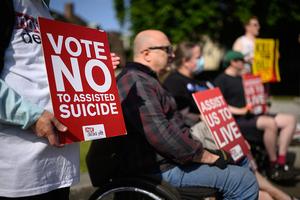
UK Pro-Life Groups Hail ‘Great Victory’ as Assisted-Suicide Legislation Fails
Proposed legislation in England and Wales, which much of the media portrayed as ‘inevitable,’ stalls in House of Lords after ‘extraordinary effort’ to oppose it.
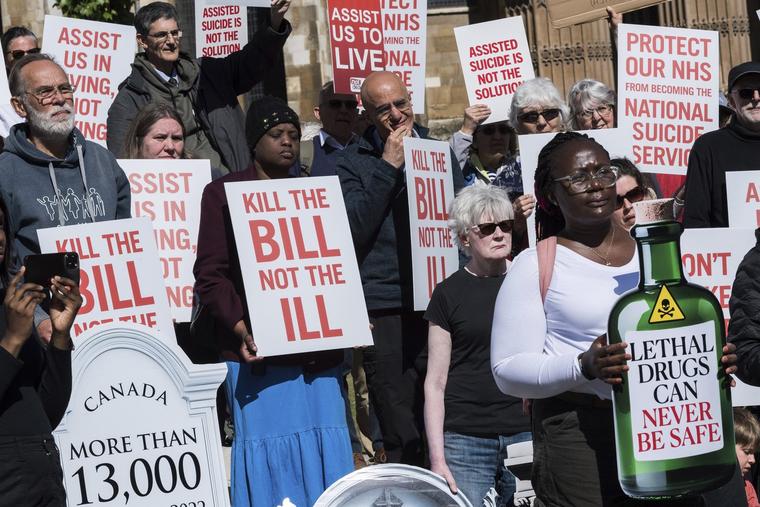
LONDON — Pro‑life advocates hailed the failure of the proposed legislation to legalize assisted suicide in England and Wales on Friday as a “great victory,” marking the end — at least for now — of one of the most closely watched moral debates in the U.K. Parliament.
The bill, introduced by Labour MP Kim Leadbeater, had initially passed the House of Commons last June by a vote of 314 to 291. Observers said the legislation would have been comparable to the 1967 Abortion Act, the abolition of capital punishment, the decriminalization of homosexuality, and the introduction of same-sex “marriage.”
Supporters of the Terminally Ill Adults (End of Life) Bill argued it would grant individuals the autonomy to end their lives in cases of terminal illness. Opponents, including pro-life campaigners and Catholic Church leaders, warned it would fundamentally undermine the dignity of human life, place vulnerable people at risk, and instead urged greater investment in palliative care.
Despite its early momentum, the legislation ultimately stalled in the House of Lords, where hundreds of amendments were introduced and debated. Unlike the Commons, the Lords must consider each proposed change in detail, and as scrutiny intensified, time ran out before the bill could complete its passage. Its failure was not marked by a final vote, but by the expiration of parliamentary time — effectively halting its progress.
“This is brilliant news,” said the Society for the Protection of Unborn Children (SPUC) in a statement, adding that it bucked a media narrative that tried to portray the legislation as “inevitable.”
“Make no mistake, this outcome is not because of procedural fluke,” said the pro-life charity that has been at the forefront of the opposition. “The Lords took their job of scrutiny seriously, and the more they scrutinized the bill, the more its flaws were exposed.”
“This will save many lives from deliberate destruction, with patients instead being cared for and accompanied to the end,” said Anthony McCarthy, director of the U.K.-based Bios Centre, a pro-life bioethics research center. “It is the culmination of an extraordinary effort throughout Britain, uniting those of widely different beliefs, politics and ways of life.”
Recalling the campaign, McCarthy told the Register that hospices “underlined the threats the bill posed to vulnerable patients and to institutional and individual conscience. Psychiatrists stressed their normal role of suicide prevention, while domestic-abuse experts cast doubt on confident claims that coercion could be readily identified.”
SPUC also highlighted the difference made by many people lobbying their MPs and then peers. “The shift in narrative around this bill has been remarkable,” the charity added. “This is a great victory, and we should acknowledge that.”
Supporters of the bill expressed frustration with the result, claiming that procedural delays allowed a minority in the unelected chamber (the House of Lords) to block legislation approved by elected MPs. Others said several MPs who supported the bill in principle had done so conditionally, expecting further safeguards and revisions that were never fully realized.
According to Right to Life UK, a pro-life charity, new polling has shown decreasing support for assisted suicide in the House of Commons and among the public at large. The polling results suggest that if the legislation were to be put to a vote today, “it would likely be rejected by the House of Commons,” the charity said in a statement on Friday.
As a private members bill, the legislation cannot be revived as the same bill in the next parliamentary session. Another MP, however, could reintroduce very similar proposed legislation through an annual ballot process in the next session. The next ballot for private members bills will take place in a few weeks, and SPUC warns that any MP who receives many votes on that ballot will be “under huge pressure to take on the bill.”
While some have suggested that an obscure mechanism (the Parliament Act) might be used in future to bypass the House of Lords, such a move would be highly unusual — particularly for a private members bill — and would raise constitutional questions. Right to Life UK said only a minority of the public polled supported bypassing the House of Lords.
Scotland, which has a separate legal system to England and Wales, recently rejected assisted-suicide proposals, while the Isle of Man and Jersey have moved toward legalization. This means that, to date, no uniform approach has emerged across the British Isles.
McCarthy stressed that “much remains to be done to support palliative care in Britain,” but added that, in the meantime, “this is a deeply welcome outcome which honors Hippocratic medicine.”
- Keywords:
- assisted suicide
- u.k.
- dignity of human life

Edward Pentin Edward Pentin is the Register’s Senior Contributor and EWTN News Vatican Analyst. He began reporting on the Pope and the Vatican with Vatican Radio before moving on to become the Rome correspondent for EWTN's National Catholic Register. He has also reported on the Holy See and the Catholic Church for a number of other publications including Newsweek, Newsmax, Zenit, The Catholic Herald, and The Holy Land Review, a Franciscan publication specializing in the Church and the Middle East. Edward is the author of The Next Pope: The Leading Cardinal Candidates (Sophia Institute Press, 2020) and The Rigging of a Vatican Synod? An Investigation into Alleged Manipulation at the Extraordinary Synod on the Family (Ignatius Press, 2015). Follow him on Twitter at @edwardpentin.