Priestly Vocations Are Booming in the Midwest and the South
The Register analyzed data on ordinations collected by Georgetown’s Center for Applied Research in the Apostolate.
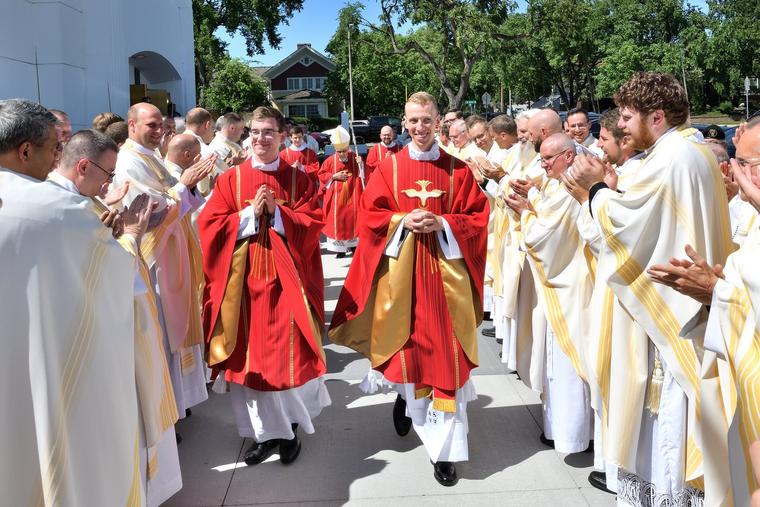
In a 2008 address in Washington, D.C., Pope Benedict told the U.S. bishops that “the ability to cultivate vocations to the priesthood and the religious life is a sure sign of the health of a local Church.”
By Benedict’s metric, some American dioceses are thriving today, producing lots of priestly vocations from holy families, schools and parishes. Others are struggling.
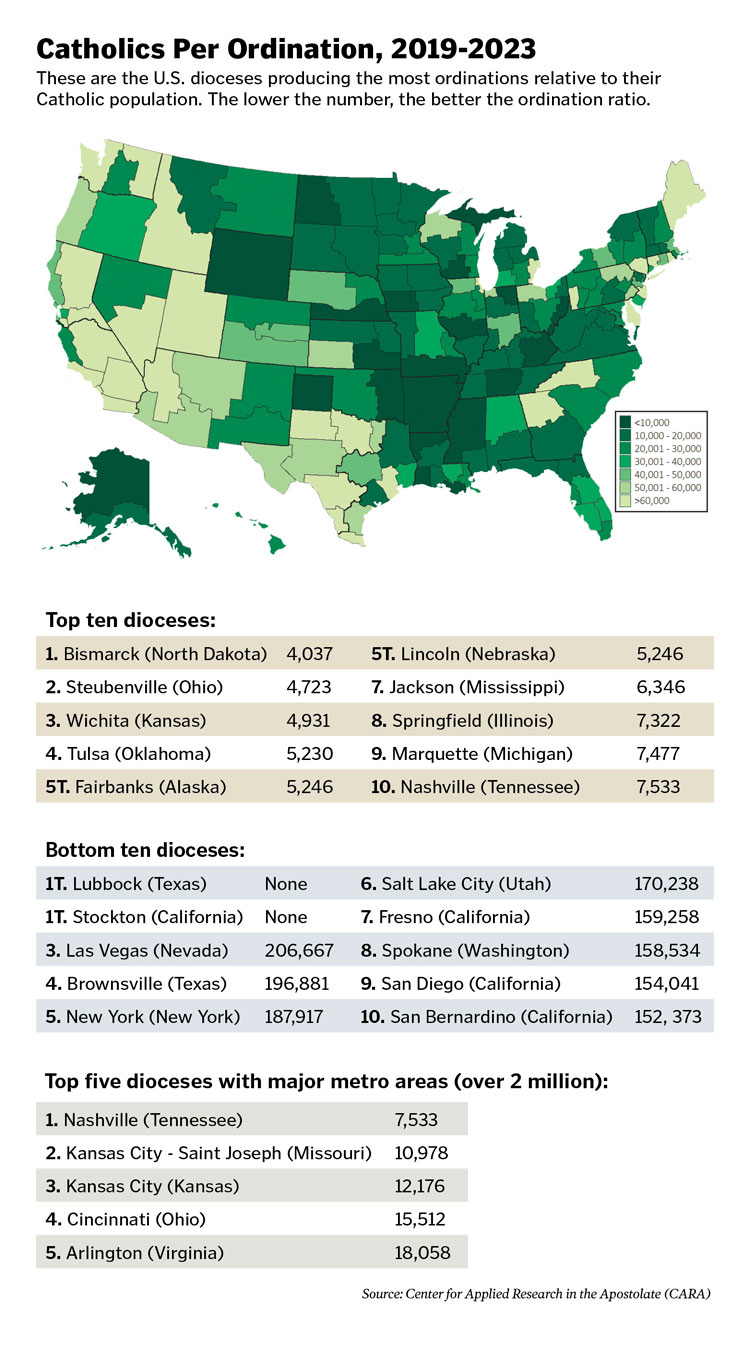
To get a concrete measure of this, the Register analyzed data on ordinations collected by Georgetown’s Center for Applied Research in the Apostolate (CARA). CARA compiled numbers from the Official Catholic Directory, an annual report that collects official data from each diocese on total Catholic population, ordinations and other statistics. CARA compared each diocese’s current Catholic population to its number of ordinations during the most recent five years in the Official Catholic Directory’s data, 2019 to 2023. In other words, the total Catholics per recent diocesan ordination in every diocese.
This statistic provides a snapshot in each diocese of the amount of ordinations relative to the Catholic population. Measuring ordinations relative to total Catholic population is important because while 20 ordinations would be very impressive in a diocese with a small Catholic population like Jackson in Mississippi, it would not be in a diocese with large numbers of Catholics like Los Angeles.
The data only accounts for ordinations of diocesan priests, that is, priests who serve a particular diocese. It does not factor in priests ordained for religious orders like the Benedictines or Franciscans.
This “Catholics per recent diocesan ordination (2019-2023)” statistic reveals some interesting stories about the state of priestly vocations across the 50 states.
Among the findings:
- While diocesan ordinations have been falling nationwide (down 22% between 2014 and 2023), some dioceses in overlooked regions are bucking the trend. The South, America’s least Catholic region, and the Great Plains, one of America’s most sparsely populated regions, are hitting well above their weight.
- The region’s historically most Catholic regions — the Southwest and the Northeast — are struggling with priestly vocations.
- Of the nation’s 50 best-performing dioceses, exactly half are in the Midwest, and 18 are in the South (including Texas and Oklahoma). The rest of the country combined, despite making up 25 states, has just seven of the top 50.
- Nationwide, no matter the region, rural dioceses tend to outperform urban ones. The top five — Bismarck, Steubenville, Wichita, Tulsa and Fairbanks — are all largely rural. Many of the bottom 25 are dioceses covering major metro areas like New York, Los Angeles, Chicago, Seattle, Dallas and Pittsburgh.
- The Diocese of Bismarck, with just 60,000 Catholics, has had more priestly ordinations in the last five years — 15 — than eight dioceses with more than a million Catholics, including San Diego, Fort Worth and Fresno.
- The best-performing diocese in a major metro area of more than 3 million is Arlington (Virginia), which ranks 66th in the country. Some dioceses representing smaller major metros, however, do make the top 50: Nashville, Kansas City-Saint Joseph, Kansas City in Kansas, and Cincinnati.
Bumper Crop in the Midwest
From Steubenville to Wichita, vocations numbers are quite good across the Midwest. Most of the region’s strongest dioceses are on its western edge. In the wide-open spaces of ranches and wheat fields stretching from Kansas through the Dakotas, young men are heeding the call at some of the highest rates in the country. The Great Plains dioceses of Bismarck (North Dakota), Lincoln (Nebraska), and Wichita (Kansas) are all in the top 10 on the Catholics per diocesan ordination metric.
To put it in perspective, the Diocese of Wichita — with just over 100,000 Catholics — had 40 seminarians in the 2024-2025 academic year. The Archdiocese of New York — with 3.1 million Catholics — had only 18.
In Bismarck, there are 4,038 Catholics for every ordination in CARA’s five-year window. That’s the best in the country, far outperforming the nationwide figure of 38,487 Catholics per ordination.
Father Jordan Dosch, who served as Bismarck vocations director from 2020 until this past June, says that the high rate is due largely to the diocese’s strong Catholic families with down-to-earth Midwestern values, its emphasis on reverent liturgy, and its healthy “culture of vocations.”
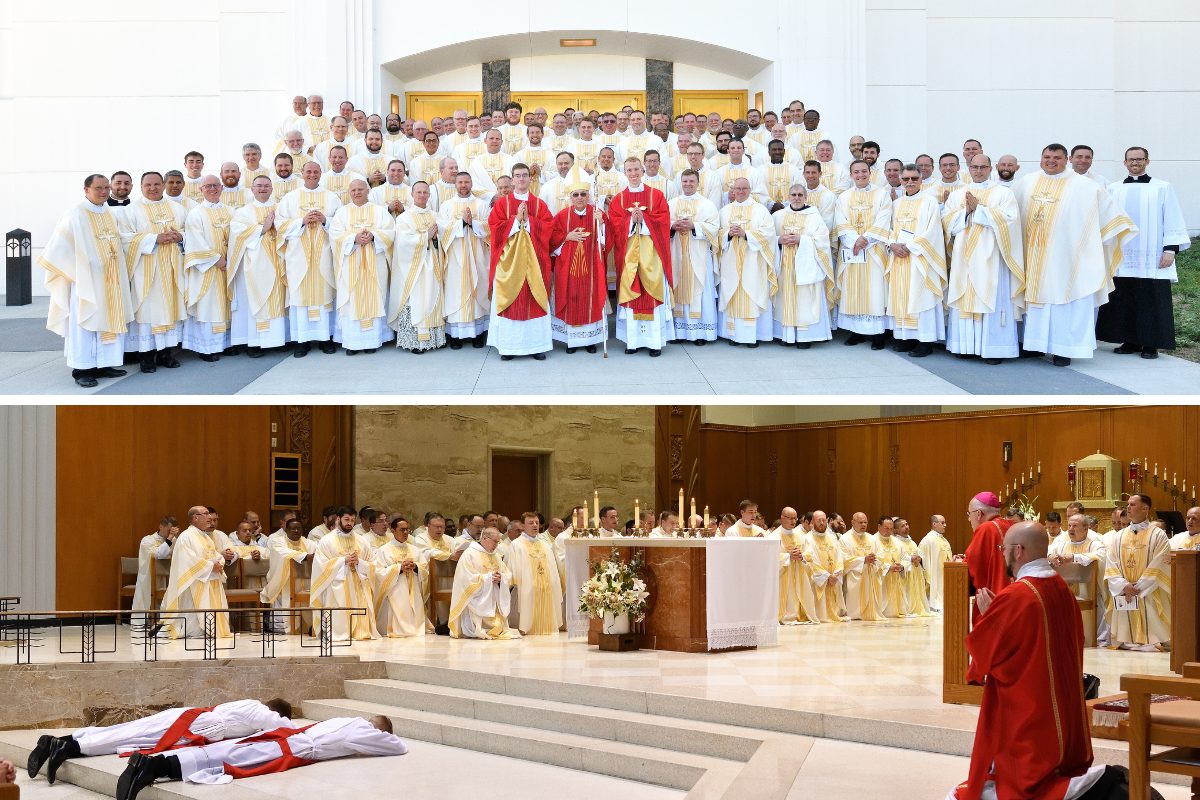
“You’re not looked at as weird [for going to seminary],” he said. “It is just kind of like a normal thing that guys do and give it a shot.”
He also pointed to the fact that, starting in the ’90s, the diocese prioritized placing priests as teachers and chaplains in Catholic schools.
One of those teachers is Father Eric Artz at Bishop Ryan Catholic School in Minot, North Dakota. While Father Artz didn’t attend Catholic school himself, seeing the energetic and joyful witness of young priests in his community made the priesthood seem heroic and captivating.
Support from his family and community helped, too. In North Dakota farming communities, he says, “[there’s] the sense of others actually depending on me […] that idea of ‘we’re in this together’; we actually need each other. [...] Priesthood’s the way that I can support others, priesthood’s the way I can sacrifice for others.”
The Breviary Belt
The deep Protestant heritage of the South makes it an unlikely bright spot in the Church in America. Of the country’s 10 least Catholic states, nine are in the Southeast. Only Louisiana, Florida and Virginia are more than 10% Catholic. Mississippi comes in at the bottom, with just 4%. But while the Catholics are few, the vocations, relatively, are many.
Of the top 20 dioceses for recent ordinations per capita, eight are in the South. The numbers in the Diocese of Jackson, Mississippi, are the best in the region: one ordination for every 6,436 Catholics. Nashville, Tennessee, follows close behind at 7,533. Nearly all Southern dioceses are better than the national average, the exceptions being major metro areas like Atlanta, Charlotte, and Galveston-Houston.
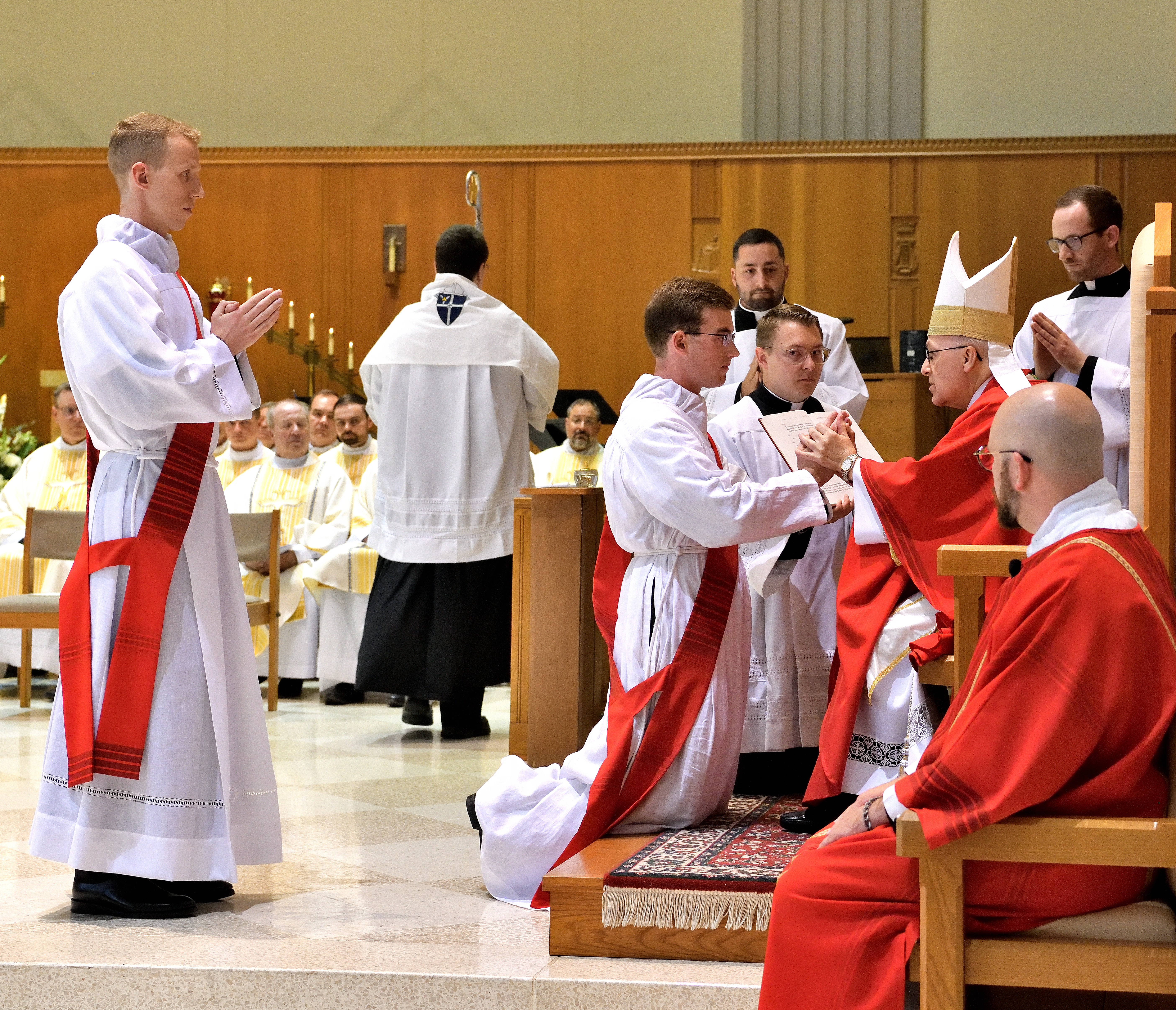
Skylar Cummings, a Nashville seminarian studying at Kenrick-Glennon Seminary in St. Louis, can trace his family lineage back six generations in Nashville. For him, the culture of the Bible Belt is a help, not a hindrance, to vocations.
“The culture is a lot more open to God,” he said.
“Even if they’re not Catholic, they’ll [tell seminarians], ‘Oh, you want to be a preacher? That’s great!’”
Attending a public school with almost no Catholic classmates also served to encourage his vocation, as it led him to learn to defend and cherish his faith from a young age.
While other historically Catholic regions like the Southwest and urban Northeast struggle with priestly vocations, the numbers remain strong in largely French Catholic south Louisiana. Father Blake Dubroc, vocations director for Lafayette, Louisiana, gives some credit to the diocese’s effort to strengthen the Catholic identity of its schools and some to the South’s ability to resist secularizing national trends.
“We’re just Southern [...] we know who we are,” he said. “We haven't been affected by a lot of the influences that may change other regions of the country at a swifter pace.”
Vocation Drought
The story is quite different on the other side of the Sun Belt. States like California, New Mexico and Nevada are among the most Catholic in the country, all with at least a quarter of their population belonging to the Church.
This does not, however, translate to strong vocations numbers. Dioceses in the Southwest region — including the west Texas ecclesiastical province of San Antonio — make up 15 of the bottom 25 dioceses for ordinations. Lubbock, Texas, and Stockton, California, are the only dioceses that did not record any diocesan ordinations in the last five years. Of the rest, the lowest in the country was the Archdiocese of Las Vegas, with one ordination per roughly 206,700 Catholics.
What sets the Southwest apart from the rest of the American Church is the especially large share of the Catholic population that is Hispanic.
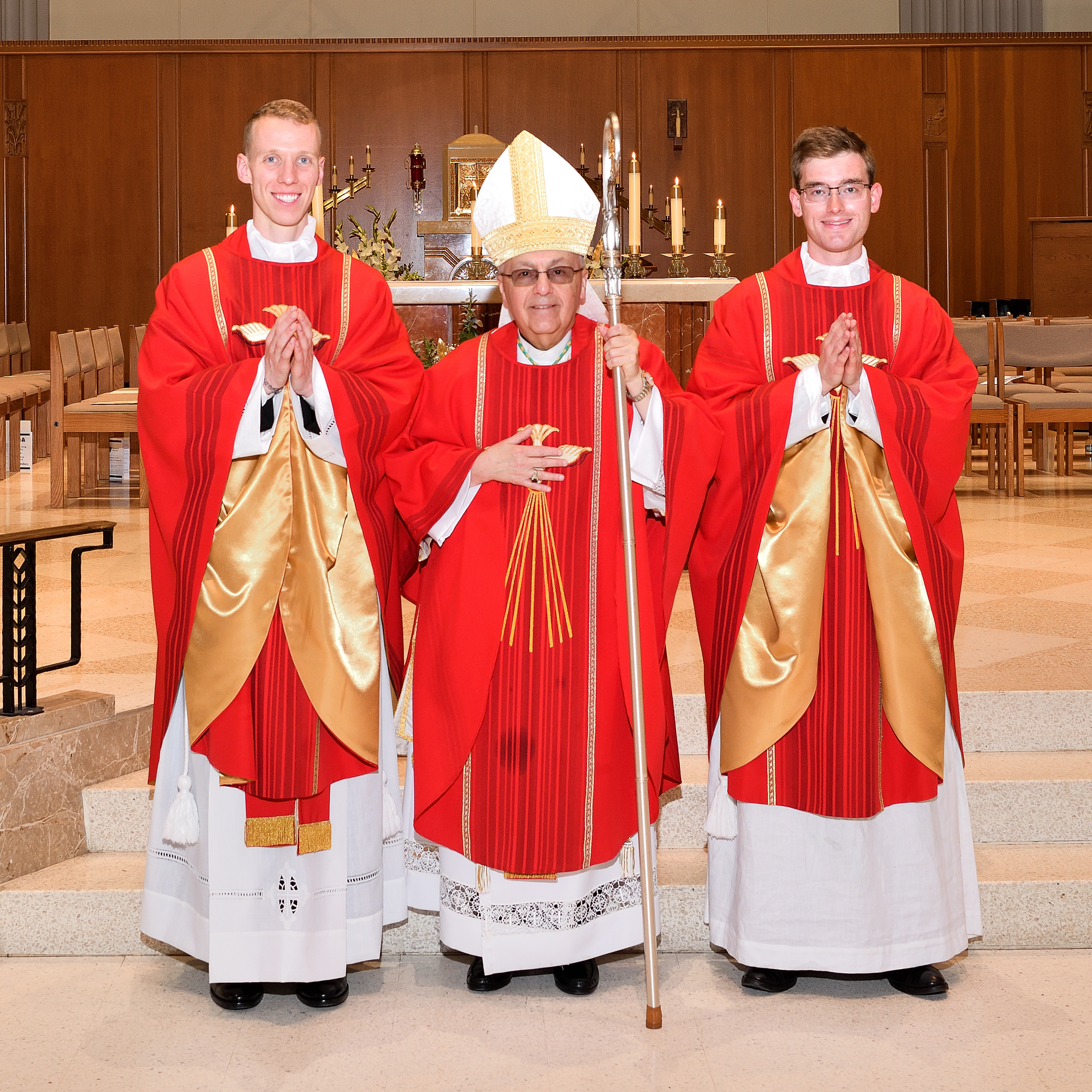
Hispanics are significantly underrepresented among American priests. It’s a bit of a paradox because, as newly ordained Phoenix priest Father Jacob Chavez observed, “[Hispanics] have really great and high respect for the priests, for the clergy.”
Hispanics also tend to have a great devotion to a daily living of the faith, which Father Chavez experienced in his family growing up. His father’s regular at-home catechism lessons were pivotal for him in growing in the faith and eventually hearing God’s call.
As Phoenix vocations director Father Will Schmid said, though, the tight-knit family bonds in the Hispanic community can sometimes make parents hesitant to support their sons in becoming priests.
“The family dynamic is really strong. There’s something beautiful about that. They want their children close to home, and I think the children want to be close to home,” he said.
“So when you send a guy off to a seminary that’s really far away [...] that really affects the discernment.”
The expansive dioceses in the Southwest, where a man may serve in parishes many miles apart over the course of his priesthood, don’t help either.
“I don’t think anybody has really cracked the code on Hispanic vocations,” said Rhonda Gruenewald, head of Vocation Ministry, an organization she founded in 2014 to promote vocations in the United States.
Rural Areas Outpace Urban
Illegal immigration status also prevents men from considering priesthood. But the numbers are underwhelming among the population in general.
“The newer the immigrants, the less likely they are to be able to enter seminary,” explained Gruenewald. “We might have to wait it out.”
Both Father Schmid and Father Dubroc have noticed an uptick in interest in priesthood in the Hispanic community in recent years, though, suggesting the wait may come to an end before too long.
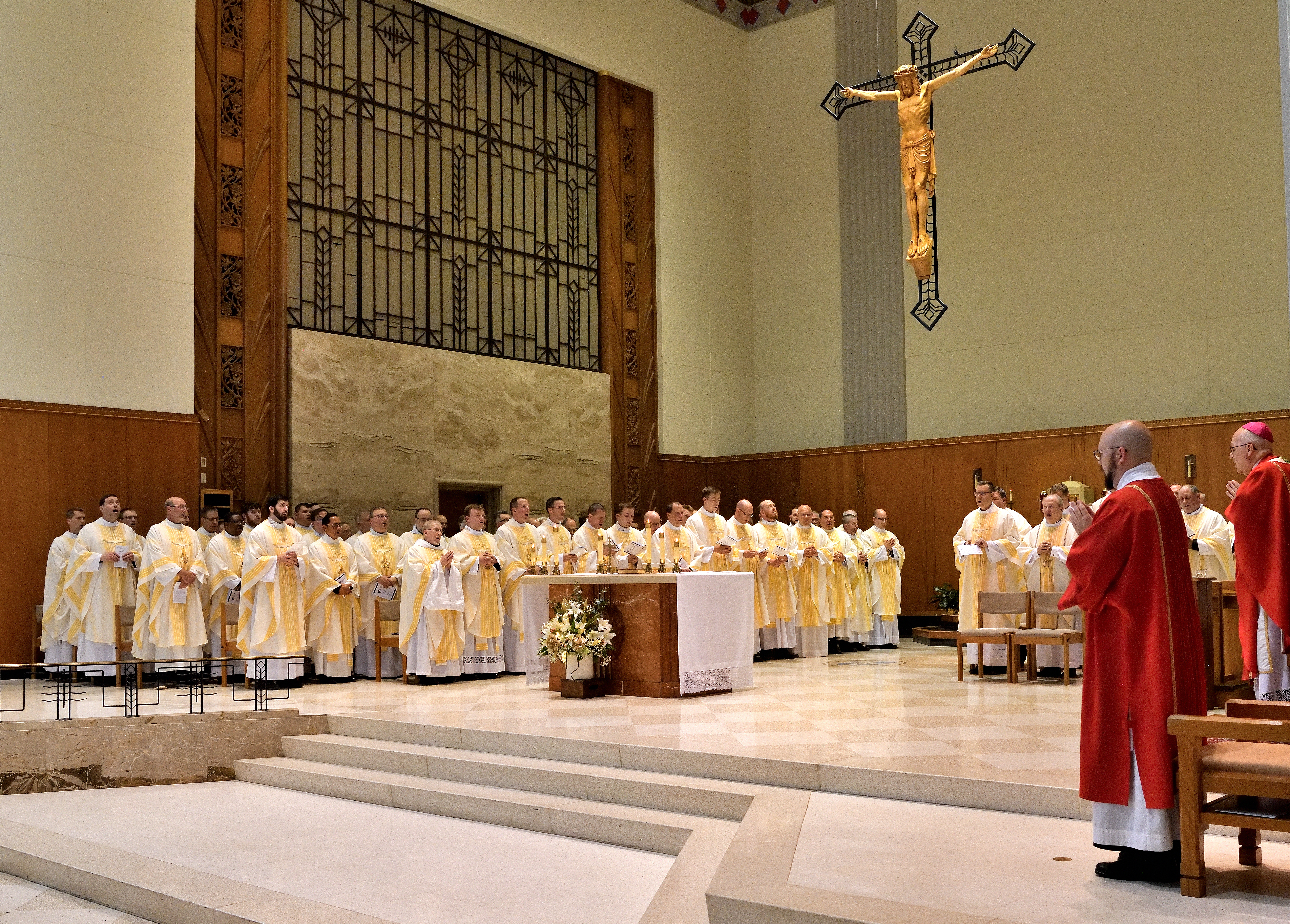
According to Gruenewald, the biggest key to understanding the very multifaceted trends in vocations is not regional dynamics, but the urban-rural divide. In 2023, Vocation Ministry released “The State of Priestly Vocations in the United States,” a study tracking 10 years of priestly vocations data. Their research found that, in general, the more urban a diocese is, the less priestly vocations it will produce per capita. Within dioceses, rural areas tend to outperform urban areas.
None of the 19 American metro areas with more than 3 million people make the top 50 for ordinations per capita. The bottom 50 include many of America’s largest metro areas, like New York, Los Angeles, Chicago, Seattle, Dallas and Pittsburgh.
Gruenewald explained that the phenomenon is largely due to the fact that urban dioceses tend to have larger parish communities. Vocation Ministry’s research shows that once a diocese’s average congregation surpasses 1,800 per priest, priestly vocations begin to noticeably drop. The less opportunity potential discerners have to get to know their priest, the less the priesthood will occur to them as a compelling option.
Church Connection
Father Joe Ryan, ordained this summer for the Diocese of Syracuse, New York, grew up in small-town Binghamton, New York, and studied in an urban environment at Saint Mary’s Seminary in Baltimore.
“You can feel that connection to your local church much more when you’re in a rural or semi-rural area than you can in an urban area,” he said, reasoning that a smaller, rural diocese can feel more close-knit and familiar than a large impersonal city.
“I think the community aspect of the church at the local level is key for vocations, both [for] encouraging seminarians and just for Christian faithfulness in general.”
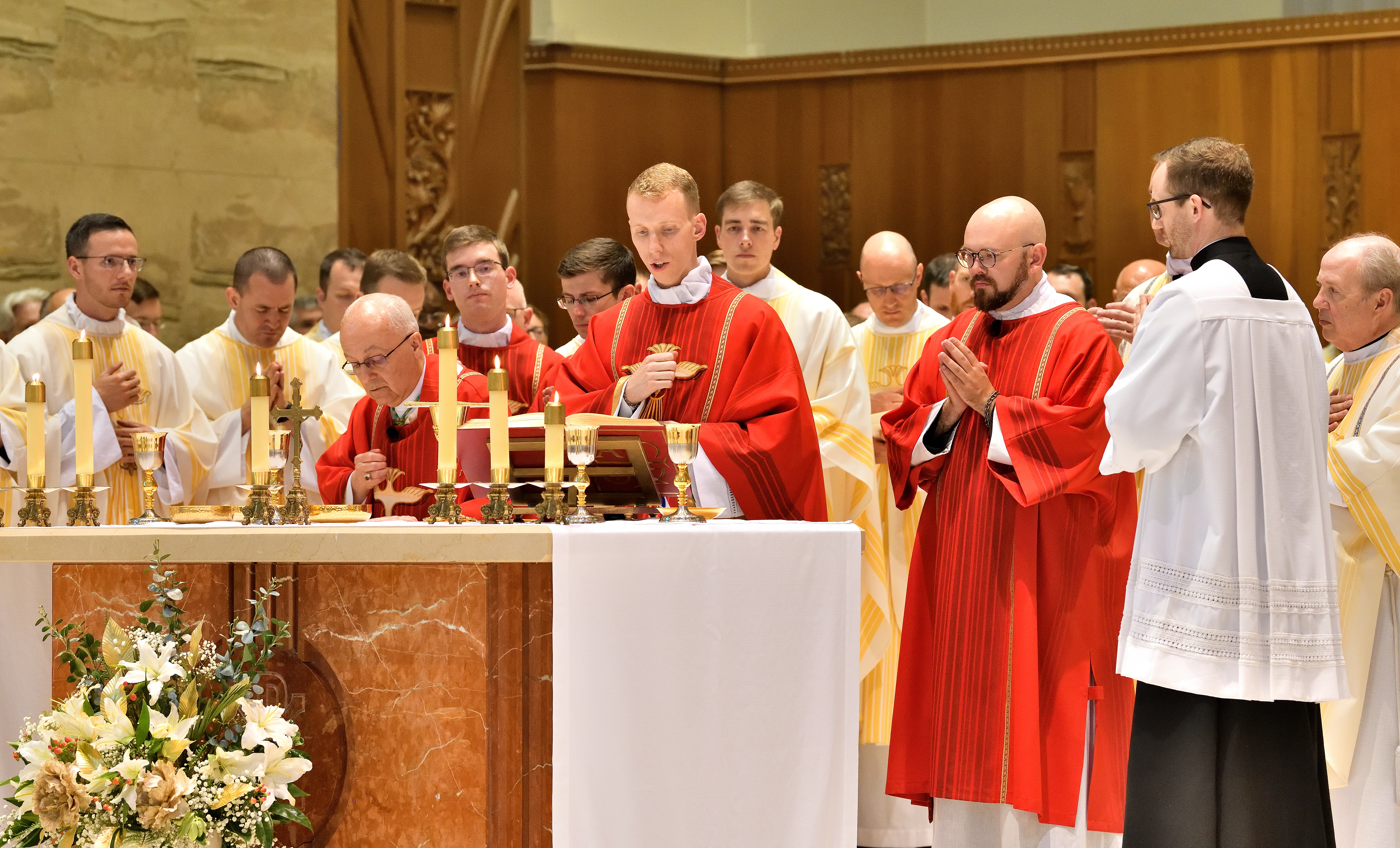
Despite the bright spots, vocations in America are trending downward.
Vocation Ministry’s research reveals that between 2014 and 2023, the number of active priests in the U.S. fell 12%, ordinations fell 22%, and total seminarians fell 23%.
“We want to have the solutions. I don’t want to just be a complainer,” said Gruenewald. “We cannot fix what we cannot measure. We have to know the reality of the situation to be able to say this is important enough to address.”
It’s a reality that is important not just for vocation directors to understand, she explained, but also for pastors and lay faithful, who, by their prayers and encouragement, can help more young men hear and respond to God’s call for their life.
By the Numbers: U.S. Ordinands and Seminarians
For readers who want to explore the full scope of this year’s ordinations and seminarian numbers, here’s the entire dataset — diocese by diocese.
- Keywords:
- priestly vocations