‘Give the Best for Jesus’: Memories of Mother Angelica on Her Birthday
Those who worked with her and knew her personally remember the nun on what would’ve been her 103rd birthday.
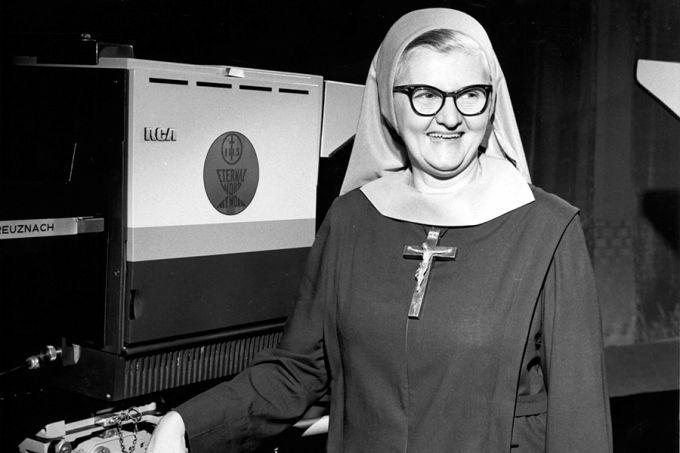
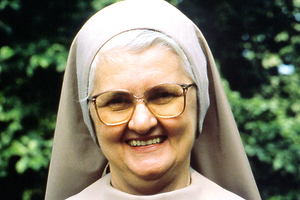
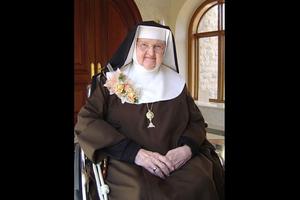
Rita Rizzo was born in Canton, Ohio, 103 years ago today. The young girl would grow up to be a Catholic nun who founded her own order and started the Eternal Word Television Network in Birmingham, Alabama, now a global Catholic network that offers broadcast and radio programming, along with its own production studio, publishing house and news division.
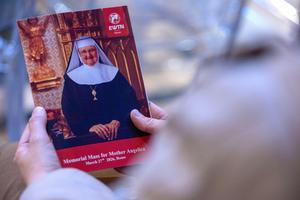
On the occasion of Mother Angelica’s birthday — and in the year marking a decade since her passing — two long-standing EWTN figures, Raymond Arroyo and Jeff Burson, recollect their most precious moments with the nun who had such a profound love for the Child Jesus.
Laughter and Nutter Butters
Now in his 30th year at the network, Mother Angelica’s biographer, Raymond Arroyo — host of EWTN’s The World Over, the first news program ever produced for the network — was just 24 when he began working alongside the foundress. While he was trained as an actor, he found that his real education in communication began over tea and Nutter Butters.
“I most cherish those quiet, fun moments with Mother. She had a wonderful sense of joy that I’d argue we are at a loss for today. I can remember coming back from interviews or reporting and telling her what I’d seen. I would always lean into the laughs — trying to find the humorous bits — and she would literally go red laughing.”
“Many times before the live show, over tea and Nutter Butters, I would unpack my travels for the week. It was just her and one of the sisters, and it was so laid back. There was nothing like her laughter; it was infectious,” he told the Register. “I’ve always thought it was simply the overflow of the Holy Spirit in her. She reveled in those moments. There was always a lot of laughter and joy around Mother, and that is what I miss most: that sense of fun she brought to the work.”
The Theology of the Hood of the Car
Arroyo recalled a specific moment that serves as a lesson in how a public figure should truly relate to an audience.
“She taught me a lot about public life and what it is supposed to be. She often suffered from terrible asthma attacks, where she could barely get through a show. I remember one night, there were busloads of people who had come to the network to see her. They didn't fit in the studio, so they were in the overflow Guadalupe Room.”
“After the show, the people were back on the buses, and the buses pulled up next to her car as we were putting her in to go home. People were banging on the windows and waving,” he recalled. “I told her, ‘You better go now, or you won't be able to get away.’ She was already seated in the car. She put both hands on the roof, pulled herself out, and said, ‘These are the people we’re here for.’
“She went around and sat on the hood of that car. For the next 45 minutes, she took pictures, signed autographs, and prayed with people in the cold, despite her asthma. That is her whole ministry in one picture: Despite her personal setbacks and illness, she continued to give. A lot of people in public life now are afraid of the public; they have armed squads to take them in and out. Because of Mother’s example, I try never to do that. You are there for them, and they are there for you.”
Letting Go of the Script
For Arroyo, co-hosting with Mother was a lesson in spiritual and professional surrender, a “high-wire act” where the script was replaced by the Holy Spirit.
“Mother Angelica is the only person I’ve ever encountered in broadcasting who had no script, no bullet points, and no chart forward. Before a show, she would put her finger in the Bible, flip it open, and whatever page she landed on, that was what she taught that night,” he recounted.
“Co-hosting with her in those early years was a wild ride. It was a high-wire act. But it taught me to let go of the rehearsal and stay in the present moment. She had a certain confidence that allowed her to let whatever happens, happen — because those are the most fascinating moments on television. They are human moments that come out of the ether when you are relaxed and having a good time. Those shows still crackle with that unplanned inspiration and mischief she brought to the game.”
The Art of Holding Hands
Long before EWTN became a global household name, its foundation was being built one soul at a time — often through the unconventional discernment of its foundress. For Jeff Burson, a Protestant engineer at the time who had a long tenure with EWTN Radio, the interview process was less about a résumé and more about a mysterious, silent connection.
“I was a Protestant when Mother Angelica hired me,” Burson told the Register.
“The network was just a month away from going 24 hours a day. I walked in for my interview with this woman I’d only seen on cable television, and one thing I’ll never forget is that as we talked, she reached out and grabbed my hand. She just held onto it. I remember thinking, ‘Do I pull back?’ But I didn’t; I just sat there.”
“Within 24 hours, I had the job. Years later, when I was in charge of hiring for the engineering department, I’d bring candidates to see her. I watched people go in to talk to her, and if they reached in and grabbed her hand and she pulled back, she’d tell me, ‘Don’t hire them.’ But when Patrick Campbell came in, he sat there and held her hand just like I did. Before the interview was even over, she looked at me and said, ‘Hire him.’ He’s been there ever since.”
‘The Widow’s Mite’
Mother Angelica’s intuition wasn't just reserved for hiring; it extended into the private lives and struggles of her family of employees. Burson saw this firsthand during a particularly challenging Christmas when his own daughter’s health was failing.
“There was a year I was really struggling. My daughter had been ill her whole life, and Mother was very aware of that; she and the sisters were always praying for us. It was Christmas, and I knew that with my family’s medical expenses and finances, I wasn’t going to be able to do much of anything for my children that year.”
“Mother called me into her office. She looked at me and said, ‘I know this has been a hard year for you and your family, Jeff.’ She reached out and handed me an envelope full of low-denomination bills. She told me, ‘This isn’t from me, but someone wanted to give this to you. I wanted to make sure your family had something for Christmas.’ I knew the network was struggling at that time, too — things were tight for everyone — but she showed me such compassion. She shared that ‘widow’s mite’ with me because she knew I was hurting.”
Mother’s Prayer in the Parking Lot
This maternal care wasn’t a one-way street. In the trenches of their shared mission, the line between the visionary leader and the suffering employee often blurred into a shared moment of prayer, sometimes in the most unlikely places.
“Mother treated her employees like family. One night, I had been up all night at the Children’s Hospital with my daughter. I stepped across the street to get some breakfast, and there in the parking lot was one of those brown station wagons the sisters used to drive,” Burson recalled.
“One of the sisters saw me and asked how my daughter was doing. Then she said, ‘Mother has been in the hospital all night, too. She’s in the back of the car.’ I walked over, and there was Mother — clearly in pain, exhausted, and not doing well herself. But she reached out, grabbed my hand, and with tears in both our eyes, she prayed with me right there. She was just like a mother; she’d chew you out if you did something stupid, but she loved you through it all.”
‘Give the Best for Jesus’
While her heart was deeply pastoral, Mother Angelica was also a fierce steward of the mission before her. She had a surprising grasp of the technical world that often left even her chief engineers floored, including Burson.
“I used to meet with her one-on-one every week to discuss engineering. I remember talking to her about some equipment we needed for the on-air department. Because money was always tight, I was pitching lower-quality gear.”
“She looked at me and started talking technical specs — lines of resolution, broadcast quality — and I was floored. I’m talking to a cloistered nun and I’m ‘dumbing down’ the conversation, but she was talking to me like a fellow engineer,” he continued. “She told me, ‘We aren’t going to buy the low end just because it’s $1,000 cheaper. We give the best for Jesus. I will find a way to get the money, but we will not give Him a low-quality signal.’ She was always looking toward the future, whether it was the internet or the latest broadcast tech, to ensure the word of God was sent out with the highest possible quality.”
The Conversion: A Diary in the Dark
Working in the presence of such a force eventually led Burson to look deeper into the faith that fueled this fiery nun. It wasn’t a sermon that changed him, but a quiet moment during an overnight shift with a discarded book and the message of Divine Mercy.
“My conversion happened during the overnight shifts at EWTN. Someone had left a copy of Sister Faustina’s diary lying around. I didn't have anything else to read, so I picked it up. I was raised with hellfire-and-brimstone preaching — the idea that God was just waiting to get you — and I had turned my back on religion because of it.”
“But reading that diary changed everything,” he admitted. “I saw that God was a God of mercy. The thing that woke me up was the idea that even if someone rejects Him their whole life, if they just glance toward Him in their final moment, He accepts that. It answered all my boxes. I realized that if God is a God of mercy, then this is the truth. I looked into the history, saw that Jesus started this Church and not some man hundreds of years later, and I knew: This is it.”
- Keywords:
- mother angelica

Alyssa Murphy Alyssa Murphy is the Register's Managing Editor of Digital Assets. Starting her career on the airwaves in San Francisco, she has worked in all facets of media. Alyssa enjoys writing and covering stories that inspire and uplift. Register readers may be familiar with her voice from EWTN radio's Morning Glory. Alyssa currently lives in New Jersey just outside Manhattan with her husband Andrew and young daughter, Annabelle.