Leo XIV Returns to La Sapienza, Where Benedict XVI Was Silenced
Eighteen years after protests forced Benedict’s cancellation, the episode still reveals a deeper clash between faith, reason, and the fallacy of much secular tolerance.
When Pope Leo XIV addresses Rome’s La Sapienza University on Thursday, he will avoid the trial that beset Benedict XVI, who, 18 years ago, was forced to cancel his visit amid mounting protests.
Never before had a pope been forced to cancel an address at any university in the city. La Sapienza, ironically, was founded by Pope Boniface VIII in the 14th century, and his visit would have also followed those of his predecessors, St. John Paul II in 1991 and St. Paul VI in 1964. An esteemed professor himself, Benedict’s lecture was keenly anticipated.
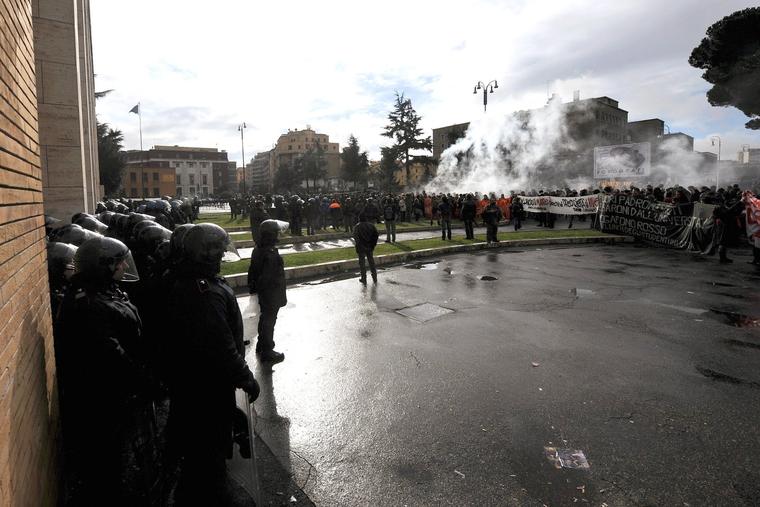
Yet as the date approached, opposition intensified. On Jan. 15, 2008, just two days before his appearance, the Pope took the unprecedented step of cancelling his visit after Italy’s minister for the interior said there was a chance of clashes between extremist groups. Cardinal Tarcisio Bertone, then secretary of state, said the decision was the “prudent” course “in order to remove any pretext for demonstrations that would have been unpleasant for all.” Benedict sent the university his prepared text instead.
I well remember covering the story, as the cancellation shocked the ecclesial, civic and academic establishment, prompting Italy’s president and the vicar of Rome to voice their support, though few other prominent figures followed. More significantly, the affair crystallized a deeper clash between the claims of the Catholic tradition — especially on faith and reason — and a secular liberal culture that presents itself as rational, tolerant and inclusive, yet in practice often is not.
The immediate trigger was a remark Benedict had made in a talk 18 years earlier, as Cardinal Joseph Ratzinger, ironically, also at La Sapienza, when he quoted the agnostic Austrian-America philosopher of science, Paul Feyerabend. Feyerabend had argued that in Galileo’s time “the Church remained far more faithful to reason than Galileo himself” and that, considering science’s broader ethical and social implications, the Church’s judgment was “reasonable and just.”
Cardinal Ratzinger’s point was that the Galileo affair should not be reduced to a simple story of the Church opposing science, which has been the narrative developed from the Enlightenment. Instead, he used it to argue that modern debates about science, reason and responsibility are more complicated. By citing Feyerabend (and German physicist and philosopher Carl Friedrich von Weiszäcker, who undertook nuclear research for Nazi Germany), he showed that even nonreligious thinkers had used Galileo to question whether science always knows best, especially when scientific progress can lead to serious harm. Weizsäcker, he noted, identified “a very direct path” that leads from Galileo to the atomic bomb.
La Sapienza’s protests, however, overlooked Ratzinger’s point and instead used it as pretext for a largely ideological protest that claimed the faith was against scientific progress. Marcello Cini, an elderly physics lecturer who led the protests, warned it was “dangerous” for the Pope to speak, alleging Benedict sought to “bring science to heel” under “the pseudo-rationality of religious dogma.” The visit, he said, threatened the autonomy of both culture and the university.
Alongside objections to Benedict’s Galileo reference, critics claimed a papal address at a public, secular institution was “incongruous,” invoking La Sapienza’s long-standing independence, despite its papal foundation. In total, 67 professors, out of the university’s some 4,500 lecturers and researchers, signed a letter opposing the visit, while roughly 100 students demonstrated.
Yet Benedict had anticipated precisely such objections in the lecture he never personally delivered. He stressed that both the papacy and the university share a commitment to truth, albeit through different methods. The Pope, he wrote, does not impose belief “in an authoritarian way,” but offers the Church’s moral and intellectual tradition to public reasoning. The university, for its part, pursues truth through reason, rooted in Socratic inquiry and the historical interplay between faith and reason.
He warned against reducing reason to mere utility or scientific positivism, thereby losing sight of deeper questions of meaning and the good. “What is the good that makes us true?” Benedict asked. “The truth makes us good, and goodness is truth. This is the optimism that lives in the Christian faith, because it has been granted the vision of the Logos, of the creative Reason that, in the incarnation of God, revealed itself at the same time as the Good, as Goodness itself.”
Ultimately, he stressed both the papacy and the university must preserve a “sensitivity to truth,” encouraging people, especially in academic life, to continue seeking moral and spiritual truth even when it is challenging. “The danger for the Western world is now that man, precisely in consideration of the greatness of his wisdom and power, could surrender before the question of the truth,” he warned. “And this means, at the same time, that in the end reason collapses under pressure from special interests and under the lure of utility, being forced to recognize this as the ultimate criterion.”
Writing in L’Osservatore Romano, La Sapienza mathematician Giorgio Israel defended Benedict, noting the irony that those who invoked Voltaire’s famous defense of free speech opposed the Pope’s right to speak. Italian universities, he observed, are open to every form of expression — except, it seemed, that of the Pope.
If only the protesters had bothered to read Benedict’s speech in its entirety, Israel wrote, as its theme was the crisis of confidence in science itself, and it cited the shift in attitude regarding the Galileo case as an example.
Academic politics, entrenched anti-clericalism, and a largely hostile Italian press also played their part in the clash. But the deeper irony remained: Those accusing Benedict of being against the scientific method effectively replicated the very intolerance they attributed to the Church — silencing a voice with which they disagreed.
As Israel put it, the episode revealed a strand of secular culture that “does not argue, but demonizes; it does not discuss, but creates monsters.” In that sense, the attempt to block the Pope’s address was not only a cultural failure, but a civic one.
How Pope Leo XIV chooses to recall, or perhaps not recall, Benedict’s cancellation will be closely watched.
The Holy Father will spend the morning of May 14 at La Sapienza, delivering an address at 11:30 a.m. in the Aula Magna after greetings and a private meeting with the rector. The program includes prayer at the university’s chapel, a student greeting, and a plaque unveiling, before departing at 12:30 p.m.
- Keywords:
- 'pope leo xiv'
- benedict xvi

Edward Pentin Edward Pentin is the Register’s Senior Contributor and EWTN News Vatican Analyst. He began reporting on the Pope and the Vatican with Vatican Radio before moving on to become the Rome correspondent for EWTN's National Catholic Register. He has also reported on the Holy See and the Catholic Church for a number of other publications including Newsweek, Newsmax, Zenit, The Catholic Herald, and The Holy Land Review, a Franciscan publication specializing in the Church and the Middle East. Edward is the author of The Next Pope: The Leading Cardinal Candidates (Sophia Institute Press, 2020) and The Rigging of a Vatican Synod? An Investigation into Alleged Manipulation at the Extraordinary Synod on the Family (Ignatius Press, 2015). Follow him on Twitter at @edwardpentin.