Connecting the Dots From ‘Rerum Novarum’ to ‘Magnifica Humanitas’
ANALYSIS: There have been seven phases of development over the past 135 since Pope Leo III issued his groundbreaking document.

The fact that Pope Leo XIV decided to formally sign Magnifica Humanitas on May 15 is no coincidence.
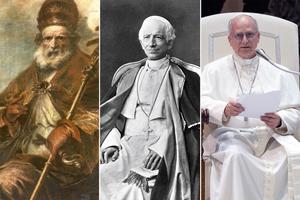
It was precisely on that date in 1891 his namesake, Leo XIII, had signed Rerum Novarum, the first social encyclical in the history of the Catholic Church. Even today, Leo XIV wants to address “new things” (what Rerum Novarum means), the new challenges posed by contemporary society.
But why, then, is it necessary to look back at Rerum Novarum? And how has the Church's social teaching developed in the 135 years since its publication?
When Leo XIII addressed the “new things” of the time, he had to provide a Christian response to two major phenomena: socialist thought, which effectively gave the poor hope by calling on them to engage in class struggle; and Enlightenment thought, which had led to an unprecedented attack on the Church. In addition to that, he also faced the problems of the Industrial Revolution, the rapidly changing world of work, which was creating a profound social imbalance between rich and poor.
With Leo XIII, a social doctrine emerged that began with human issues and then touched on international issues. It is no coincidence that Pope St. John XXIII, in his 1961 encyclical Mater et Magistra, spoke of global imbalances and how these were a threat to peace. It is also no coincidence that Pope St. Paul VI, in his 1967 encyclical Populorum Progressio, underlined that “development is the new name for peace.”
What Rerum Novarum Addresses
What did Leo XIII talk about in Rerum Novarum? The first part is dedicated to the question of private property. The Pope rejects the “community of goods proposed by socialism” because it “offends the natural rights of each individual.”
Leo XIII also addresses the issue of the destination of goods, emphasizing that it is the good or bad use of goods that determines the issue because “riches do not free one from suffering.” The encyclical then addresses the issue of poverty, emphasizing that “virtue is a common heritage, attainable equally by the great and the small, by the rich and the proletarian,” which is important for understanding that all are equal before God.
Leo XIII also addresses the theme of fraternity, to which Pope Francis would eventually dedicate an encyclical, and emphasizes that living fraternity means that “the goods of nature and grace are the common heritage of the human race” because if all are children, they are also all “heirs of God and co-heirs with Jesus Christ. This is the ideal of rights and duties contained in the Gospel.”
Leo XIII spoke of a Church that is also immersed in the world and therefore prioritizes improving living conditions and making work more dignified. For that reason, Rerum Novarum dwells on the difficult working conditions of industrial workers, emphasizing that “it is neither just nor humane to demand so much work from man that his mind becomes dulled by overwork and his body weakens.”
Leo XIII also states that “the wage must not be less than the workers’ subsistence” and that, in turn, the worker must learn to save.
The great theme is to establish a just social order, with a central path: the path of charity.
“Let everyone,” wrote Leo XIII, “do his part and not delay, for delay could make the cure of an already grave evil more difficult. Let governments work towards this goal with good laws and wise measures; let capitalists and employers always keep in mind their duties; and let the proletariat, who are directly affected, do what they can, within the bounds of justice.”
Seven Phases of Social Teaching
Since Rerum Novarum, there have been 12 social encyclicals, if we count among them Pope Francis’ Laudato Si and Fratelli Tutti. All reference Rerum Novarum, updating thinking in response to new developments, addressing new social challenges, and giving substance to a thought called to respond to the questions of the time.
Bishop Emeritus Mario Toso of Faenza-Modigliana, Italy, one of the Church's leading experts on social doctrine, emphasizes that “the Church’s social doctrine provides interpretative keys that bring various disciplines into dialogue to contribute to knowledge, peace, and the realization of the Kingdom of God. Social doctrine is not deduced knowledge; it is not imposed by others; it is not an elaborate doctrine. Social Doctrine is open knowledge.”
Ernesto Preziosi, for years director of relations with the territory (manager of the area where the university is located) at the Catholic University of the Sacred Heart in Milan, emphasizes that at the heart of Catholic social doctrine is “the proclamation of the Gospel.”
Preziosi identifies seven phases in the development of social doctrine.
The first is the one that begins with Rerum Novarum in the 1920s and 1930s, when social teaching became the prerogative of a more popular movement, and next to the phase that arose at the end of the Second World War, with a new form of social teaching, which also clashed with the evolution of socialism.
Then there is the fourth phase, that of the Second Vatican Council, because, Preziosi says, “John XXIII and Paul VI changed the method of developing social doctrine: from the deductive method to an inductive method.”
The fifth phase follows the Council, and is delicate, because “the Council opens a new scenario; it recognizes the change in method.” Already during the conciliar debate, the use of the term “doctrine” was contested, and there was talk of a freer interpretation.
With Benedict XVI — this is the sixth phase — “the debate ends, because the crisis of ideologies has given way to a single way of thinking,” Preziosi explains. The new humanism, already in the mind of John Paul II, is emphasized with Laborem Exercens, Sollicitudo Rei Socialis and Centesimus Annus, which brought the theme of social ethics back into play, to overcome the present ideologies.
Finally, the seventh phase, with Pope Francis, is the phase of great social changes.
Magnifica Humanitas will likely usher in a new era. It looks ahead to a new industrial revolution ushered in by artificial intelligence, to new global imbalances resulting from the new distribution of labor, to a new world to which the Church is called to respond. This may not be Leo XIV’s only social encyclical, but it will be a starting point worth following.