‘Stations of the Eucharist’ Aim to Help Catholics Better Understand the Sacrifice of the Mass
Indiana priest has written a series of reflections on those stations in a new book.
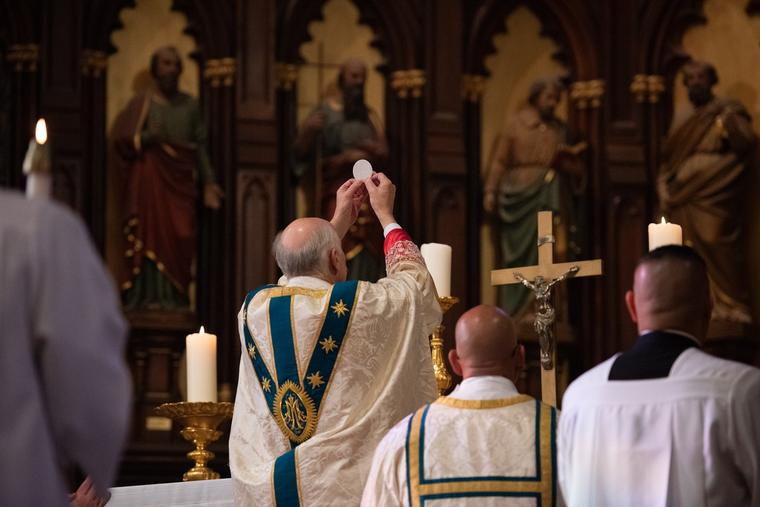
Inspired in part by the recent Eucharistic Revival, one priest is on a mission to help churchgoers enrich their understanding of the Mass in the context of Christ’s sacrifice.
In 2024, Father Jonathan Meyer’s talk on the Mass at a men’s conference in Palm Beach Gardens, Florida, went viral on YouTube, telling him that Catholics were hungry to know more about the celebration they attend at least once a week. As part of his talk, he took the men through 14 “Stations of the Eucharist” he had developed to help Catholics celebrate and participate in the Mass more fully. Now, Father Meyer has written a series of reflections on those stations in a new book, The Stations of the Eucharist.
Since the Second Vatican Council, there has been “a huge emphasis on communion and presence, but a lack of understanding of the Mass being one perfect sacrifice which unites us to Christ’s sacrifice,” Father Meyer told the Register. “My book is to help people get to that understanding in a very accessible way.”
A priest of the Archdiocese of Indianapolis and one of 50 priests selected as preachers for the recently concluded three-year National Eucharistic Revival, Father Meyer spoke with the Register about what led him to write the book — along with a companion book featuring prayers and reflections — and the element of the Mass that he thinks many Catholics are missing.
When and how did you first become aware that Catholics were lacking in their understanding of the Mass? Was something of this missing in your own life as a priest as well?
When I was invited to be a National Eucharistic Revival preacher, we were commissioned to preach specifically on the Eucharist as communion, presence and sacrifice. I had no problem at all talking about the Eucharist as communion, no problem talking about the Eucharist as presence. But when I got to the topic of sacrifice, I really struggled. I remember giving my first talk and, given what I know now and where I’m at now, I chuckle to myself. My understanding of the Eucharist and sacrifice was the fact that we receive Jesus and should try to love like him and that’s the sacrificial love we learn from the Eucharist. I had no ability to articulate the fact that the Mass itself is Calvary, the re-presenting of the passion, death and resurrection of Our Lord. The more I began to travel around and preach on the topic, the more I began to realize this is not just a “me” problem, it’s a “we” problem. One of the tremendous blessings of the Second Vatican Council was the emphasis on the Eucharist as communion. And praise God for Popes St. John Paul II and Benedict XVI and the National Eucharistic Revival, which have had a huge emphasis on presence. But I believe another chapter is opening and that’s going to be understanding the Mass as sacrifice.
Do you think Catholics of past ages had a better connection with the Mass as the re-presentation of the sacrifice on Calvary?
I do, and I’ll give an example. I think when I look at my early priesthood and the foot traffic at a parish office 23 years ago when I was newly ordained, a lot of it was people coming in to have a Mass offered for a particular intention. I think written into the minds and hearts of many parishioners of days ago was that fact that I can attach an intention to Mass because it is a sacrifice and the priest offering it unites my prayer intentions to Calvary. I think this was instilled in a generation that for the most part is no longer with us. Many priests no longer have Mass intentions because no one asks for it. The average age of those who ask are very elderly. For those in their 20s, 30s and 40s, it’s a foreign concept.
How did we lose this understanding of the Mass as sacrifice?
Since the Second Vatican Council, the emphasis has been on Mass as communion. We receive Jesus and become one with him, but we also become the Church through the Mass. This was one of the great fruits of the Council, but the idea of Mass being the place where you can unite your whole life to the cross and Calvary and that it’s the reason Jesus gave us the Mass is just not something we think about. Even for more pious parishioners the concept of Mass is we go to Mass to receive Jesus’ Body and Blood. We’re not going to Mass to say, “I just want to be present, and I don’t even need to receive communion because redemption is being poured out for us.” There’s a huge emphasis on communion and presence, but a lack of understanding of the Mass being one perfect sacrifice which unites us to Christ’s sacrifice. My book is to help people get to that understanding in a very accessible way.
Are some Catholics today still reluctant to think of the Mass as a sacrifice even when they hear it in a homily?
Honestly, I think it is just something people never heard, a concept that always has been there but hasn’t been the main thrust. There’s been a huge shift in the last 20 years of the Eucharist as presence. I do believe that there is now this new shift of saying let’s not forget about the third prong also being sacrifice and how do we communicate it effectively to people who don’t know that. If I had heard it or studied or read it, clearly it didn’t “click.” Most people are like, “I’ve just never heard this before.” I think people are actually excited when they do hear it.
Do you think the recent National Eucharistic Revival helped improve Catholics’ understanding of the Mass or did it merely reveal the work that needs to be done?
Clearly, I believe the Revival had tremendous fruits. And think the majority of those fruits were focused on presence. We processed the presence of Jesus through the four corners of America. The majority of my priest brothers increased the amount of Eucharistic adoration or had processions. Those liturgical actions are an emphasis on presence. I don’t think the Revival had tremendous emphasis on sacrifice. But it was not one of the intents. The intent was to look at the Pew Research study and solve a problem, which is that 70% of Catholics don’t believe in the True Presence. If you had asked, “Do you believe the Mass is a re-presentation of Calvary?” I think 90% or even more would say “I don’t even know what you’re talking about. I didn’t know it was a sacrifice; I thought it was a meal,” which it is, but it’s a both-and.
When did you create the 14 “Stations of the Eucharist,” and what inspired you?
I was giving a retreat to priests of the Diocese of Lafayette in Indiana and was looking for content. I had prayed a version of the Stations of the Eucharist that the Poor Clares of Perpetual Adoration in Hanceville, Alabama, had devised, and I turned the stations into a talk. The priests responded positively; and then I decided, seeing the fruit of that, to turn the small talk into a larger one. I began changing some of the biblical passages and meditations and replacing them with ones I thought would make better sense for the people I was preaching to. The 12 stations turned into 14 as I removed some and replaced others.
Why 14 stations?
I wanted them to coincide with the 14 Stations of the Cross, and I wanted the 12th Station of the Eucharist — the Last Supper — to correspond to the 12th Station of the Cross, which is the Crucifixion.
You’ve said your favorite station is No. 13, the Walk to Emmaus. Why?
I think because biblically it’s a powerful image of people that are on a journey, people that are confused, people that encounter Our Lord in the Breaking of the Bread, which is the Mass. I deeply love the connection to the liturgy, especially in the breaking of the Host, the commingling. That is the resurrection. We believe theologically that placing the Host in the chalice is bringing together the Body and Blood of Christ. Each time I fracture the Host, in my mind I am at Emmaus. The Stations of the Eucharist have deeply helped me to enter into the Mass in a powerful way. I celebrated Mass for years without understanding what I was doing there besides fulfilling what was in the rubrics of the Roman Missal.
- Keywords:
- sacrifice of the Mass
- catholic priests
- eucharist