New Book Sheds Rare Light on Newman’s Vision for the Laity and Its Modern Relevance: ‘Holiness Is the Great End’
Acclaimed Newman expert Paul Shrimpton says the newest doctor of the Church ‘foresaw the world we live in and tried to prepare Christians to face it.’
ROME — St. John Henry Newman, whom Pope Leo XIV will formally declare a doctor of the Church at the Vatican on Saturday, championed the essential role of laypeople in the Catholic Church, insisting on their need for a well-formed faith, a robust theological education, and active engagement in the life and mission of the Church.
Newman taught that the laity have a central and indispensable role who, in Church history, had often upheld orthodoxy when the clergy had faltered. He insisted the laity be holy and know the creed “so well that they can give an account of it” and defend it — a novel concept in the 19th century.
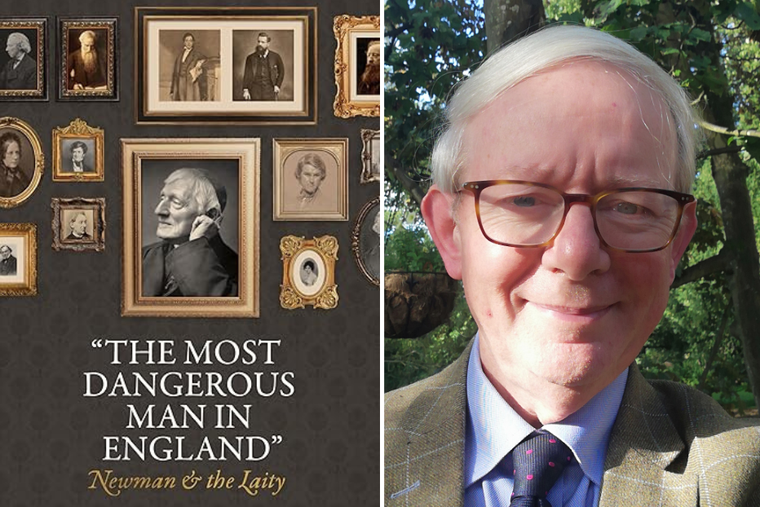
But so far no full study has been made on his legacy in this regard, nor any serious case made for anticipating the Church’s teaching on the subject. Now, in a major new work entitled The Most Dangerous Man in England: Newman and the Laity, acclaimed Newman expert Paul Shrimpton offers a fresh, original and thorough examination of the 19th-century theologian’s bold views on the laity that challenged the ecclesial structures of his day.
In this Oct. 29 email interview with the Register, Shrimpton, who teaches at Magdalen College School in Oxford, discusses how Newman’s thinking on the laity influenced the Second Vatican Council, his striving for balance and the realization of complementarity between the hierarchy and laity, and what Newman would make of synodality and using his famous teaching on the development of doctrine for ideological ends.
Dr. Shrimpton, what was the impetus behind the book, and how large an undertaking was it?
The book was three years in the writing but 33 in the thinking. The theme of Newman and the laity has been in the background of all my Newman scholarship, which has been focused on education. Over the years I became aware that Newman and the laity was a neglected topic, despite claims that his “theology of the laity” is one of his main contributions to the modern Church.
Why has there, until your book, been no major study on Newman and the laity, given that the laity’s role in the Church was such a focus for him?
I suspect that this omission can be accounted for by scholars focusing on Newman’s abundant and seminal theological contributions at the expense of his more practical teachings and example; by scholars concentrating on Newman the thinker rather than the man of action; by inhabiting theological faculties rather than the busy world.
There are also other related areas of Newman scholarship which have been relatively unexplored, such as Newman and journalism and Newman’s genius for friendship. These will be wonderful topics to explore.
Your book explores Newman’s vision of a laity taking more of a role in the life and mission of the Church, challenging the established, clergy-centered model of his day and anticipating ideas that would become mainstream over a century later at Vatican II. In what way do you think this vision truly influenced the Council and shaped the Church we see today?
The question as to whether he influenced the Council indirectly, if not directly, is tortuously difficult to assess and must be left to scholarly speculation. But that Newman anticipated the Council, there is now no doubt to my mind. No one in the 19th century had such a rich understanding of the laity as Newman, though it was not expressed in words so much as his actions.
Newman’s influence in the Church has been muted for a variety of reasons. In his own lifetime, he was deliberately kept at the margins of the Church, as he was suspected of not having a fully Catholic spirit, with the risk that he would introduce Protestant teaching and practices into the Church.
On the other hand, it is not at all clear to my mind that the teaching of the Council on the laity is well understood or lived out today. But what I hope is that my book will lead to a renewed interest in the laity and their mission in the Church and the world.
Considerable concern exists today that the pendulum has swung too far, that the Church is now more human-centered than Christ-centered, with her hierarchical structure undermined and her authority significantly diminished as a result. In what way does your book deal with this concern, and do you think Newman’s teaching in this regard was in some way responsible, or could it offer what some see as a much-needed corrective, and, if so, how?
Newman views reality in a highly intuitive manner and excels at holding disparate truths together in creative tension. Cardinal Marc Ouellet captured this when he called him a “prophet of equilibrium.”
We can see how Newman exemplifies this equilibrium in the way he holds in balance the rival claims of clericalism and congregationalism. The hierarchical division of the Church into clergy and laity is of its essence but does not exhaust its reality; it exists alongside the radical equality of the faithful arising from their baptism. The challenge is to respect both principles — hierarchical structure and all it implies about authority and offices on the one hand, unity and radical equality of all the faithful on the other — while resisting the temptation to exaggerate one at the expense of the other. The aim is to bring them into a dynamic relationship of harmonious complementarity, to combine wholeness and organic unity with tension and polarity.
While Newman’s has an extraordinary ability to hold complementary truths in creative tension, this approach does lay him open to misrepresentation, especially by those who merely wish to hitch Newman to their own bandwagon by quoting only what suits them.
From what I have just said, it is obvious that Newman’s teaching on the laity is highly instructive for clergy as well as laity.
How does Newman’s approach to the laity offer tangible help to lay faithful to be better Catholics? What did he do and say in particular that helps us answer the “universal call to holiness”?
Besides all his “controversial” or polemical writings, Newman preached over 600 pastoral sermons in Oxford, which effectively amount to a call to holiness. They helped to inspire an extraordinary revival in the Church of England by exhorting its members to take seriously their Christian faith. In these sermons Newman uses all his rhetorical skills and psychological insights to shake up his congregation (or readers) from their easygoing ways.
Just after he was ordained an Anglican deacon in 1824, Newman wrote, “Those who make comfort the great subject of their preaching seem to mistake the end of their ministry. Holiness is the great end. There must be a struggle and a trial here. Comfort is a cordial, but no one drinks cordials from morning to night.”
A year later, as an Anglican priest, Newman asserted that “all education should be conducted on this principle — that it is a means towards an end, and that end is Christian holiness.” Moreover, “the object of education is to write the divine law upon the heart ... to prepare the heart for the gospel of Christ — it is to lead us to correct views of our own state and knowledge of our own hearts — it is to train us and win us over to habits of practical godliness, to accustom us to deny ourselves, to govern our passions, to fix our affections on God, and to trust Him with a humble and implicit faith.”
In a remarkable letter to a married friend, Newman writes about the possibility of attaining holiness, indeed “perfection,” in the married state: “I often think what poor creatures we, priests, are, who like ‘gentlemen of England, sit at home at ease,’ while you, married men, have all the merit of the anxiety and toil, which the care of a family involves. Your state is in fact one of ‘perfection,’ when compared with ours, and there is a day in prospect when ‘the first shall be last, and the last first.’”
In Newman’s vast correspondence, we see him advising, counseling and encouraging the laity to live deeply Christian lives. But all this I have spelt out at length in my book.
The Church today is experiencing a resurgence of Tradition, especially among young people, and an apparent yearning for pre-conciliar models that emphasize the Church’s divine nature and an ordered and authoritative hierarchical structure in an increasingly chaotic and disorderly world, one that appears to ignore the existence of sin and Christ’s redemption. What advice do you think Newman would give to both clergy and laity to the Church today in the face of these challenges?
Rather than casting a nostalgic glance back to some imagined golden age of the Church — a practice he disliked — Newman effectively cautions us against insisting on the revival of past customs, liturgical or otherwise, when he writes, “Our rules and our rubrics have been altered now to meet the times, and hence an obsolete discipline may be a present heresy.”
In his day, there were intelligent but willful Catholics who were unable to comprehend how he was able to hold in tension freedom of thought and expression with due obedience to ecclesiastical authority. Indeed, Newman deplored “the common mistake of supposing that there is a contrariety and antagonism between dogmatic creed and vital religion.” Regarding Church authority, he held that
“Catholic Christendom is no simple exhibition of religious absolutism, but presents a continuous picture of Authority and Private Judgment alternately advancing and retreating as the ebb and flow of the tide; it is a vast assemblage of human beings with willful intellects and wild passions, brought together into one by the beauty and the Majesty of a Superhuman Power.”
Despite the “never-dying duel” between authority and private judgment, which he considered “necessary for the very life of the Church,” ultimately there was a need for submission to authority, for the reason that “men begin with disobedience and end with spiritual blindness.”
Newman also had to contend with theological rigorists like W.G. Ward. On one occasion, he told Ward to his face that “you are making a Church within a Church ... by exalting your opinions into dogmas” and protested “against what I must call your schismatical spirit.” No doubt he had Ward in mind when he told the high Anglican churchman Edward Pusey, “It is no trouble to believe, when the Church has spoken; the real trouble is when a number of little Popes start up, laymen often, and preach against Bishops and Priests, and make their own opinions the faith, and frighten simple-minded devout people and drive back enquirers.” Against doctrinaire people like Ward, Newman employed the aphorism In necessariis unitas, in dubiis libertas, in omnibus caritas (“Unity in essentials, freedom in nonessentials, and charity in all”).
To what extent do you think Newman’s teaching on the development of doctrine, and his focus on giving laypeople more of a voice, is manifested in synodality — what some see as an apparent wish to “democratize” the Church by giving laity more of a say? And do you think this teaching has been abused by those who ascribe to what’s been described as a “liquid Church” that moves with the times?
Newman would be horrified by those attempts which seek to “democratize” the Church by invoking his name. Again, it is a case of listening carefully to what he has to say and not taking isolated comments of his as if they expressed the whole truth he sought to convey.
In his famous article “On Consulting the Faithful in Matters of Doctrine,” he relates that during the Arian controversy in the fourth century, something unusual happened: As Newman says, “the divine tradition committed to the infallible Church was proclaimed and maintained far more by the faithful than by the episcopate. Much of the episcopate became heterodox while in the main the laity remained true to the teaching of Nicaea.” Some have tried to apply the logic of analogy to suggest that the episcopacy is out of touch with the world and that they should heed what the bulk of the laity think, but this is a false way of reasoning.
What does Newman being made a doctor of the Church mean to you, and what effect do you think it will have on the Church?
Being made a doctor of the Church fulfills a dream I have nurtured for over 30 years. In so many ways, Newman foresaw the world we live in and tried to prepare Christians to face it. His idea of the laity is captivating and emboldening. He saw the importance of the laity in the Church and viewed them as having an irreplaceable role to play in spreading the faith and bringing Christianity to the wider world. To this end, as well as for their own good, he believed they should be well-educated and involved in the life of the Church, and he urged them to develop their own spiritual lives through prayer, the sacraments and devotions. For this reason, his sermons are intentionally unsettling, rousing, challenging. Indeed, their bracing and reinvigorating power comes partly from his appeal to his listeners to be real participants in their salvation.
As to the effect he will have on the Church, that depends on whether we are prepared to listen to him, to take the trouble to explore the wonderful legacy he leaves us.
- Keywords:
- paul shrimpton
- book reviews

Edward Pentin Edward Pentin is the Register’s Senior Contributor and EWTN News Vatican Analyst. He began reporting on the Pope and the Vatican with Vatican Radio before moving on to become the Rome correspondent for EWTN's National Catholic Register. He has also reported on the Holy See and the Catholic Church for a number of other publications including Newsweek, Newsmax, Zenit, The Catholic Herald, and The Holy Land Review, a Franciscan publication specializing in the Church and the Middle East. Edward is the author of The Next Pope: The Leading Cardinal Candidates (Sophia Institute Press, 2020) and The Rigging of a Vatican Synod? An Investigation into Alleged Manipulation at the Extraordinary Synod on the Family (Ignatius Press, 2015). Follow him on Twitter at @edwardpentin.