As Profile Rises, Cardinal Pizzaballa Keeps Focus on Holy Land’s Christians
The Latin patriarch is most interested in drawing attention to the ongoing plight of his flock.
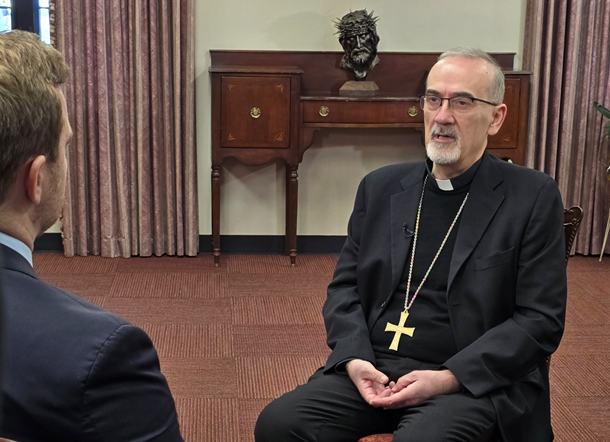
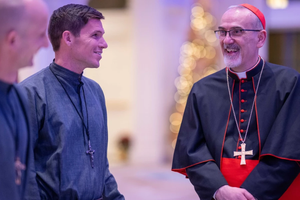
DETROIT — Cardinal Pierbattista Pizzaballa is one of the most well-known Catholic prelates in the world. But the Latin patriarch of Jerusalem doesn’t quite get what all the fuss is about.
After all, he considers the episode that first brought him to the wider world’s attention to have been nothing more than a basic instance of pastoral duty.
The incident in question occurred shortly after Hamas’ Oct. 7, 2023, attack on Israel. With the Islamist group holding several Israeli children hostage, journalists asked Cardinal Pizzaballa, the highest-ranking Catholic in the Holy Land, if he would be willing to offer himself in exchange for hostages. His affirmative response went viral.
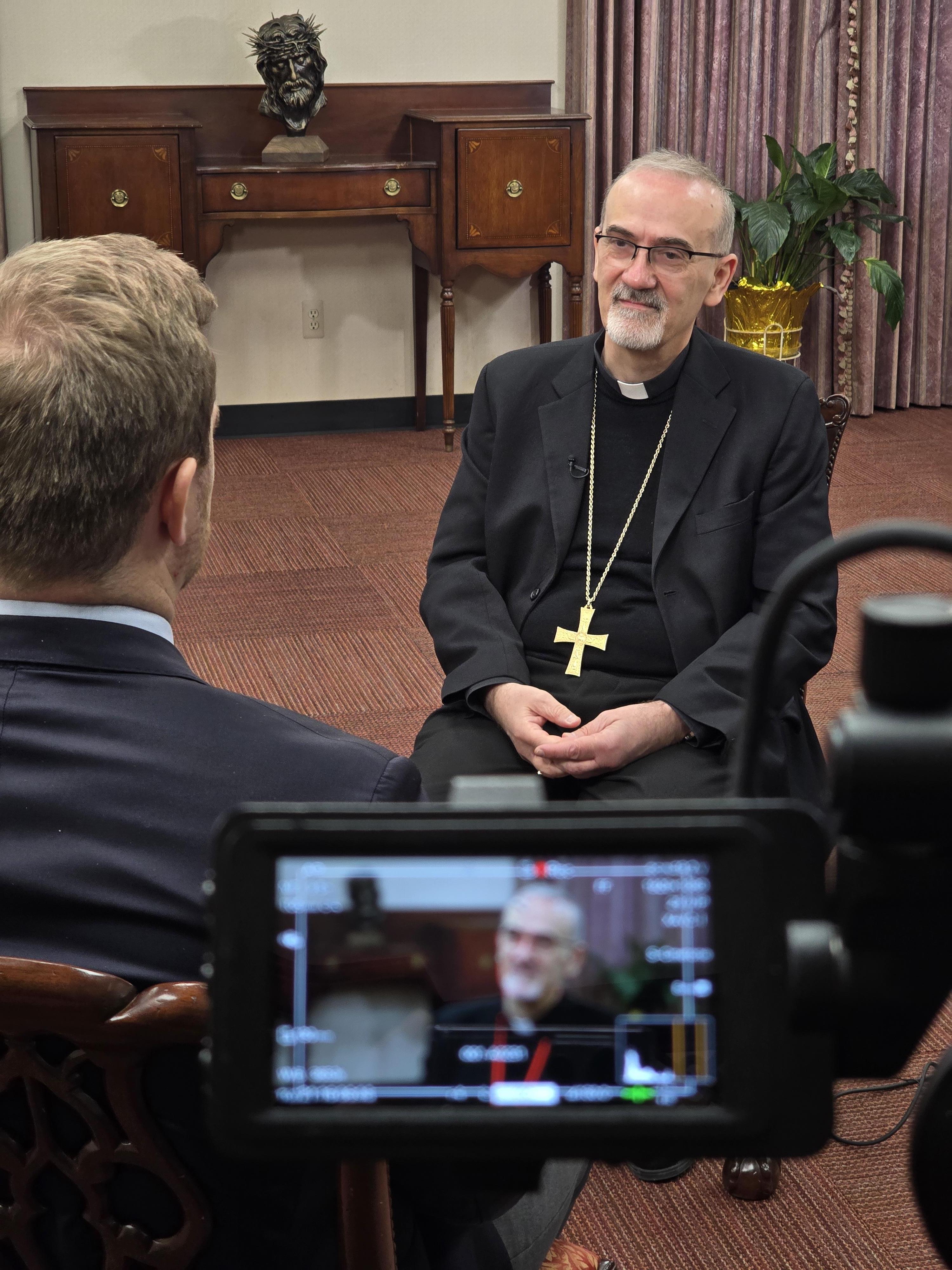
“I don’t understand why this created so much attention,” shared Cardinal Pizzaballa in a recent interview with EWTN News amid a three-day visit to the Archdiocese of Detroit. “Because this is what any pastor should do: give your life for your flock, for your people, the people you love.”
“I am a consecrated person; I gave my life to God, so my life doesn’t belong to me,” continued the cardinal. “To donate the life is part of my vocation and all [that] I am. I don’t feel like I’m a hero. I feel that this is part of my duty.” (Watch a portion of the EWTN News interview with the cardinal at the link at the end of the article.)
Whether the cardinal’s response was worthy of international attention or not, he has it. In the run-up to this past May’s papal conclave, the 60-year-old was considered by various Vatican experts as a contender, in large part due to his leadership and push for peace amid the Gaza-Israel war. He enjoys a strong following among Catholics on social media and currently serves on three Vatican dicasteries. When Cardinal Pizzaballa speaks, the world tends to listen.
But the Latin patriarch isn’t using his status to publicly weigh in on controversies in the universal Church. Instead of the Holy See, he’s far more interested in drawing others’ attention to the Holy Land — especially to the ongoing plight of his flock.
Centering Christians in the Holy Land
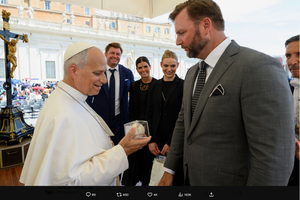
This was the purpose of the cardinal’s Dec. 4-7 visit to Detroit, which aimed to raise support for Christians in the Holy Land through fundraising dinners and speaking engagements.
Cardinal Pizzaballa said that, for his flock — which includes about 190,000 Christians in Israel, 45,000 in the West Bank, and 500 in Gaza — life continues to be difficult, despite a ceasefire that began on Oct. 10.
In Gaza itself, where 80% of homes have been destroyed and more than 70,000 people have been killed since the start of the war, members of the small Christian community centered around Holy Family parish struggle to access medicine, education, food and shelter.
But the Latin patriarch underscored that Palestinian Christians living in the West Bank, which includes Bethlehem, have also been significantly impacted, as tourism has all but ceased and worker permits into Israel have been halted.
“The Israelis don’t want to have any more Palestinians among them working after Oct. 7, so the two main resources have disappeared,” he explained. “This created a very problematic situation from the economic point of view.”
What’s more, the war has exacerbated tensions between Israelis and Palestinians in the West Bank, highlighted by settlers’ attacks on Palestinian communities, including Christian ones. And terms of the ceasefire, which calls for Israel to withdraw from Gaza in phases as conditions are met, remain vague, leaving questions like when rebuilding will begin and who will oversee it unanswered.
“The situation is very chaotic and very problematic. And what is scary also for the people [is that] you don’t know how, when this will finish,” said Cardinal Pizzaballa.
Still, the cardinal sees the U.S.-brokered ceasefire as “the only path we have.”
“We don’t have alternatives. So we have to follow it,” he said. “Because going back to war is worse.”
When asked about claims made by some scholars and activists that Israel has engaged in genocide in Gaza, Cardinal Pizzaballa didn’t use the term himself, but neither did he dismiss it. Instead, he urged patience.
“For us, it’s more or less clear what happened there,” he said. “But we need also evidence and also to follow all the process in order to evaluate the facts in their real context.”
The patriarch also expressed disapproval of basing support for the Israeli state’s policy decisions on sacred Scripture’s description of God’s covenant with the Jewish people, a common practice among some American Christians.
“I do not like this confusion between religion and politics,” he said.
At the same time, he condemned antisemitism, reaffirmed the right of the state of Israel to exist, and said criticism of the Israeli government should be “distinct from our relations with the Jewish people.”
Germany, the Liturgy and Pope Leo
Given his wider stature in the universal Church, many Catholics are keen to know what Cardinal Pizzaballa thinks about controversial issues, such as disputes over the liturgy and the Germany Synodal Way. But when the patriarch was asked to comment on these issues, he spoke about them begrudgingly and decidedly from the perspective of his flock.
For instance, when asked about the German Synodal Way, an ecclesial reform effort in Germany that has promoted radical changes to Church teaching, such as lay governance and same-sex-blessing ceremonies, he dismissed it as irrelevant to the lives of Christians in the Holy Land.
In response to a follow-up question over worries that the Synodal Way risks fracturing Church unity, a worry Pope Leo XIV recently expressed, Cardinal Pizzaballa responded with minimal concern.
“These are topics that periodically come [up]. As they come, they go,” said the cardinal.
Similarly, the Franciscan cardinal was not particularly interested in weighing in on ongoing disputes over the liturgy, such as the availability of the traditional Latin Mass, characterizing clashing liturgical perspectives as a predominantly Western problem. In the Holy Land, he explained, a variety of liturgical rites is the norm.
In the end, however, he said Catholics must do what “the Church decides.”
“The liturgy is not a private possession,” said Cardinal Pizzaballa, who was responsible for the translation of the Roman Missal into Hebrew in 1995. “It’s a place where the Church expresses itself. So what the Church says, we have to apply.”
The Latin patriarch also spoke about Pope Leo XIV, whom he recently met with during the Pope’s visit to Lebanon, describing the American-born Pontiff as “a very peaceful person” who also has “clear ideas” and is “very free,” “which is important for such a position.”
Regarding unity between Catholics and the Orthodox, a theme of Pope Leo’s recent visit to the Middle East, Cardinal Pizzaballa said that it is already a reality among Christians in the Holy Land, where communities and families often include members of both churches. In terms of promoting unity more broadly, he advised patience rather than imposition from above.
“We have to grow in it and let things grow naturally, little by little, without forcing anything,” said the cardinal, who is a member of the Vatican’s Dicastery for Promoting Christian Unity.
A Plea for Pilgrimage and Peace
Like Pope Leo XIV, an American who nonetheless has spent more years as a priest in Peru than anywhere else, Cardinal Pizzaballa is something of a missionary. Born in northern Italy, he came to the Holy Land as a 25-year-old Franciscan and has now lived and served there for 35 years.
“The life in the Holy Land shaped a new way in my faith and my vocation,” he shared.
Citing his own experience in the Holy Land, Cardinal Pizzaballa made an urgent appeal for the resumption of Christian pilgrimages.
He framed pilgrimage to the place where Christ ministered as both an irreplaceable way to encounter “the historical presence of Jesus,” but also as an opportunity to provide support to Christian families in the region.
As for lasting peace in the Holy Land, Cardinal Pizzaballa sees it as possibility only if the two sides are willing to move forward without retribution.
The Latin patriarch cited a message that St. John Paul II issued after the Sept. 11 attacks in the U.S., stating, “There is no peace without justice and no justice without forgiveness.”
Cardinal Pizzaballa said that forgiveness is not about justifying evil that has been done, but about breaking a “closed circle.”
“Without forgiveness,” Cardinal Pizzaballa said, “this will continue to create tensions, revenge, hatred.”
Echoing Pope Leo’s recent calls for a two-state solution, he said recognizing the Palestinians as a people who have a right to “their own land” and “their own self-determination” is necessary for peace in the Holy Land and the entire Middle East.
Cardinal Pizzaballa is not particularly confident in current leadership on either side of the conflict. But he is inspired by the witness of priests, religious and other Christians in the Holy Land, who “bear witness of their faith out of love, commitment [and] presence, especially during the war.”
“This is what gives me hope,” he said, “to see that, despite everything, there are people, youth and elderly also, ready to commit themselves to do something for others out of love.”
WATCH ON EWTN