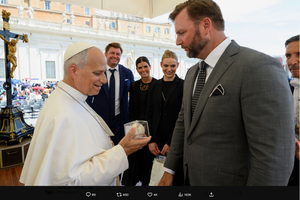
Ex-Banker Prepares Gen Z-ers for Life After College
Mark Harrington addresses the growing financial illiteracy and discouragement among students.

The Catholic Church speaks clearly about stewardship, acknowledging that as Christians, we gratefully receive God’s gifts — our time, talent and treasure — and return them in kind to the Lord.
But many of today’s college students are asking an entirely different question: How am I supposed to give back to the Church when I don’t even know how to afford rent?
Generation Z is entering adulthood amid an economy consisting of student loan burdens, costly housing prices and a job market that feels uncertain at best. According to a February 2026 report by Goodwill Industries International, 42% of Gen Z respondents said concerns about their employment and the economy have forced them to put off major financial goals, such as “paying off debt, pursuing education, purchasing a home and making investments.”
Many were never taught how to build a budget, understand interest rates or invest for the future. Some feel overwhelmed, while others avoid the topic of finance altogether.
At the University of Colorado Boulder’s St. Thomas Aquinas Catholic Center, Mark Harrington — until recently the director of advancement — saw this dilemma firsthand.
“I realized that there’s a lot of anxiety and unknown around personal finances for those entering the workforce,” he told the Register. “Our aim is to form these students spiritually and intellectually.”
He noted that the four pillars of the Catholic center reflect those of priestly formation: spiritual, apostolic (or pastoral), human and intellectual. “But we seemingly never touched on personal finance,” he added, “which is a huge part of most people’s lives as they’re preparing to graduate.”
Before joining the development office, Harrington served as a FOCUS missionary on campus. He had studied finance in college and worked in investment banking for several years before entering missionary work.
Seeing the growing financial illiteracy and discouragement among his students, Harrington set out to create a financial literacy event that would mirror the guidance he himself had received from professors and mentors during his undergraduate years.
“It seemed like a lot of the students I worked with didn’t have that same experience,” he said. “I wanted to share what I had received over the years and prepare them better so they could be more well-formed Catholics and professionals.”
What began in 2023 has since grown into an annual “Finance Bootcamp,” held one week before graduation. During the three-hour session, Harrington walks seniors through practical tools and foundational concepts not covered in their “normal coursework,” such as “budgeting, debt strategy, first job decisions, what a 401(k) is, how to maximize your savings, and how to use credit.”
Within the first few minutes of the workshop, one topic often surfaces among students’ “common finance stressors”: tithing.
Students frequently associate tithing with “the 10%” they hear mentioned at church, yet struggle to imagine how it applies to their own financial reality.
“Giving is such a big part [of the bootcamp],” Harrington said. “It’s how we should think as Catholics about charitable giving — living generously and freely.”
Stewards of Christ
The discussion often bears immediate fruits. Armed with a budget template and a newfound plan for managing their first year after graduation, students approach their final week of college with greater confidence in their ability to give.
At the annual senior cocktail night shortly after, many feel newly empowered to financially support the Catholic center. According to Harrington, the 2025 event saw the senior gift triple in size despite the class being smaller than previous years.
Harrington concluded his role at the Catholic center in March but plans to continue offering the workshops at the Catholic center and other locations through Pilgrim Finance, a Catholic personal finance platform he is developing that grew out of his work with students.
Workshops like this, Harrington added, are a gift to receive “at 21 or 22 years old” as students begin stepping into the working world rather than “20 years later,” when they may be “trying to provide for a family.”
“Financial formation is a precondition for vocational freedom — how you steward your own resources, how you care for a family and how you ultimately honor God,” he said. “To live generously, you need some freedom and margin in your finances, because if you’re living paycheck to paycheck with no plan and you can’t give, you can’t really respond freely to God.”
That mindset, Harrington explained, helps reorient young people’s perception of money altogether.
“[It’s] understanding that money is a tool, not an identity,” Harrington said. “Your worth isn’t your salary or your job, but [money] is something to think about and have a plan so that you can steward your whole life well and live intentionally.”
A ‘Higher Calling’
And for young Catholics who struggle with financial literacy and may not have these resources readily available to them?
According to Camila Gonzalez, interim executive director of Compass Catholic, the starting point is simple: Remember that “everything is from the Lord, and we should therefore be responsible.”
Founded in 2010, Compass Catholic offers Bible studies specifically designed for Catholic parishes, such as Faith & Money Matters and Spiritual Cents for Teens. Like the students Harrington encounters, Gonzalez said many young adults begin the studies with little to no formation in financial literacy.
“Something is always missing,” she told the Register. “That’s giving everything you have to the Lord, entrusting your money to him, and allowing him to guide you. How should I spend my money? How should I invest? Should I invest in a company that’s not aligned with my faith?”
Financial well-being, she emphasized, is “important and necessary” for “peace of mind and being able to pay your bills and eat.” But financial discipleship is “a higher calling.” Scripture itself underscores that truth, with more than 2,300 verses addressing money and possessions.
Approaching budgets, loans, investments and tithing with that eternal perspective reminds young adults that their “time, treasure and talent” are ultimately gifts meant to be returned to God.
Church Teaching on Stewardship
Stewardship is an integral part of Christian discipleship. As the U.S. bishops explain in their document “To Be a Christian Steward,” a summary of their 1992 pastoral letter on stewardship, quoting the First Letter of Peter, “As each one has received a gift, use it to serve one another as good stewards of God’s varied grace” (4:10).
Stewardship, therefore, is the faithful use of the gifts God has entrusted to each person, exercised in service to others as part of our “human and Christian vocations.”
This understanding is further grounded in the Church’s teaching on creation and the common good. The Catechism states that “the goods of creation are destined for the whole human race,” highlighting that all resources are entrusted to humanity for the benefit of others (2402). Stewardship requires the proper use of time, abilities and material resources to serve both God and neighbor.