Why Catholic Media Matters
COMMENTARY: Every radio broadcast, every podcast, every digital stream is a kind of procession where the Word is carried into homes, cars or earbuds.
Mainstream media was quick to highlight recent friction between President Donald Trump and Pope Leo XIV through a partisan lens. What was missing from their reporting was not better sourcing or airtime, but a framework that takes seriously both the responsibilities of political leadership and the prophetic role of the Church. That is precisely what Catholic media exists to provide. And why it matters.
I was reminded of that last weekend at the Guadalupe Radio Network’s Fishers of Men Dinner, held in Bethesda, Maryland — an evening in support of the EWTN-affiliated Catholic radio apostolate serving the greater Washington, D.C., area. Catholic media is not a luxury. A faithful voice that refuses to separate the headlines from the eternal fills a role that nothing else can. It is a complement to the broader national conversation — and an essential one.
We are heirs to a remarkable tradition. The Church has always recognized every new medium as an opportunity to proclaim the Gospel. No one grasped this more instinctively than Archbishop Fulton J. Sheen, whose beatification is set for Sept. 24, 2026. Once dubbed “God’s microphone,” Archbishop Sheen proclaimed God’s truth to untold millions through radio, print and television. He grasped that the evangelist’s task is to walk through whatever door culture has opened, and in his era, that door opened into the American living room.
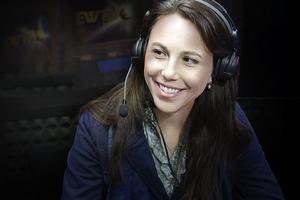
That tradition is alive and well. I am grateful to play a small part in it through my weekly guest appearances on Ave Maria in the Afternoon, from EWTN-affiliated Ave Maria Radio, and as a legal analyst for EWTN News. I also contribute regularly to a range of Catholic radio programs to discuss legal and spiritual matters. These are conversations that reveal that professional lives are never separate from our life in Christ.
This is not a romantic abstraction. Catholic media saves souls. Authoritarian regimes know it. That is precisely why, when governments seek to crush a people’s spirit, they always target the Church’s means of communication. The Daniel Ortega regime in Nicaragua made this plain with its systematic shuttering of Catholic radio stations, silencing the voices of priests and lay faithful who dared to speak the truth on air. In China, the CCP actively forces Catholics to adapt to its sinister Sinicization campaign where genuine religious freedom is impossible. The pattern is as old as tyranny itself: Control the message, control the people.
That power does not diminish with changing technology. It multiplies. Digital platforms extend apostolates far beyond any terrestrial signal. The medium changes; the mission does not.
The evening’s honorees made all of this luminously concrete. The Byrne family of Virginia was recognized for what the Guadalupe Radio Network rightly called a “garden for vocations,” grown in the model of Sts. Louis and Zélie Martin, parents of St. Thérèse of Lisieux. The late Dr. Bill Byrne and his wife Mary went to Mass daily and prayed the family Rosary nightly with their eight children. From their domestic church, extraordinary fruit has grown. Sister Dede Byrne, a renowned surgeon, religious sister and Army colonel, ministered at Ground Zero on Sept. 11, 2001, and carried out surgical missions in Afghanistan, Sudan, Iraq and Haiti and gave a powerful speech at the 2020 Republican National Convention on the sanctity of life. Her brother, Bishop William Byrne, serves the Diocese of Springfield, Massachusetts. During his eight years as chaplain at the University of Maryland, 14 men entered the priesthood and five women entered religious life. Mother Angelica often said that evangelization is simply telling someone that God loves them. The Byrnes have been telling that story for generations.
The keynote speaker, Msgr. Roger Landry, an EWTN radio host and regular Register contributor, who serves as national director of The Pontifical Mission Societies USA, brought the evening to a crescendo. A man who walked the entirety of one of the four National Eucharistic Pilgrimage routes in 2024 — carrying the Body of Christ himself — shared what unfolded along those miles. The four routes traversed 27 states and 65 dioceses across 6,500 miles until all routes converged at the National Eucharistic Congress in Indianapolis. Msgr. Landry spoke of the conversions that took place along the way: confessions long postponed, lapsed Catholics brought to their knees before a monstrance on a sidewalk, hearts hardened by hurt quietly broken open by the wordless witness of the Lord carried through their town. His point was simple and convicting: Evangelization has never been about cleverness or technology. It has always been about encounter.
Every radio broadcast, every podcast, every digital stream is a kind of procession where the Word is carried into homes, cars or earbuds. We trust that the encounter it makes possible will do its own quiet, transforming work.
The airwaves belong to God. Let us use them accordingly.
- Keywords:
- catholic media
- new evangelization