Who Is Vito Marcantonio, the Catholic Socialist Invoked by Zohran Mamdani?
COMMENTARY: Zohran Mamdani’s admiration for Marcantonio revives the memory of a Catholic socialist whose legacy remains deeply contested.
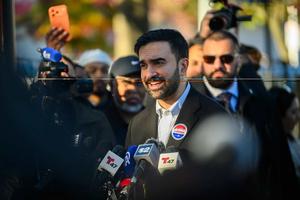
The election of Zohran Mamdani as mayor of New York City has breathed new life into leftist politics in America.
Whether the mayor-elect will prove to be the next Fiorello La Guardia, as his supporters hope, or the next John Lindsay, as his critics allege, remains to be seen. What is clear is that his election signals a resurgence of left-wing politics in the Big Apple.
While opponents went out of their way to portray Mamdani as a political outsider, New York City has a long history of radical politicians. One of the most famous, and an inspiration for Mamdani, was a Catholic socialist who carried his rosary everywhere he went: Vito Marcantonio.
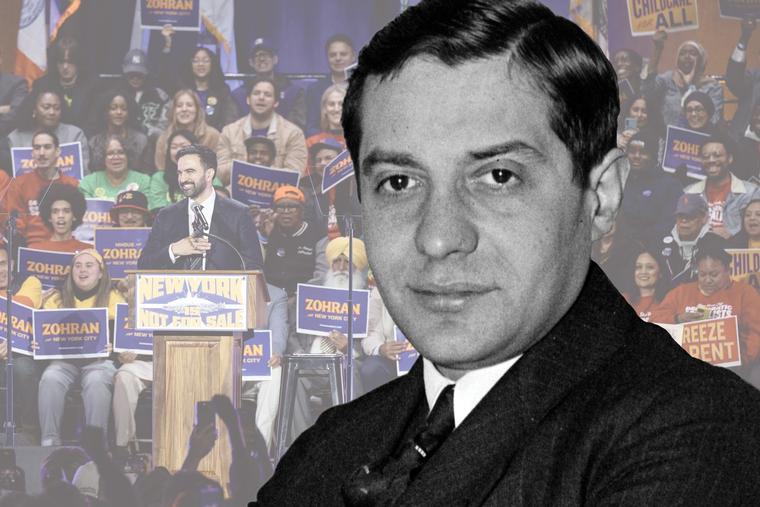
Mamdani voiced his admiration for Marcantonio (1902-1954), invoking his legacy in one of the final ads of his campaign.
Born into poverty in East Harlem, Marcantonio got his start in politics working for Fiorello La Guardia, eventually becoming campaign manager for La Guardia’s final four campaigns for Congress. That experience helped Marcantonio land the position of assistant district attorney. He soon resigned, however, on principle, objecting to work that largely involved going after immigrants:
I was supposed to deport Greeks and Italians and Jews, whose only crime was to skip the boat and stay in this country without a passport. … I couldn’t warm up to work that forced me to crack down on little fellows struggling to some place in a strange country. It’s no fun breaking up families …
Initially elected to the House as a Republican, Marcantonio aligned himself with the American Labor Party, founded in 1936. He was a tireless advocate not only for his own constituents but also for the impoverished throughout the country — advocating for West Virginia coal miners and Black Americans in the South as fiercely as he did for his Italian neighbors in New York City.
During his first term in office, he made sure that his constituents could meet weekly with him (or his special secretary if he was in Washington). These meetings could go on until 3 a.m. He was an outspoken supporter of civil rights, speaking at a Black church in defense of the Scottsboro Boys, a group of nine Black teenagers falsely accused of assaulting two White women. The case was marred by racism and a lack of due process, with eight of the nine sentenced to death; eventually, a series of appeals led the Supreme Court to order retrials, which resulted in either lesser charges or the cases being dropped.
He championed the cause of Puerto Ricans both inside the city and on the island, advocating for their independence. Especially important to him was the protection of immigrants. At a time when Americans increasingly favored restrictions on immigration, Marcantonio resolutely opposed attempts to crack down, telling his fellow representatives to “Give them a chance to live.”
Admirable though his knowledge of domestic affairs may have been, in foreign affairs Marcantonio was at best hopelessly naïve, if not inexcusable.
Like other fellow travelers, Marcantonio denounced any attempts by the United States to support Britain against Nazi Germany (or, as he called it, the “Wall Street-Downing Street Axis” versus the “Rome-Tokyo-Berlin Axis”) while the Molotov-Ribbentrop nonaggression pact between Germany and the Soviet Union was in place, only to reverse course with the commencement of Operation Barbarossa, the German invasion of the Soviet Union.
He even had the gall to say the invasion changed the “imperialist war” into a war for “democracy.” It is particularly egregious to read Marcantonio’s later condemnations of President Truman for failing, purportedly, to uphold the legacy of President Roosevelt, especially when Marcantonio had repeatedly accused FDR of trying to “Hitlerize” America.
After the Second World War, Marcantonio adopted a pro-Soviet stance to the point that his remarks were indistinguishable from those of the Communist Party. While denouncing the nations of Western Europe as “puppet governments” of America, he made no such claims regarding the Eastern Bloc countries, believing every word they said about their economic success. He was the sole vote in Congress to oppose the Korean War.
While Marcantonio always asserted that he was not a communist, the American Labor Party increasingly came under the sway of the far left, prompting him later to leave the party. In this, Mamdani may soon face the same issue with the Democratic Socialists of America (DSA), which has increasingly catered to extremist elements. Founding member Maurice Isserman resigned in 2023 in part because of the growing communist influence within the group. (Some of these factions are highly critical of Mamdani.)
The main theme of Mamdani’s campaign was affordable housing, with a central promise of the mayor-elect being rent control. Marcantonio advocated the same position, calling housing “indivisible in the defense of democracy.”
Mamdani and Marcantonio do, however, differ in one key area: Zionism. Mamdani is an anti-Zionist but believes Israel has a right to exist. Marcantonio, on the other hand, was adamant in his support for Jewish statehood.
During a debate over supporting the U.N. partition of Palestine, Marcantonio repeatedly attacked the “Hitlerite Arabs,” saying that to oppose partition was to court a second Holocaust. After Israeli independence was secure, he continued to rail against America providing any support to the “Arab Fascist Legions.”
Central to Marcantonio’s political views was his faith. It was once said that Marcantonio’s office was like entering a confessional or a clinic.
Then Rep. Eugene McCarthy, D-Minn., recalled that when a newspaper reported Marcantonio’s wallet was either missing or stolen, the congressman told McCarthy his only regret was not the money, but the loss of two religious medals in it. One was of Mother Frances Xavier Cabrini, who had been recently canonized, and the other was a medal he had received at his confirmation.
However, it must be noted that despite his faith, he raised no word in defense of the Church when it was being persecuted by communist forces.
Marcantonio died of a heart attack on Aug. 9, 1954, while campaigning to reclaim his seat. A priest gave him both conditional absolution and Extreme Unction. On his person were his rosary and crucifix.
Despite this, the Archdiocese of New York, under the powerful Cardinal Francis Spellman, rejected requests for a requiem Mass and Catholic funeral, claiming that he had “not practiced his religion in a great many years and was not reconciled with the Church before his death.”
Both then and now, many believed the decision had more to do with Marcantonio’s politics than his faith. While popular among his constituents — despite their generally conservative views, which often led them to overlook his socialist positions — the Church hierarchy and other Catholic institutions did not take kindly to his stances.
America magazine criticized him as the “Communist mouthpiece in Congress,” labeled him “pro-communist,” and said everyone should celebrate his defeat in 1950. Alone among Catholic politicians, Marcantonio supported the Loyalists/Republicans (communists) during the Spanish Civil War, despite their well-documented anti-clericalism. It was not just that the Church was anti-communist; at a time when anti-Catholicism was still prominent in the country, anti-communism allowed Catholics to show that they were just as patriotic as their Protestant countrymen. Under such circumstances, Marcantonio’s stance could only elicit condemnation. Perhaps the best example of the congressman’s complicated relationship with his faith is a recent play about him, The Purgatory Trial of Vito Marcantonio.
Despite the denial of a Catholic funeral, Dorothy Day noted in her obituary of Marcantonio that long lines of the poor — Italians, African Americans and Puerto Ricans — came to pay tribute at Our Lady of Mount Carmel parish in East Harlem to the man who had represented them. While he was often alone in Congress, representatives across the political spectrum expressed admiration for him upon his passing.
Far-right Rep. Clare Hoffman, R-Mich., said it was a privilege to have served with him, and Rep. Emmanuel Celler, D-N.Y., said upon his passing, “I am sure, like David of old, he trusted in God’s mercy and rejoiced in his salvation for God was his shepherd and benefactor.”
What the ultimate legacy of Mamdani will be at City Hall remains to be seen, but his election is proof that the legacy of Marcantonio is still alive in the city he was committed to helping. While one might not agree with their policies, one can hope that Mamdani will bring the same dedication to City Hall.
- Keywords:
- zohran mamdani
- vito marcantonio
- socialism