Trump, Pope Leo and the Catholic Divide

COMMENTARY: President Trump’s attack on Pope Leo XIV has brought a simmering tension into the open.
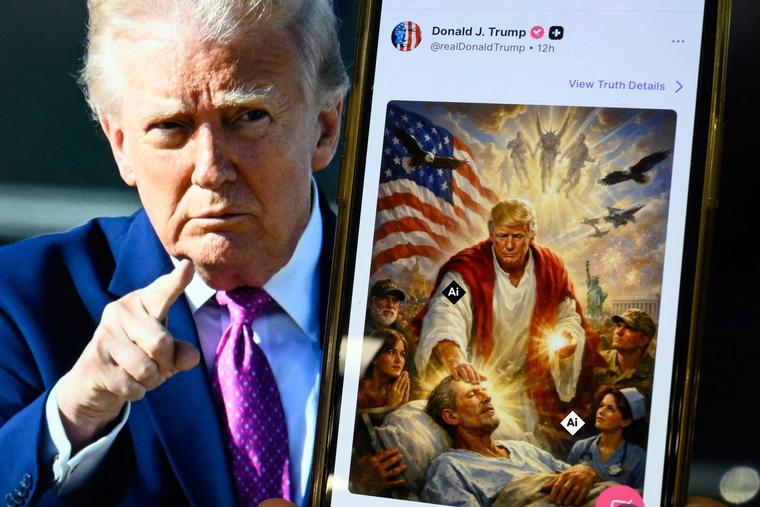
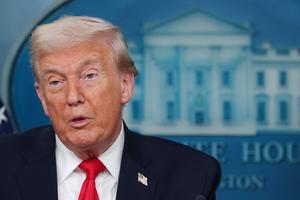
This photo illustration shows President Donald Trump with an AI-generated image he posted Sunday on Truth Social following his criticism of Pope Leo XIV.
This photo illustration shows President Donald Trump with an AI-generated image he posted Sunday on Truth Social following his criticism of Pope Leo XIV. (photo: Mandel Ngan / Public Domain)

Is blasphemy worse than shooting someone on Fifth Avenue? We may soon find out.

The political potency of President Donald Trump is due in large part to the fierce loyalty of his partisans. No matter how great the outrage, it would be overlooked, excused, justified somehow as better than an alternative. Even before the first presidential primary in 2016, Trump marveled at the phenomenon.

"I have the most loyal people,” Trump said in January 2016 in Iowa. “I could stand in the middle of Fifth Avenue and shoot somebody, and I wouldn’t lose any voters, okay?”

More than 10 years later, it has proved true enough. Now, with the president’s aggressive comments regarding Pope Leo XIV, combined with the blasphemous image depicting himself as Jesus, that loyalty is being tested.

The conflict between the American president and the first pope from the United States has prompted observers to question: Whose side will Trump-supporting Catholics take? It remains to be seen, and the answer will indicate whether the adjectival identity is stronger than the noun.

The blasphemy controversy has drawn greater attention to a curious trend over the past decade or so. Many American Catholics, of all political tribes, have been inclined to subject papal teaching to the most rigorous scrutiny, while accepting all manner of provocations from their preferred political figures. Once more evident on the political left, this is now especially true regarding Trump. For more than a decade, a minority of American Catholics have strained to accept what Pope Francis or Pope Leo has said, yet proved eager to swallow whatever Trump offers (cf. Matthew 23:24).

Will it continue after Trump’s recent Easter Octave outbursts?

With apologies to readers for the profanity, Trump posted, concluding with an apparently mocking Muslim invocation, on Easter Sunday:

Tuesday will be Power Plant Day, and Bridge Day, all wrapped up in one, in Iran. There will be nothing like it!!! Open the F------ Strait, you crazy b-------, or you’ll be living in Hell—JUST WATCH. Praise be to Allah.

When Easter Tuesday arrived, Trump escalated from threatening the deliberate destruction of civilian infrastructure — a war crime — to threatening outright genocide:

A whole civilization will die tonight, never to be brought back again. I don’t want that to happen, but it probably will. However, now that we have Complete and Total Regime Change, where different, smarter, and less radicalized minds prevail, maybe something revolutionarily wonderful can happen, WHO KNOWS? We will find out tonight, one of the most important moments in the long and complex history of the World. 47 years of extortion, corruption, and death, will finally end. God Bless the Great People of Iran![

Pope Leo, with remarkable understatement, said that genocide against an ancient people “truly is not acceptable.”

On Divine Mercy Sunday, peace negotiations in Islamabad, Pakistan, having failed, Trump posted his rant against Pope Leo. It would have proved the ultimate shock if he did not soon after post an image of himself as Jesus Christ.

“I don’t want a Pope who criticizes the President of the United States,” Trump posted, later telling reporters that, “I am not a fan of Pope Leo.”

For his part, the Holy Father responded that he is “not afraid of the Trump administration.”

The fact that Pope Leo was on his way to Africa for a four-country visit indicated something of the context. An American pope is not for Americans alone, much less for the minority of Americans who support President Trump.

Indeed, contrary to Trump’s claims that the Holy Father’s negative judgment on the morality of the American-Israeli war on Iran is “hurting him very badly,” it is quite likely that not being intimidated by Trump — one of the world’s most unpopular political leaders — has caused Leo to rise in the esteem of many. Italian Prime Minister Giorgia Meloni, a heretofore European ally of Trump, blasted him for his attacks on Pope Leo.

What are the implications of this exchange, which USCCB president Archbishop Paul Coakley characterized in brief and modest terms:

I am disheartened that the President chose to write such disparaging words about the Holy Father. Pope Leo is not his rival; nor is the Pope a politician. He is the Vicar of Christ who speaks from the truth of the Gospel and for the care of souls.

Six considerations suggest themselves.

First, it seems that ostentatious blasphemy from the White House, if not Fifth Avenue, is still revolting to a great many American Christians, including those who have been ardent supporters of the president.

That blasphemy is a gross stain on the dignity of his office was conceded by Trump himself, who deleted the post. He declined to apologize, offering instead the implausible explanation that he thought the image portrayed him “as a doctor.”

Vice President JD Vance accepted that the blasphemous image was out of bounds, but said it was intended as a joke.

That blasphemy is considered beneath the presidency was not previously thought in doubt, but given the president’s social-media habits, it is welcome to have that confirmed.

Second, Americans may now be forced to entertain, for the second consecutive presidency, concerns about the mental fitness of the incumbent. President Trump’s postings reflect a pattern of behavior that is not only contrary to Christian virtue but suggests being unhinged.

In December, after Rob and Michele Reiner were brutally murdered, Trump posted that it was because of Reiner’s political opposition to Trump himself. In February, Trump posted a video depicting Barack and Michelle Obama as gorillas. It was deleted after Trump claimed he hadn’t seen the racist imagery. In March, Trump posted: “Robert Mueller just died. Good, I’m glad he’s dead.” In April, now the anti-papal bilge and blasphemy. Is it possible that the president is unwell?

Third, Trump’s upset with Pope Leo is, on the substance of the matter, puzzling. Leo’s position against the American-Israeli war on Iran is the very position Trump himself held in the early months of 2025, when he committed to maximum diplomatic pressure. In the lead-up to Israel’s “12-Day War” last summer, Trump was against it until the last minute. In 2024, Vance declared himself opposed to war against Iran. Trump and Vance have changed their positions; they now demand that the Pope does so too.

Fourth, at the heart of the Trump ascendancy was his opposition to the Iraq War 2003. At the time, St. John Paul the Great undertook a vocal campaign against George W. Bush’s decision to go to war. History rather vindicated John Paul, not least in the “no more wars” policy of Trump and Vance. Trump seems oblivious to the obvious parallels today.

Fifth, Catholics — and not just American Catholics — can be proud of both the courage and courtesy of Pope Leo. While the American president was embarrassing — which is a lesser offense than blasphemy, but still disappointing — the Holy Father was a model of grace under pressure. He noted the attacks, declared his determination to continue preaching the Gospel, and left the president alone with his own unworthy words.

Sixth, as evidenced by Archbishop Coakley’s statement, which had an almost pro forma quality to it, American Catholic leadership may have given up on engaging the Trump administration. It is almost assuredly the case that Archbishop Coakley was more than “disheartened” by Trump’s attacks, but his statement had a what-else-can-you-expect air of resignation to it.

Later in the week, Vance admonished the Holy Father that “he should be careful when he talks about matters of theology.” On the day that Vance — who took St. Augustine as his confirmation saint — patronized Leo, the Holy Father was literally standing on the archeological remains of Hippo, Augustine’s North African diocese. Leo served for 12 years as head of the Augustinian order. Vance’s arrogant impudence may have brought things to a point where useful exchanges are impossible.

As to the ongoing consequences of Trump’s awful Easter Octave, Catholic leaders will have to determine how and when to engage the president. Next month, President Trump plans to rededicate the United States as “one nation, under God” as part of the semiquincentennial of the Declaration of Independence. Should Catholic leaders publicly appear with him after his attacks on the Holy Father if he does not apologize — which Bishop Robert Barron has called on him to do?

Has Trump loyalty finally reached its limits?